
- Solve real problems with our hands-on interface
- Progress from basic puts and calls to advanced strategies
Interactive Options Course
Posted August 26, 2026 at 11:00 am
Copper has been one of the most closely watched commodities of 2026. After reaching new highs, the metal remains at the centre of several major investment themes: electrification, power-grid expansion, electric vehicles and, increasingly, the infrastructure required to support artificial intelligence.
But fundamentals are only one way of looking at a market. Another useful perspective comes from seasonality.
What Is Seasonality in Financial Markets?
Seasonality studies whether an asset has historically shown recurring tendencies during particular periods of the year.
The concept is relatively simple. Instead of asking only where is the price going?, we ask another question:
Has this market historically behaved differently at certain times of the year?
These patterns can emerge for many reasons: production cycles, corporate behaviour, weather, investor positioning, fiscal calendars, consumer demand or recurring flows of capital.
Importantly, seasonality is not a prediction.
A market does not rise simply because it has historically performed well during a particular month. Rather, seasonal analysis provides a statistical framework that investors can combine with fundamentals, positioning and technical analysis.
And copper provides a particularly interesting example of how this type of analysis can be used.
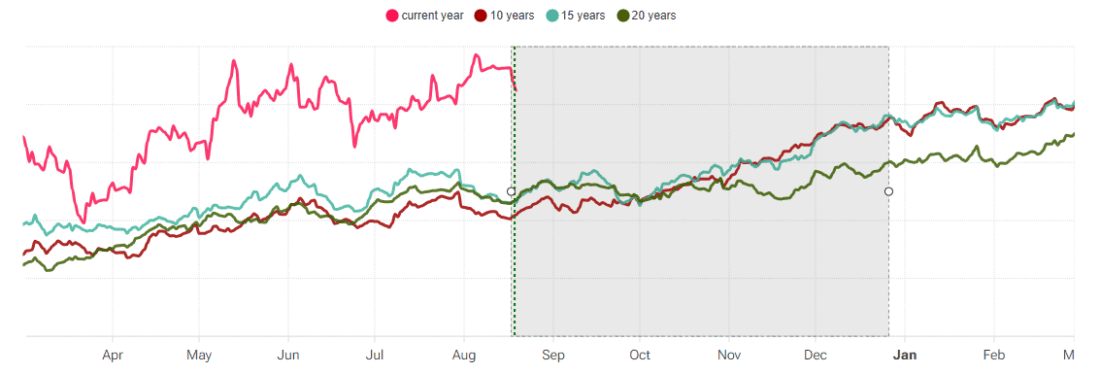
Caption: Copper seasonality across different historical horizons, highlighting the stronger seasonal trend from late summer into year-end. Source: Forecaster Terminal.
The Important Part of Seasonality Is Often the Transition
Looking at a seasonal chart as a whole is useful, but some of the most interesting information appears when the historical tendency begins to change direction.
Copper is a good example.
After a historically less favourable period during late spring and summer, the seasonal picture becomes considerably more constructive from the second half of August.
According to Forecaster Terminal, between 17 August and 26 December, copper has generated an average return of +12.6% over the last 10 years, finishing the period higher in 9 out of 10 years — a 90% historical success rate.
The pattern remains notable over longer time horizons. Over the last 15 years, the same period produced an average return of +10.9%, with positive performance in 73.3% of years. Looking back 20 years, the average return was +12.1%, with a 70% success rate.
The consistency across different historical samples is particularly interesting: although the probability of a positive outcome declines as the sample expands, the average return remains above 10% across all three time horizons.
But the key question is not simply whether copper has historically performed well during this period.
It is how those gains developed along the way.
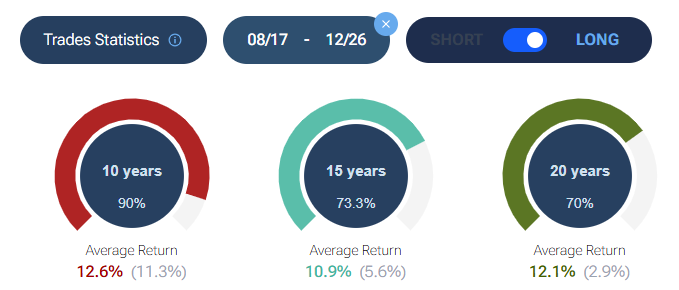
Caption: Copper’s historical performance from August 17 to December 26 shows strong consistency, with a 90% win rate and a 12.6% average return over the past 10 years. Source: Forecaster Terminal.
Bullish Seasonality Still Comes With Volatility
This is where seasonal analysis becomes more useful than simply looking at the average return.
Copper’s historical performance between mid-August and late December has been remarkably strong, but the year-by-year data reveals an important detail: even bullish seasonal periods have included pullbacks along the way.
Over the last 10 years, copper finished this seasonal window higher in 9 out of 10 years. Yet in every single one of those 10 years, the metal experienced an intra-period decline before the window closed.
Some of those pullbacks were relatively mild. In 2020, for example, copper ultimately gained 23.07%, despite falling as much as 2.31% during the period. In 2025, the final return reached an impressive 29.94%, while the maximum drawdown was 2.66%.
Other years offered much deeper corrections. In 2022, copper eventually finished the period 7.17% higher, but not before experiencing a maximum drawdown of 9.50%. Similarly, in 2021 the metal ended with a 6.32% gain despite falling as much as 5.81% along the way.
This highlights an important point: a strong seasonal tendency does not imply a straight-line move higher.
Historically, temporary weakness has often occurred even during some of copper’s best seasonal periods. For investors, that means seasonality may be useful not only for identifying a favourable time window, but also for recognizing that pullbacks can be part of the broader bullish pattern rather than necessarily a sign that it has failed.

Caption: Copper finished the mid-August to late-December window higher in 9 of the last 10 years, yet every period included an intra-period drawdown. Source: Forecaster Terminal.
Fundamentals Give the Seasonal Pattern More Context
Seasonality becomes more interesting when it aligns with a broader fundamental story.
And copper has one of the strongest structural demand narratives among industrial commodities.
Electricity grids require copper. Electric vehicles require copper. Renewable power generation and transmission infrastructure require copper. Then there is the rapid growth of data centres.
The International Energy Agency expects data-centre expansion to become an increasingly important source of electricity-demand growth, while grid constraints are already emerging as a potential bottleneck for future capacity.
AI does not simply require GPUs and servers.
It requires buildings, cooling systems, electricity generation, transformers, transmission lines and connections to the grid… Copper sits across much of that infrastructure.
The IEA’s 2026 Critical Minerals Outlook also highlights continued strong demand growth for copper from grids, electric vehicles, energy infrastructure and other electrification technologies.
Supply, meanwhile, cannot always respond quickly.
Bringing additional mined copper to market involves exploration, permitting, financing, construction and processing capacity. This makes the supply response structurally slower than many of the demand trends developing today.
That imbalance is one reason the longer-term copper story remains compelling even after the significant rise in prices.
Information posted on IBKR Campus that is provided by third-parties does NOT constitute a recommendation that you should contract for the services of that third party. Third-party participants who contribute to IBKR Campus are independent of Interactive Brokers and Interactive Brokers does not make any representations or warranties concerning the services offered, their past or future performance, or the accuracy of the information provided by the third party. Past performance is no guarantee of future results.
This material is from Forecaster.biz and is being posted with its permission. The views expressed in this material are solely those of the author and/or Forecaster.biz and Interactive Brokers is not endorsing or recommending any investment or trading discussed in the material. This material is not and should not be construed as an offer to buy or sell any security. It should not be construed as research or investment advice or a recommendation to buy, sell or hold any security or commodity. This material does not and is not intended to take into account the particular financial conditions, investment objectives or requirements of individual customers. Before acting on this material, you should consider whether it is suitable for your particular circumstances and, as necessary, seek professional advice.
Investments in certain commodities (precious metals) may be subject to significant price volatility and often involve risks related to market fluctuations, liquidity constraints, geopolitical events, and changes in global economic conditions that could adversely affect their value.
Related Articles


















Join The Conversation
For specific platform feedback and suggestions, please submit it directly to our team using these instructions.
If you have an account-specific question or concern, please reach out to Client Services.
We encourage you to look through our FAQs before posting. Your question may already be covered!