
- Solve real problems with our hands-on interface
- Progress from basic puts and calls to advanced strategies
Interactive Options Course

Posted June 24, 2026 at 1:03 pm
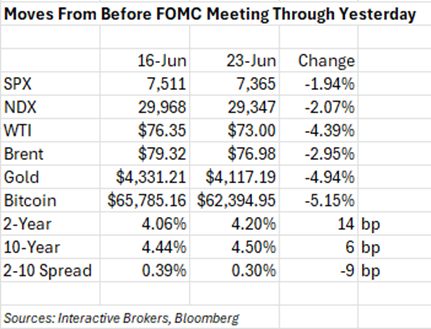
Last week, during his first press conference as Fed Chair, Kevin Warsh went to great lengths to lay out his inflation-fighting bona fides. As we noted the following day, rate-hike expectations soared, bringing short-term rates higher along with them. Although key stock market measures have not broadly welcomed the Chair’s tonal shift –through yesterday, both the S&P 500 (SPX) and Nasdaq 100 (NDX) were each down about 2% since the day prior to the FOMC meeting – prices of assets that tend to act as inflation hedges have suffered more.
Foremost among them are the prices of oil futures and energy stocks. Those declines are of course primarily the result of negotiations to reopen the Strait of Hormuz and to end the war in the Persian Gulf, but they certainly contribute to lower global price pressures. Crude futures prices had already been in a steep, steady decline, but in the week that ended yesterday, August WTI (CL) and Brent (CO) futures fell by 4.4% and 3%, respectively. (They’re both down by another 4% today, by the way.) Energy stocks, however, have already priced in much of those declines, with the Energy Select Sector Total Return Index falling by less than 1% over that span.
Other inflation proxies are not faring well either. Gold fell by 4.9% in the week from the day prior to the FOMC meeting through yesterday, and it is down by another 2.7% this morning, after briefly trading below the $4,000 level. Again, there are extenuating factors behind that decline. We have noted that gold has a tendency to act as an “antidollar.” All things being equal, commodities that are denominated in US dollars tend to have an inverse relationship with the currency. A stronger dollar means that fewer of them are required to purchase the quantity of commodities represented by a futures contract, and vice versa. This is of course only one of the factors that influence commodity prices, but gold’s historic role as a store of value makes it more sensitive to changes in the dollar than most.
For better or worse, bitcoin, or “digital gold,” is keeping pace with the yellow metal. It was also down about 5% in the prior week and is falling by an additional 3% this morning. Again, there can be factors that are specific to bitcoin and to cryptocurrency overall, but if it can be thought of as an inflation hedge, this decline would be evidence of reduced inflationary pressures. Or, like gold, it can be falling victim to the combination of a stronger dollar and higher rates.
Yes, a key to all these moves is the dollar. Driven by easing geopolitical tensions and higher short-term rates, DXY, a US dollar proxy index, rose by nearly 2% during the prior week. Higher rates boost the price of a currency versus its counterparts, and the rise in 2-year yields boosted the appeal of the USD. In turn, a stronger dollar can act as a headwind for the multinational stocks that dominate major US stock indices. They tend to generate revenues in a wide variety of foreign currencies, and a stronger dollar means that those revenues are worth marginally less when translated back into their home currency.
It’s all quite circular. We start with a worthy goal – lower inflation – and we end up with a set of financial outcomes that seem adversely affected by the measures taken to achieve it. Markets will eventually sort out the various crosscurrents, but in the meantime, don’t be surprised if we see a bit more volatility until that occurs.
New to Interactive Brokers?
Already an Interactive Brokers Client?
New to Interactive Brokers?
Open AccountAlready an Interactive Brokers Client?
Request Trading PermissionThe analysis in this material is provided for information only and is not and should not be construed as an offer to sell or the solicitation of an offer to buy any security. To the extent that this material discusses general market activity, industry or sector trends or other broad-based economic or political conditions, it should not be construed as research or investment advice. To the extent that it includes references to specific securities, commodities, currencies, or other instruments, those references do not constitute a recommendation by IBKR to buy, sell or hold such investments. This material does not and is not intended to take into account the particular financial conditions, investment objectives or requirements of individual customers. Before acting on this material, you should consider whether it is suitable for your particular circumstances and, as necessary, seek professional advice.
The views and opinions expressed herein are those of the author and do not necessarily reflect the views of Interactive Brokers, its affiliates, or its employees.
Futures are not suitable for all investors. The amount you may lose may be greater than your initial investment. Before trading futures, please read the CFTC Risk Disclosure. A copy and additional information are available at ibkr.com.
Trading Bitcoin involves significant risk. Bitcoin prices can be highly volatile and may fluctuate rapidly, potentially resulting in substantial losses. Because Bitcoin operates on a decentralized blockchain, network congestion or technical issues may occasionally delay transaction settlement. Regulatory frameworks for digital assets are still evolving and could impact availability, liquidity, or pricing. When trading through Interactive Brokers, execution and custody are facilitated by regulated partners such as Paxos or Zero Hash; however, these arrangements do not eliminate the possibility of operational or counterparty risk.
Trading in digital assets, including cryptocurrencies, is especially risky and is only for individuals with a high risk tolerance and the financial ability to sustain losses. Eligibility to trade in digital asset products may vary based on jurisdiction.
U.S. Spot Gold trading through IB LLC accounts is only available to legal residents of the United States that do not reside in Arizona, Montana, New Hampshire, and Rhode Island.
Investments in certain commodities (precious metals) may be subject to significant price volatility and often involve risks related to market fluctuations, liquidity constraints, geopolitical events, and changes in global economic conditions that could adversely affect their value.
There is a substantial risk of loss in foreign exchange trading. The settlement date of foreign exchange trades can vary due to time zone differences and bank holidays. When trading across foreign exchange markets, this may necessitate borrowing funds to settle foreign exchange trades. The interest rate on borrowed funds must be considered when computing the cost of trades across multiple markets.
Spot currencies are not available at IBKR Singapore.
Related Articles














Join The Conversation
For specific platform feedback and suggestions, please submit it directly to our team using these instructions.
If you have an account-specific question or concern, please reach out to Client Services.
We encourage you to look through our FAQs before posting. Your question may already be covered!