
- Solve real problems with our hands-on interface
- Progress from basic puts and calls to advanced strategies
Interactive Options Course

Posted July 31, 2026 at 1:02 pm
Stocks are advancing in a rocky trading session that has already featured the major benchmarks swinging between sizable gains and losses. Investors are viewing the glass as half full after Mag7 earnings in the past two days depicted ongoing appetites for monumental AI capital expenditures and robust cloud and semiconductor sales performances. But the equity appreciation is narrow—only three of the principal 11 sectors are climbing while another jump in borrowing costs has the 7- through 30-year maturities at their heaviest levels of 2026. It’s precisely the relentless bear-steepening Treasury curve that has blocked the stock market broadening because the rate-sensitive, cyclically oriented names in the Dow Jones Industrial and Russell 2000 indices are disproportionately harmed by these tighter financial conditions that are essentially pushing the Fed to hike. Indeed, the fixed-income complex is moving further away from the central bank’s current mid-point of 3.63% as bond vigilantes protest Chair Kevin Warsh’s overly patient posture while dialing up inflation expectations amidst a monetary policy institution that isn’t following through on its hawkish rhetoric at this juncture. Yields are also reacting, to a lesser extent, to elevated geopolitical tensions. This morning’s hotter-than-anticipated ECI and UMich revisions, furthermore, haven’t helped government debt assets as the prints signaled a healthy employment picture alongside improving consumer sentiment. Elsewhere, the greenback is nearly flat, commodities are retreating minus crude, cryptocurrencies are getting battered and volatility protection instruments are seeing modest demand. Additionally, prediction markets are catching bids.
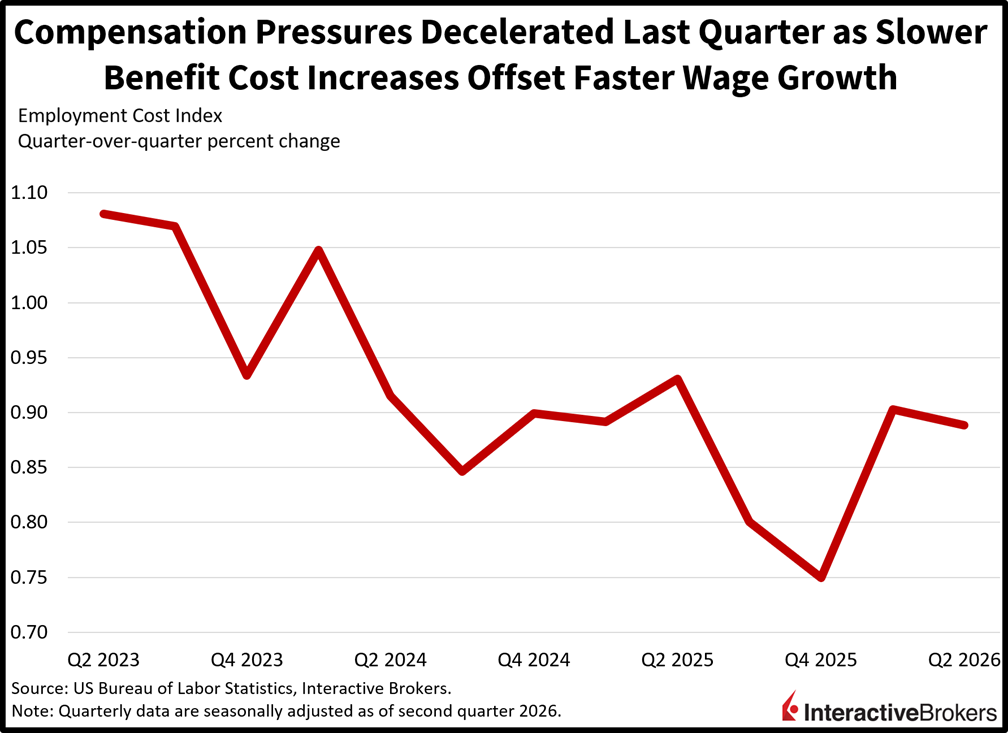
The cash component of labor compensation continued to grow during the second quarter, but the gains were countered by slower benefit charge increases. The Employment Cost Index (ECI) rose by a hotter-than-expected 0.9% quarter-over-quarter (q/q) pace, matching the prior period’s progress while beating the 0.8% estimate. Wages accelerated from 0.8% to 0.9%, but benefits decelerated from 1.2% to 1% q/q. Overall, the state/local government sector experienced a climb of 1% q/q while private employers saw a lift of 0.9%. Separately, the 3.4% year-over-year (y/y) expansion in the ECI points to workers struggling to keep up with inflation, which ran at a slightly faster rate of 3.5% in June.
The University of Michigan (UMich) Consumer Sentiment Index was revised higher as households reported improving optimism about the road ahead. The headline was adjusted from 54.4 to 55.2, while the indices for current and future conditions saw bifurcated shifts. The former was downgraded slightly from 54.9 to 54.8 while the latter was upgraded from 54 to 55.4. Despite shoppers expressing rising confidence regarding economic prospects, pocketbook issues remained top of mind amidst elevated inflation and geopolitical uncertainty.
The recent dissatisfaction in the fixed-income space is poised to become much worse if the Federal Reserve doesn’t hike at its next meeting. Bond vigilantes are in a confused position with the central bank, as Chair Warsh has moved from being ranked the most hawkish member of the committee to somewhere in the middle of the pack. This dynamic was evident when three dissenters voted in favor of an increase prior to Wednesday’s presser, while the chief seemed to want to kick the can down the road and simultaneously try to explain that the previous group allowed inflationary pressures to run above target for an excessive period of time. The Treasury complex is yelling that it won’t allow the monetary policy institution to have its cake and eat it too and significant consequences are set to hit the long end if rates aren’t lifted in September. Indeed, duration is going to suffer substantially amidst market participants that are waiting to see if current leadership has the discipline to aggressively follow-through on the price side of its mandate. I ultimately think the organization will raise at its upcoming opportunity and that would benefit equity and debt assets; however, a failure to do so will likely result in more pain.
The euro zone’s Harmonized Index of Consumer Prices, (HICP) which is also referred to as the Consumer Price Index, was up 2.9% y/y in July, a hotter print than 2.8% in the preceding month, according to a flash estimate from Eurostat. The July reading matched the economist consensus estimate. Price pressures also accelerated on a month-over-month (m/m) basis with the metric up 0.2% following June’s 0.1% decline. For the annual result, energy was a major pain point, posting a 10% gain. In fact, the HICP excluding energy was up only 2.2% y/y but unchanged m/m. The full core version of the gauge, which excludes energy, food, alcohol and tobacco, however, was up 2.5% y/y and was flat m/m. Within the headline print, the services category was 3.3% more expensive than in the year-ago period and the food, alcohol and tobacco category produced a 1.2% jump. Non-energy industrial goods trailed with a 0.9% ascent. In June, the European Central Bank hiked its key deposit facility rate 25 basis points to 2.25%, explaining that the Middle East War was generating price pressures, and it forecasted an average inflation rate of 3% for this year and 2.3% for 2027. Earlier this month, it decided to hold the current rate with energy prices matching the organization’s outlook.
Hong Kong’s second-quarter gross domestic product sank 0.6% q/q and the y/y expansion slowed from 5.9% during the first three months of 2026 to 4.3%, according to advanced estimates from the Census and Statistics Department. Both July metrics were disappointing with economists anticipating a q/q decline of 0.3% and an annual gain of 4.8%. The quarterly decline, the first in approximately four years, was brought on by slower growth of investment, government spending and private consumption. The deceleration occurred even as Hong Kong exports have soared as a result of demand for semiconductors needed for artificial intelligence. The exports, however, have primarily been re-exports as Hong Kong is a gateway for China’s trade with other markets.
The government provided Composite Purchasing Managers Index (PMI) for China fell 1.3 points in July from 50.6 in the preceding month, depicting a decline in economic activity, according to the preliminary release. The index’s threshold of contraction and growth is 50. The manufacturing component of the PMI slipped from 51.4 to 49.9 with seasonal factors, such as high temperatures, rainfall and typhoons hindering activity. and the non-manufacturing component dropped from 50.2 to 49. Demand for manufactured products also slowed. Construction contracted considerably while sales prices weakened and orders softened.
New to Interactive Brokers?
Open AccountInformation posted on IBKR Campus that is provided by third-parties does NOT constitute a recommendation that you should contract for the services of that third party. Third-party participants who contribute to IBKR Campus are independent of Interactive Brokers and Interactive Brokers does not make any representations or warranties concerning the services offered, their past or future performance, or the accuracy of the information provided by the third party. Past performance is no guarantee of future results.
This material is from IBKR Macroeconomics, an affiliate of Interactive Brokers LLC, and is being posted with its permission. The views expressed in this material are solely those of the author and/or IBKR Macroeconomics and Interactive Brokers is not endorsing or recommending any investment or trading discussed in the material. This material is not and should not be construed as an offer to buy or sell any security. It should not be construed as research or investment advice or a recommendation to buy, sell or hold any security or commodity. This material does not and is not intended to take into account the particular financial conditions, investment objectives or requirements of individual customers. Before acting on this material, you should consider whether it is suitable for your particular circumstances and, as necessary, seek professional advice.
Futures, event contracts, and forecast contracts are not suitable for all investors. Before trading these products, please read the CFTC Risk Disclosure. For a copy, visit our Warnings and Disclosures Page.
Trading in digital assets, including cryptocurrencies, is especially risky and is only for individuals with a high risk tolerance and the financial ability to sustain losses. Eligibility to trade in digital asset products may vary based on jurisdiction.
Related Articles














Join The Conversation
For specific platform feedback and suggestions, please submit it directly to our team using these instructions.
If you have an account-specific question or concern, please reach out to Client Services.
We encourage you to look through our FAQs before posting. Your question may already be covered!