
- Solve real problems with our hands-on interface
- Progress from basic puts and calls to advanced strategies
Interactive Options Course
Posted July 28, 2026 at 1:13 pm
A worsening chip selloff has sent the Nasdaq 100 into correction territory, as the gauge fell by over 10% from its all-time high reached on June 3. Despite the significant damage in the tech-heavy basket, driven by anxieties pertaining to capital return prospects, valuations, circular financing dynamics and Chinese competition, the Dow Jones Industrial and S&P 500 benchmarks are advancing, with the former especially benefiting from 9 of the 11 major sectors in the green. The cyclical trade is also being bolstered by tanking oil prices and plunging interest rates, with the retreats transpiring ahead of tomorrow afternoon’s Fed decision, and that’s helping the small-cap Russell 2000 rebound from morning turbulence. Renewed optimism about the ability for Tehran and Washington to negotiate a lasting peace deal has generated the drop in energy costs while weaker-than-expected economic data from both the ADP-weekly employment and Consumer Confidence fronts have added additional fuel to the Treasury rally. Broad price drops across the commodity complex alongside safe-haven demand stemming from AI weakness have supported gains for fixed-income assets too while weakening the greenback. Elsewhere, cryptocurrencies have bounced from earlier losses, prediction markets are catching bids and volatility protection instruments are becoming less expensive after buyers stepped in to capitalize on cheaper stocks.
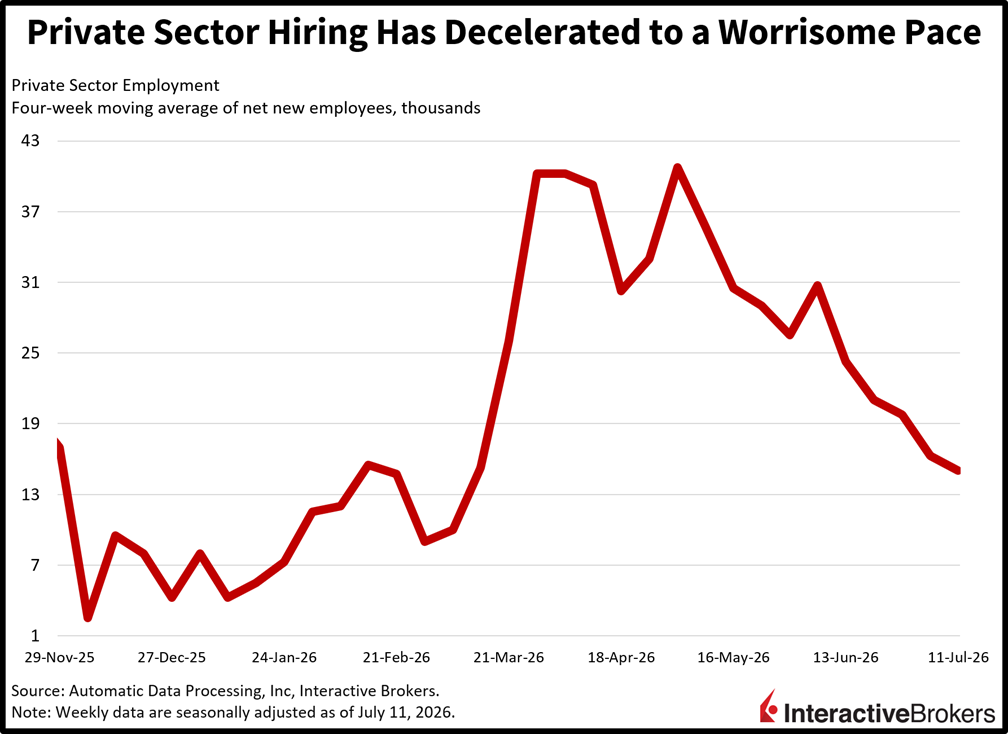
The deceleration in private sector hiring is beginning to reach worrisome levels, as ADP’s high-frequency indicator has declined for five consecutive weeks. The 15k headline figure represents the average headcount additions in each of the four weeks during the period that ended July 11, pointing to a monthly run rate of around 65k and is threatening to fall to the critical area below 50k. The weakness, however, has more to do with cratering labor force participation rather than a lack of employee demand. Still, subdued payrolls as a result of a shrinking pool of prospects could lower productivity while placing upward pressure on wages, presenting a headwind to corporate profit margins.
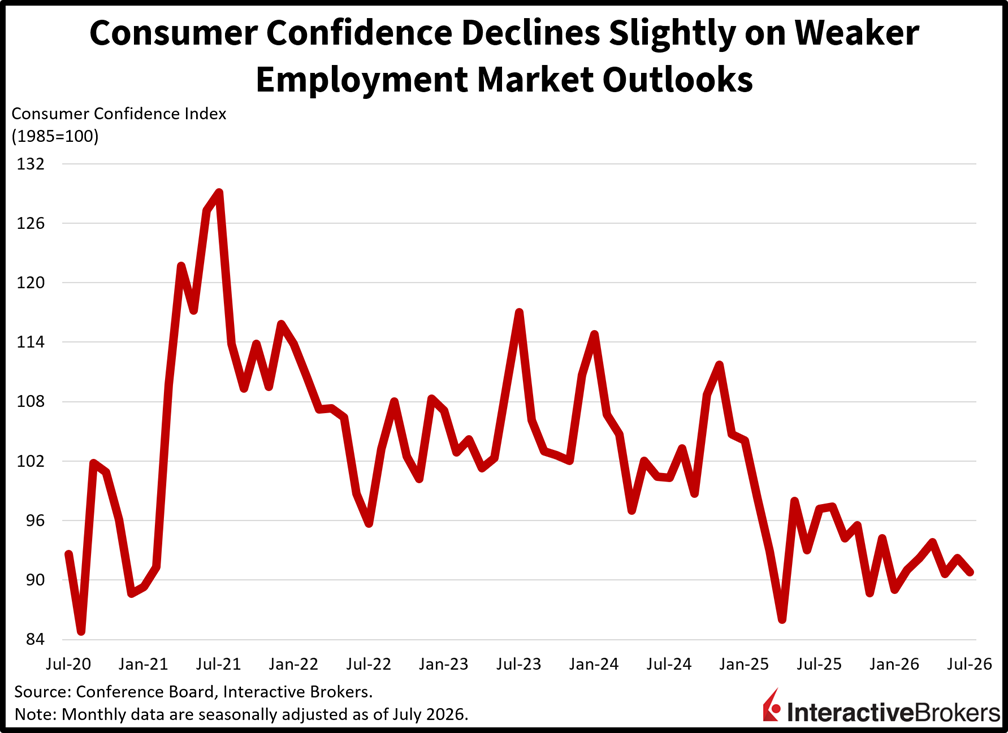
Consumer confidence faltered this month even as an alleviation at the pump improved inflationary dynamics for families. The headline Conference Board figure of 90.8 was below the anticipated 92.3 and June’s 92.2, as the sub-index of the present situation slipped to 114.9 from 118.5 while the expectations benchmark arrived at the flatline of 74.7. Household concerns remained focused on elevated prices, especially for energy and groceries, while worries about geopolitics and employment were more pronounced than during the preceding period. However, spending plans on discretionary services and big-ticket items rose in aggregate, supported by beliefs that the stock market will be higher over the next 12 months.
Animal spirits are thriving even with the tech sector having suffering brutal losses in recent weeks, with investors craving cyclical names and fixed-income assets instead of the ice-cold AI stocks. The bull market’s resilience has been growing with time, as portfolio managers seem to have infinite levers to pull that can continue supporting advancing equity benchmarks in aggregate. Indeed, this session’s buoyancy is being underpinned by cooling geopolitical tensions and softer-than-expected economic data that has yields and the dollar cratering. Meanwhile, the path to stronger appreciation into year-end without the Mag7 and the semiconductors has widened in light of these ferocious bids for the Dow Jones Industrial Average and the Russell 2000, as old-economy shares are proving that they can offset the weakness from new-technology themes. Still, earnings in the next two days from 4 of the 7 magnificents could very well revive the momentum trade if at least a few of the firms show revenue strength and slower free cash flow degradation that together signal monetization progress resulting from monumental capital expenditures. Furthermore, today’s correction in the Nasdaq 100 Index could mark the point at which traders say enough is enough, as participants dive back into the world’s most prominent businesses at better valuations while perhaps becoming increasingly willing to look past lackluster short-term results.
The net balanced of UK retailers reporting a decline in sales volume for the year through July eased from June with the Confederation of British Industry (CBI) Distributive Trades Survey score of -26% moderating from -54%, but a sense of gloom still persists among shoppers. The score is calculated by subtracting the percentage of firms that experienced sales declines relative to the preceding year from the number of firms that generated sales growth. Despite the downbeat mood of individuals at cash registers, the survey was stronger than the economist consensus expectation of -45%. Retailers judged conditions to be poor for this time of year but to a lesser extent than in June. Retailers also reported declines in orders placed with their suppliers. On a positive note, automobile sales bucked the trend, with net balance of 57% of respondents reporting growth through July, the fastest pace since April 2024. In a press release, Martin Sartorius, the lead CBI economist, said consumer gloom and cost pressures are weighing on the sector. He called upon the country’s new prime minister, Andy Burnham, to address rising labor costs and business tax rates that are a constraint on the industry’s investment and growth.
UK shop price inflation as measured by the British Retail Consortium (BRC) Shop Price Index moderated from 1.2% year over year (y/y) in June to 0.9% this month, which is lower than the three-month average of 1.1% and the economist consensus estimate of 1.1%. Fresh food was the only category to experience stronger inflation with prices up 3.1% y/y in July following the 2.8% climb in June. July’s result matched the three-month average.
The following three categories, however, experienced easing inflation:
A wave of summer promotions for foods and other goods contributed to the easing sticker pressures. Additionally, retailers held snacks and alcoholic drink promotions during the World Cup, according to Helen Dickinson, chief executive of the BRC. Retailers also discounted clothing and footwear to prepare for the fall season. Higher computer chip prices and increased manufacturing costs, however, led to price pressures intensifying for electronic products and health and beauty items.
Optimism about the job market and strong demand for artificial intelligence technology in South Korea pushed consumer confidence higher in July despite recent stock market losses, the Middle East crisis and stronger inflation, according to the Bank of Korea’s Consumer Confidence Index. The gauge climbed 0.2 points to 106.8 in July, the highest result in three months. The index depicts neutral confidence with a score of 100.
On one hand, households said their living conditions have deteriorated, a result of ongoing inflation and declining equity valuations. On the other hand, consumers’ views of the following items improved:
The Bank of Japan’s (BoJ) core CPI, which excludes volatile food prices, climbed 2.7% in June, matching the preceding month’s print and lingering above the central bank’s 2% goal. The release comes as the country’s yen currency is nearing a 40-year low exchange rate with the US greenback, which has been fueling import price pressures. The BoJ currently maintains a 1% key interest rate, which is considerably lower than rates of other developed economies. The organization meets this week and will announce its decision regarding its key interest rate on Thursday.
New to Interactive Brokers?
Open AccountInformation posted on IBKR Campus that is provided by third-parties does NOT constitute a recommendation that you should contract for the services of that third party. Third-party participants who contribute to IBKR Campus are independent of Interactive Brokers and Interactive Brokers does not make any representations or warranties concerning the services offered, their past or future performance, or the accuracy of the information provided by the third party. Past performance is no guarantee of future results.
This material is from IBKR Macroeconomics, an affiliate of Interactive Brokers LLC, and is being posted with its permission. The views expressed in this material are solely those of the author and/or IBKR Macroeconomics and Interactive Brokers is not endorsing or recommending any investment or trading discussed in the material. This material is not and should not be construed as an offer to buy or sell any security. It should not be construed as research or investment advice or a recommendation to buy, sell or hold any security or commodity. This material does not and is not intended to take into account the particular financial conditions, investment objectives or requirements of individual customers. Before acting on this material, you should consider whether it is suitable for your particular circumstances and, as necessary, seek professional advice.
Futures, event contracts, and forecast contracts are not suitable for all investors. Before trading these products, please read the CFTC Risk Disclosure. For a copy, visit our Warnings and Disclosures Page.
Trading in digital assets, including cryptocurrencies, is especially risky and is only for individuals with a high risk tolerance and the financial ability to sustain losses. Eligibility to trade in digital asset products may vary based on jurisdiction.
Related Articles
















Join The Conversation
For specific platform feedback and suggestions, please submit it directly to our team using these instructions.
If you have an account-specific question or concern, please reach out to Client Services.
We encourage you to look through our FAQs before posting. Your question may already be covered!