
- Solve real problems with our hands-on interface
- Progress from basic puts and calls to advanced strategies
Interactive Options Course

Posted January 21, 2026 at 11:22 am
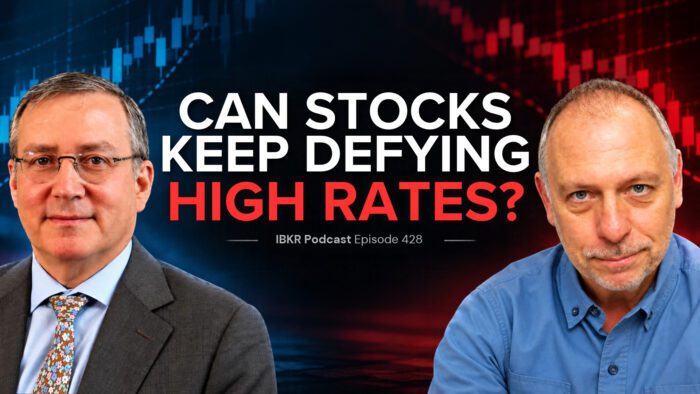
Chinese markets are showing renewed momentum in early 2026, driven by advances in AI, a reopening IPO pipeline, and supportive policy shifts. In this IBKR Podcast episode, Andrew Wilkinson is joined by Xiaolin Chen of KraneShares to break down what’s fueling the rally and what global investors should be watching next.
The following is a summary of a live audio recording and may contain errors in spelling or grammar. Although IBKR has edited for clarity no material changes have been made.
Hello, everybody. Welcome to today’s event. This is Andrew Wilkinson with Interactive Brokers, and I’m joined on this call by Xiaolin Chen, who’s the Head of International at KraneShares in London. Xiaolin, a huge welcome back to the program. How are you?
Very well. Thank you so much for having me again.
A pleasure. So we’re going to talk about China and Chinese stock markets. The Shanghai Composite is up by about 5% to begin 2026, and trading volumes set a record at the start of the week. What’s behind the current bout of enthusiasm for Chinese shares?
I think it’s fair to say that China’s Chinese New Year wishes have arrived earlier than many people expected. You often hear the phrase “Christmas wishes” in the West — this is really the Chinese New Year version of that.What we’re seeing now is the result of last year’s policy announcements and monetary support from the government, particularly funding aimed at technology, AI, and innovation. Right at the start of 2026, several companies in AI, technology, and large language models began coming to market. Investors had been watching these trends for some time, but now they’re starting to see real, tangible progress.The market is reacting to a wave of companies that had been preparing for IPOs for years and are finally able to come to market. As those doors open, investors who were waiting on the sidelines are asking, “What else is coming out of China?” And the answer is: quite a lot. These new listings are encouraging because they reflect real industrial progress supported from the top down. More companies are now reaching the public markets, allowing retail investors access to these growth areas. And perhaps most importantly, China is catching up with developed markets by building its own AI ecosystem across multiple layers of the value chain.
There are a couple of things I want to dig into with you in a moment — AI and the IPO market — both of which you just mentioned. But first, let’s take a step back. How have China’s recent macroeconomic policy shifts impacted domestic growth and the global outlook?
That’s a great question. China is still an emerging market, and in emerging markets, policy direction matters a great deal. Investors want to understand where the government is taking the country. One of the most important recent policy developments is the 15th Five-Year Plan. Every five years, the Chinese government lays out a strategic roadmap, and this plan clearly highlights a few key priorities.First and foremost is the consumer. China’s greatest asset is its people, so the focus is on helping households build wealth and feel more confident about spending and supporting their lifestyles. From a top-down perspective, restoring consumer purchasing power is a major policy theme. That includes continued support for e-commerce and related sectors. The second priority is technological self-sufficiency, particularly in AI and advanced technologies across the entire value chain. The third priority is staying competitive at the technological frontier while also addressing demographic challenges, especially an aging population. Technology plays a key role here — automation can help fill labor gaps, improve productivity, and allow people to move into higher-value roles.
Overall, policy remains very accommodative. Roughly 80% of current policy efforts are focused on domestic issues — helping people, supporting growth, and generating wealth. The remaining focus is on managing global uncertainty, maintaining international engagement, and expanding technology cooperation overseas. As a result, we’re seeing more constructive and open communication from Chinese policymakers toward the global community. From China’s perspective, that means continued dialogue and, hopefully, more positive outcomes.
What I find fascinating about this rally is that the renewed appeal of Chinese stocks seems to have pushed concerns about real estate into the background. People aren’t really talking about that anymore. Why is that?
There are two main reasons. First, Chinese households are not highly leveraged overall. While the property market has gone through consolidation — including a psychological adjustment — the situation is very different from highly leveraged housing markets elsewhere. If you think back to 2008, many households in other countries experienced severe stress due to negative equity. That hasn’t been the case in China. Even after corrections, most households didn’t face significant negative equity, and leverage levels remained relatively low. As a result, the property market has gone through a gradual and orderly correction. Importantly, it also corrected investor expectations. Real estate is no longer seen as the primary engine of wealth creation in China. After three years of consolidation, the dust has largely settled. People now recognize that growth opportunities lie elsewhere — in technology, new IPOs, and emerging industries. Meanwhile, China’s job market remains relatively stable, which helps support household confidence. One characteristic of emerging markets is that they tend to move on quickly. Instead of dwelling on past cycles, investors focus on the next opportunity — and that shift is clearly underway.
Let’s bring it back to artificial intelligence. What’s the current outlook for AI in China?
I would describe this as a real “springtime” moment for AI in China. China was late to the most advanced stages of AI development — particularly in cutting-edge chip design — but it was not late in recognizing how important AI would be for society. China’s focus is now on open-source models and, most importantly, commercialization. While the country may not yet have chips as advanced as Nvidia’s, it does have sufficient computing power and energy capacity to deploy AI at scale. That foundation allows AI to be applied quickly in real-world settings. We’re already seeing this in practice. Robots are being deployed in hotels, logistics centers, restaurants, hospitals, and home-care facilities. In hotels, for example, robots can greet guests and communicate in multiple languages around the clock — something that’s simply not feasible with human staffing alone. China’s logistics sector is another good example. The country handles enormous delivery volumes — tens of billions of parcels annually — which simply wouldn’t be possible without automation. AI-powered robotics is now deeply embedded in these systems.In elder care, AI is also playing a growing role. Given China’s demographic challenges, companion robots are being used to provide interaction and support. These applications may sound simple, but they represent meaningful social and economic value. From an investment perspective, China’s emphasis is on making AI tangible and profitable. Investors want to see AI working in the real world, not just theoretical investment in infrastructure.
In 2026, I believe humanoid and service-oriented robots will be one of the most visible themes. We’ve already seen this at CES — robots cleaning facilities, assisting in hospitals, and supporting logistics. The opportunity extends across the entire supply chain, from sensors and processors to software and robotics hardware. Many winners will emerge along that value chain.
We mentioned the IPO market earlier. Let’s turn to Hong Kong. It seems particularly healthy right now. What’s driving that growth?
Over the past two to three years, the IPO market in China was nearly frozen. During and after the pandemic, economic uncertainty led many companies to delay listings — especially during periods when negative news dominated headlines. As a result, a significant pipeline has built up. Recent research suggests there are roughly 180 Chinese unicorns with valuations of $1 billion or more that have strong operating histories but have not yet gone public. These are traditional IPO candidates that simply waited for better conditions. That’s why the current pipeline is so healthy. In Hong Kong, companies are now coming to market in a more orderly and gradual way. This year, we’ve already seen listings related to large language models and advanced chipmakers. However, we generally don’t recommend investors pick individual IPO names due to volatility. A basket or thematic approach makes more sense. According to current estimates, there are 200 to 300 IPO applications in the Hong Kong pipeline for 2026, including firms from mainland China. Many of these companies also have diversified revenue streams or backing from large technology firms, which provides additional stability. From an investment standpoint, this reflects an entire ecosystem rather than a single dominant player — especially in areas like robotics, where multiple specialized companies contribute to the final product.
Let’s turn to trade. Given the headlines coming out of the White House in 2025, how have Chinese manufacturers responded globally?
2025 was certainly challenging for Chinese manufacturers, particularly with renewed trade tensions. That said, there has been a noticeable shift toward more constructive dialogue, and manufacturers were better prepared for a second round of trade pressure than they were during the first. Exports were impacted, but resilience returned relatively quickly. China has spent the last decade diversifying its trading partners, and exports to emerging markets and Europe have increased as a result. That said, China and the U.S. are still likely to remain two of the world’s largest trading partners for a very long time.
Xiaolin Chen, Head of International at KraneShares in London. Thank you again for joining me.
Thank you.
And thanks to our audience. If you enjoyed today’s episode, be sure to like and subscribe wherever you get your podcasts. Bye for now.
The analysis in this material is provided for information only and is not and should not be construed as an offer to sell or the solicitation of an offer to buy any security. To the extent that this material discusses general market activity, industry or sector trends or other broad-based economic or political conditions, it should not be construed as research or investment advice. To the extent that it includes references to specific securities, commodities, currencies, or other instruments, those references do not constitute a recommendation by IBKR to buy, sell or hold such investments. This material does not and is not intended to take into account the particular financial conditions, investment objectives or requirements of individual customers. Before acting on this material, you should consider whether it is suitable for your particular circumstances and, as necessary, seek professional advice.
The views and opinions expressed herein are those of the author and do not necessarily reflect the views of Interactive Brokers, its affiliates, or its employees.
Content on China Last Night is for informational purposes only and should not be construed as investment advice. This material represents an assessment of the market environment at a specific time and is not intended to be a forecast of future events or a guarantee of future results; material is as of the dates noted and is subject to change without notice. This information should not be relied upon by the reader as research or investment advice regarding the funds or any security in particular.
This material may not be suitable for all investors and is not intended to be an offer, or the solicitation of any offer, to buy or sell any securities. Investing involves risk, including possible loss of principal.
This material contains general information only and does not take into account an individual’s financial circumstances. This information should not be relied upon as a primary basis for an investment decision. Rather, an assessment should be made as to whether the information is appropriate in individual circumstances and consideration should be given to talking to a financial advisor before making an investment decision.
Forward-looking statements (including Krane’s opinions, expectations, beliefs, plans, objectives, assumptions, or projections regarding future events or future results) contained in this presentation are based on a variety of estimates and assumptions by Krane. These statements generally are identified by words such as “believes,” “expects,” “predicts,” “intends,” “projects,” “plans,” “estimates,” “aims,” “foresees,” “anticipates,” “targets,” “should,” “likely,” and similar expressions. These also include statements about the future, including what “will” happen, which reflect Krane’s current beliefs. These estimates and assumptions are inherently uncertain and are subject to numerous business, industry, market, regulatory, geo-political, competitive, and financial risks that are outside of Krane’s control. The inclusion of forward-looking statements herein should not be regarded as an indication that Krane considers forward-looking statements to be a reliable prediction of future events and forward-looking statements should not be relied upon as such. Neither Krane nor any of its representatives has made or makes any representation to any person regarding forward-looking statements and neither of them intends to update or otherwise revise such forward-looking statements to reflect circumstances existing after the date when made or to reflect the occurrence of future events, even in the event that any or all of the assumptions underlying such forward-looking statements are later shown to be in error. Any investment strategies discussed herein are as of the date of the writing of this presentation and may be changed, modified, or exited at any time without notice.
Any discussion or mention of an ETF is not to be construed as recommendation, promotion or solicitation. All investors should review and consider associated investment risks, charges and expenses of the investment company or fund prior to investing. Before acting on this material, you should consider whether it is suitable for your particular circumstances and, as necessary, seek professional advice.
IPO investments carry substantial risks including extreme price volatility, limited operating history, lack of liquidity, potential for significant losses, and uncertainty regarding future performance.











Join The Conversation
For specific platform feedback and suggestions, please submit it directly to our team using these instructions.
If you have an account-specific question or concern, please reach out to Client Services.
We encourage you to look through our FAQs before posting. Your question may already be covered!