
- Solve real problems with our hands-on interface
- Progress from basic puts and calls to advanced strategies
Interactive Options Course
Posted March 26, 2026 at 11:23 am
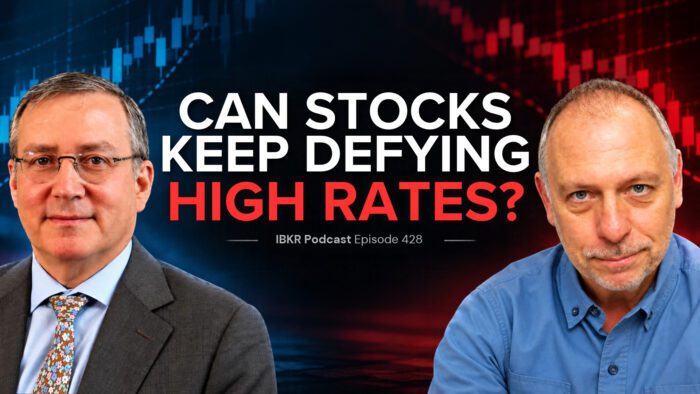
In this episode of the IBKR Podcast, Jeff Praissman sits down with GraniteShares CEO Will Rhind to unpack the growing buzz around autocallable ETFs. They discuss how these products work, where the income comes from and whether the promise of high yield with downside protection holds up in today’s market.
The following is a summary of a live audio recording and may contain errors in spelling or grammar. Although IBKR has edited for clarity no material changes have been made.
Hi everyone, this is Jeff Praissman with Interactive Brokers. It’s my pleasure to welcome back to the IBKR Podcast studio Will Rhind, the founder and CEO of GraniteShares ETFs. How are you, Will?
Very well. Thanks, Jeff. Yeah, good to be back.
Yeah, great to have you in for our monthly talk. Today we’re going to talk about something that I think most people aren’t too familiar with: auto‑callable ETFs. I kind of want to kick it off, Will, by asking if you could explain the core mechanics behind auto‑callable ETFs. How do they generate income, and how do they differ from traditional income‑generating ETFs?
Yeah, so this is a new category within the ETF industry, and it comes from the structured product world. Auto‑callable ETFs essentially combine income‑paying characteristics, or yield characteristics, with downside protection, and they do that principally through the options market. This is a structure that is now becoming very popular with investors where, particularly in these kind of volatile times, people are not just concerned about yield or upside, but they also would like, or are interested in, downside protection as well.
So auto‑callable ETFs, or barrier‑based ETFs, are something that you’re going to see a lot more of in the market.
And what type of risk do investors face when they’re investing in these auto‑callable ETFs, and how do they compare to those other income‑focused ETFs you mentioned?
Yeah, so income ETFs run the gamut of what you might call very safe income investments on one end of the spectrum, which would be things like money market funds or short‑dated Treasury bond‑style ETFs. There’s not going to be much movement, if any, in terms of your principal.
But the trade‑off is that the yield that you’re able to generate is also quite low. As you move out on the spectrum, you get into higher‑yielding fixed‑income instruments, or in the equity world, dividend‑paying stocks. When you come to options‑based income products, that’s typically nearer, if not at, the higher end of the yield or income‑paying spectrum.
For example, you might see an auto‑callable ETF with an income or yield closer to 20% per annum. Contrast that with short‑term Treasuries at somewhere around 3% or less, and you’ve got that spectrum. So it runs the gamut in terms of risk‑return.
Likewise, if a low‑yield product has a relatively small amount of risk, then it stands to reason that a higher‑yielding ETF would have a higher level of risk. When it comes to auto‑callable ETFs, while you get a high level of yield, the risk is higher, but the way that is presented to investors is in the form of downside protection through certain barriers. The barriers imply that if the underlying — which could be a stock or an index — moves below a certain percentage point, then the product will not pay a coupon, or not pay the income, for that particular month.
The worst‑case scenario is if the underlying drops below a certain barrier, then the product will give the performance of that underlying, be it a stock or an index. So you do have a higher level of risk, with some parameters put around that so that people can identify those risks and assess whether they’re right for them.
And I’m certainly not an accountant, and we’re certainly not giving any kind of tax advice on this podcast, but I do want to ask you: are there potential tax advantages in these auto‑callable ETFs?
There potentially can be. It’s a bit of a tough one because with all options‑based ETFs, or options‑based income ETFs, there can be a fairly large component, depending on the strategy and, of course, depending on the circumstances, of return of capital. Return of capital is a more tax‑efficient treatment than income, but that will very much depend on the strategy and the circumstances around the performance for the given period being measured.
And Will, you touched on this when describing the risks in the previous question as far as investing in these auto‑callable ETFs, but I want to dive in a little bit deeper. From a market‑conditions perspective — kind of the flip side of that — where do they tend to perform best?
I think the product is principally designed for steady income payments. That’s really the genesis of the product. If the underlying is rising — so if it’s a single stock and that stock is appreciating over time — you would expect that to be a favorable environment. Likewise, if the underlying stays flat over that period of time, that’s also a favorable environment.
Even if the underlying goes down, as long as it stays above the barrier — above certain levels — it can still be favorable. Let’s hypothetically say that the barrier is set at 40%. That means that so long as the underlying doesn’t go down by more than 40%, you will still get your coupon payment or your income payment. So it’s actually quite favorable in different market environments.
I think the key attraction to investors is that even in a downside market, there are preset levels of downside protection that investors can look at and assess whether that’s the right thing for them.
Right, and they seem to be able to potentially offer some high yields while still providing some level of downside protection. Is that a fair statement?
Yeah, absolutely. That is the proposition in a nutshell: a high level of income, a high level of yield, but with downside protection that is defined.
And what role, if any, do structured notes play in the underlying strategy of auto‑callable ETFs?
Structured notes are where this comes from. In the structured‑note world, these are typically products designed by banks and wholesaled out to either financial advisors or ultra‑high‑net‑worth individuals. Auto‑callables in the structured‑note world are among, if not the most popular, strategies out there.
For financial advisors, it’s a very popular strategy for clients to implement. When it comes to auto‑callable ETFs, this is a very popular strategy. Obviously, products will vary, but in terms of how a lot of the products in the market choose to do it, they don’t actually hold structured notes. They hold options, or packages of options, and through these option payoffs, they generate the callable payoff.
Got it. Got it. Okay. So basically, I guess my follow‑up question would be: how do they simplify access to those instruments? They’re not really offering the instruments themselves, but rather offering access to how those instruments behave, for the most part. Is that a correct statement?
Yeah, I think one of the core benefits in terms of ETFs versus structured notes is, like a lot of things the ETF market does, it takes an existing idea and converts that into ETF form and makes it more attractive to investors. If you think about structured notes, they’re typically very expensive because there are large upfront fees.
Well, you don’t have upfront fees in an ETF; you just pay for the holding period. With structured notes, there’s credit risk of whatever bank is issuing that structured note. With ETFs, there’s no credit risk against the ETF. With structured notes, you have to decide what particular payoff, or what particular note, that you want to invest in. With the ETF, you are buying exposure to a number of different auto‑callable options. So there are diversification benefits that you don’t get just with buying one.
And then with the ETF, those auto‑callable options are automatically rolled. So again, you don’t have to worry about if your particular structured note gets called away and having to choose another one and roll into another one.
So there are a number of benefits that the ETF gives you. I think the last one, which would be the unique benefit I think every investor gets from ETFs, is that ETFs are liquid. You can buy and sell during market hours, whereas with structured notes, typically you can buy, but there’s very little, if any, secondary‑market liquidity.
So if you want to sell it back before that note matures, that can be a very difficult thing to do. Whereas, of course, when you’re buying an ETF portfolio, liquidity is really one of the core benefits of the ETF package.
And what are some of the potential downsides of these high yields, though, offered by the auto‑callable ETFs? I mean, we talked about the risks earlier in the podcast, but I want to maybe dig a little bit deeper into how investors could manage these risks.
I think there are really two principal risks that investors need to be aware of. First and foremost is the risk of a coupon not being paid, or an income payment not being made, for that particular month. Again, there are predefined rules around that relating to the coupon barrier and the observation period.
So at an observation period, if the underlying is trading below the coupon barrier, there won’t be a coupon paid for that month. Of course, if it recovers for the next observation period, it will be paid for that month. So whether your coupon gets paid or not is clearly a risk.
The other risk is the downside, which is again preset at a certain level. Providing the underlying doesn’t fall below that certain level, you’ll get your coupon paid. So those are really the two risk levels that I think people, for the most part, are concerned about.
And how do these ETFs fit into a broader income investment strategy, and what would be some of the key considerations for investors looking to incorporate them into their portfolios?
I think the jumping‑off point is that because you’re talking about a much higher level of income or yield, what it’s probably going to do before anything else is increase the level of yield or income you get from your portfolio without necessarily doubling down on key risks — such as, in the fixed‑income world, credit risk or duration risk within the portfolio.
So it acts very much as a complement to fixed‑income exposures and, indeed, even to equity exposures, where with options you’re generating a different type of risk than the rest of the portfolio. Depending on what kind of income portfolio you have at the base level, you can see an auto‑callable structure adding to or increasing the level of yield that you’re able to obtain without necessarily increasing the level of risk from some of the key factors you’re exposed to in the fixed‑income world.
Will, this has been great. And for our listeners, they can find more at will@graniteshares.com, and keep an eye out for our monthly podcast as we talk about ETFs and commodities and metals and everything else under the sun. Thanks, Will.
Thanks, Jeff. Appreciate it.
Past performance is no guarantee of future results.
Investing in physical commodities, including through commodity-linked derivative instruments such as Commodity Futures, Commodity Swaps, as well as other commodity-linked instruments, is speculative and can be extremely volatile, and may not be suitable for all investors. Market prices of commodities may fluctuate rapidly based on numerous factors, including: changes in supply and demand relationships (whether actual, perceived, anticipated, unanticipated or unrealized); weather; agriculture; trade; domestic and foreign political and economic events and policies; diseases; pestilence; technological developments; currency exchange rate fluctuations; and monetary and other governmental policies, action and inaction.
©2020 GraniteShares Inc. All rights reserved. GraniteShares, GraniteShares ETFs, and the GraniteShares logo are registered and unregistered trademarks of GraniteShares Inc., in the United States and elsewhere. All other marks are the property of their respective owners.
All investing involves risks, including possible loss of principal. Investors should consider the investment objectives, risks, charges and expenses carefully before investing. For a prospectus or summary prospectus with this and other information about GraniteShares ETFs, please call (844) 476 8747 or visit the website at www.graniteshares.com. Read the prospectus or summary prospectus carefully before investing.
The analysis in this material is provided for information only and is not and should not be construed as an offer to sell or the solicitation of an offer to buy any security. To the extent that this material discusses general market activity, industry or sector trends or other broad-based economic or political conditions, it should not be construed as research or investment advice. To the extent that it includes references to specific securities, commodities, currencies, or other instruments, those references do not constitute a recommendation by IBKR to buy, sell or hold such investments. This material does not and is not intended to take into account the particular financial conditions, investment objectives or requirements of individual customers. Before acting on this material, you should consider whether it is suitable for your particular circumstances and, as necessary, seek professional advice.
The views and opinions expressed herein are those of the author and do not necessarily reflect the views of Interactive Brokers, its affiliates, or its employees.
Options involve risk and are not suitable for all investors. For information on the uses and risks of options, you can obtain a copy of the Options Clearing Corporation risk disclosure document titled Characteristics and Risks of Standardized Options by going to the following link ibkr.com/occ. Multiple leg strategies, including spreads, will incur multiple transaction costs.
Interactive Brokers does not provide tax advice, does not make representations regarding the particular tax consequences of any investments, and cannot assist clients with tax filings. Investors should consult with their tax professional about the tax implications of any investment.
Any discussion or mention of an ETF is not to be construed as recommendation, promotion or solicitation. All investors should review and consider associated investment risks, charges and expenses of the investment company or fund prior to investing. Before acting on this material, you should consider whether it is suitable for your particular circumstances and, as necessary, seek professional advice.
Autocallable and barrier ETFs involve significant risks, including the potential loss of principal, suspended income, and limited upside, and may not be suitable for all investors due to their use of complex derivative strategies. These products can stop paying income or lose substantial value if markets fall below certain barrier levels, and investors should fully understand how these strategies work and consider their own risk tolerance before investing.











Join The Conversation
For specific platform feedback and suggestions, please submit it directly to our team using these instructions.
If you have an account-specific question or concern, please reach out to Client Services.
We encourage you to look through our FAQs before posting. Your question may already be covered!