
- Solve real problems with our hands-on interface
- Progress from basic puts and calls to advanced strategies
Interactive Options Course

Posted October 20, 2025 at 12:04 pm


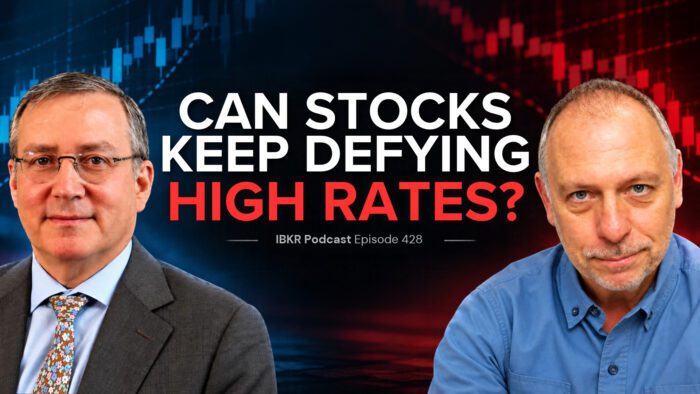
Stephen Yiu of the Blue Whale Growth Fund joins Andrew Wilkinson to discuss how new tariffs could quietly reignite inflation, even as markets bet on cooling prices. From delayed price effects to sticky consumer costs, Yiu explains why trade tensions might be the next inflation story investors aren’t watching closely enough.
The following is a summary of a live audio recording and may contain errors in spelling or grammar. Although IBKR has edited for clarity no material changes have been made.
Welcome to this week’s episode. I’m delighted to have back with me Stephen Yiu, who is the CIO of the Blue Whale Growth Fund over in London. How are you, Stephen?
Very well, thanks for the invitation, Andrew.
I think it’s been about eight months since we last spoke. We put out a podcast with you on February 5th. I listened to that one again last week, and I had a little look at some of the mumblings and grumblings you had on your website—your correspondence with investors. So, I think going forward three months to May, you provided an update for investors in response to the tariff impact. A lot happened between February when we first spoke and then May. At the time, you made a few portfolio adjustments. For example, I read that you sold or reduced your exposure to Meta and Nintendo—the former for fear that it was vulnerable to digital advertising and therefore to an economic slowdown.
So, with the power of hindsight, Stephen, what do you think about the health of the global economy in light of what seems to be a U.S.-led slowdown?
Yeah, thank you for that question—or the reminder of what we have done early this year. Obviously, I think it’s important to point out that we are in a very challenging macro environment as we go through the year and will continue that journey into 2026. There are a lot of uncertainties, unknown variables—whether it’s a Trump tariff coming into play or a slowdown in the U.S. economy, etc. And I do not think today, even though the market has recovered very strongly, that we are in a better position than six months ago. So, our view remains very much the same—that we are going to see a slowdown. Obviously, not a severe recession, depending on what Trump and China are going to do on this 100% tariff, which has come out quite recently. But barring a scenario that turns into a mega trade war between the two biggest countries in the world, I think a reasonable slowdown would come into play. And of course, the other thing to bear in mind is that while the tariffs have not actually properly filtered into the U.S. economy yet, they’re going to come with a lag—which I think you can see reflected in some sticky prices being put through by retailers in the U.S. at the same time as well.
Stephen, let’s just focus really quickly on Meta and Nintendo. Are you content with the decision to sell both stocks?
Yeah, I think there are two things going on—obviously very different parts of the investment thesis or decision. I think as far as Nintendo is concerned, we had owned the stock for over four years before we exited recently.
I think the issue with Nintendo is not so much about the content—the IP, the third-party games, which they’ve done very well—or the Mario and Zelda IP. But it’s about the Switch that they just launched, which is yet to come. The Switch has now been launched, but of course the biggest selling season is going to be over Christmas or over the New Year—which is what we are now going to tackle. And if you think about the tariffs and all that, they’ve not yet fed into the equation. So, I think we’re still being cautious about what that might mean in terms of how many units they can actually sell. Expectations are quite high just because the product is pretty good. But equally, I think you need to look at the fundamentals in terms of the actual delivery or numbers they can sell to investors. I think as far as Meta is concerned, that’s probably slightly different. It’s partly related to our concern about AI spenders. For example, within the Magnificent Seven, we don’t own anything except Nvidia—we do not own the other six. And Meta would fit as part of that equation. Even though we love the data story—with people still using Instagram, WhatsApp, and Facebook, which are very entrenched territories for data—at the same time, they’re investing heavily into AI.
Where we are in the cycle, we are very cautious on AI spenders, and we would rather be on the receiving end of any AI spending, which would include the likes of Nvidia, Broadcom, or Vertiv. We want to see some tangible revenue or free cash flow generation, rather than being the contributor to that free cash flow that Meta or Microsoft might be generating today.
Stephen, with stocks that you’ve dispensed of, do you consider that to be a permanent divorce, or would you return to Meta under other conditions?
Yeah—thanks for this question, actually something that we haven’t touched on before. I think one of the ways we think about stocks is that we never fall in love or out of love with companies, and we’ve done this before.
Using Meta as an example: we had exposure to Meta since we started back in 2017. We sold out of Meta in January 2022, and that was a very different narrative at the time—Zuckerberg decided to go into the metaverse. We were very concerned about the metaverse, which he has now stopped talking about. Later on, in 2023, while we were very much into AI—because we already had Nvidia in the fund—we were looking for more companies that had exposure to AI. One of the things about AI is data, and Meta has a very strong position in data. So, we then decided to go back into Meta in Q4 2023, and we have done very well since then, since October 2023 until recently. Hence, from an investor perspective, it is always about the investment thesis—your expectations about what you think is going to happen—that are very different from the market’s expectations.
I think at the moment the narrative is probably more one-sided, in terms of “the more money you spend, the more return on investment you get,” which is something that maybe we’re not sharing at this stage. But at some point, if expectations are going to be reset or valuations become a lot more attractive, I think Meta—in terms of the data they have—is still very valuable in the context of AI. So, that has not changed.
Back to May 2025—you know, President Trump has done an awful lot in terms of reshaping everything, and one of the relationships that he’s kind of picked at, pulled apart, and shifted is geopolitical tension, particularly between the U.S. and the EU, and rebalancing that to a large degree. You had an elevated conviction that the path of EU defense spending would be higher. Do you still feel the same way a few months on?
Yeah, so there’s this new term—obviously coined by someone else—called geoeconomics. It’s basically economics that’s tied into geopolitics at the same time. And I think European defense would be part of this narrative. I mean, we were very constructive or positive on European defense after Trump was elected late last year or early this year. I think the tipping point was the conversation between Trump and Zelensky in January that basically, I think what Trump was saying at the time was that Europe needs to have the capability themselves, and the U.S. is not just going to be the one who’s going to spend all this money on behalf of the European Union. And of course, I think what you have seen since then is that companies such as Leonardo, which we have in the fund, have almost doubled in value within the last nine months—and that has done very well.
But of course, I think where we are a bit cautious is on valuation—just because when we think about European defense versus artificial intelligence, you need to have that actual delivery of those kinds of defense equipment or capabilities. It’s not like overnight you just put more GPU compute and then come up with some use cases that are very intelligent, and people can then use ChatGPT more or something. So, it’s not like that. European defense is very much operating in the real world. Hence, when you look at the valuation of European defense companies, I think it’s definitely a lot less attractive today. I mean, we have been taking profits, so we have been keeping our position unchanged after the shares have doubled in value, but unchanged versus the beginning of the year. So we’ve been taking profits, but I do believe that the journey, in terms of spending, will continue to power on. But of course, then it’s about expectation. Is it going to all come in 2026? Is it going to get spread out between 2026 to 2027 or 2028? Then, of course, the financial market would probably expect things to come a lot sooner rather than later, right? But if I think about it in the context of many European defense companies historically, you probably would consider them as quality deep value—just because they’re good companies, but they’re not growing in line with European GDP nominal growth, mid-single-digit. Deep value means very cheap. I think today I would consider them as quality growth, just because when you look at the context of Leonardo, they’re growing their top line in low double digits, and that journey could last for the next multiple years. So they’re no longer in a deep-value category, just because they’re now growing faster. Of course, the valuation would equally have reflected that, just because the shares have doubled. So hence, I think the return profile that you might get from European defense will be a lot less versus the beginning of the year, but it doesn’t mean they can’t deliver—they would just deliver a bit less. And hence, I think you need to size your position accordingly.
Stephen, you’ve always been a long-term investor. That’s something I learned in our initial conversation back in February, and at the time you pointed to “you’ve got to buy the dips,” and that was before we had the dip. So I think you’ve stocked up further on Nvidia in the AI space.
Tell us what your current thoughts are on artificial intelligence.
Yeah, so on a very high level, if you believe AI is going to change the world in terms of our day-to-day life—on a personal basis, on a work basis—then I think we are at the very early stage of the AI development cycle. And if you do believe that’s the case, which is our belief, then there are almost only two companies in the world that are at the core of this conversation. One is Nvidia, the other one is Broadcom. Broadcom does the in-house GPU for the big tech companies. And of course, recently OpenAI has tried to have a commitment with AMD, but I think AMD would be more of a sideline to the AI infrastructure conversation. So we still have two companies, which are Nvidia and Broadcom. That is our thinking. And this year we have done a lot better from Broadcom than Nvidia, even though Nvidia’s share price has gone up probably just over 40%. But Broadcom is probably in the range of 50–60%. I mean, it’s up quite a lot today on this announcement that OpenAI has picked their chips to do the in-house GPU for some capacity. So I think what investors need to be conscious of is the valuation of, let’s say, Nvidia—it’s probably not very high. I mean, it’s trading at around 30 times earnings PE, exactly the same as Microsoft and Apple. And if you think about Apple, it has been trading at 30 times PE for the last couple of years already. It has not been growing at 50%. Nvidia probably was growing at 50%. Going forward, it will be a bit lower, but still a lot higher—still in double-digit growth rather than single-digit.
So hence, I think Nvidia is transitioning itself into more of a quality—kind of the core of the AI story. It’d be a bit like your Apple, in a way. It could still trade at a premium just because there’s no one else offering an alternative product. And at the same time, you would expect, at some point, to see a replacement cycle. The big tech companies who invested two years ago—in two years’ time, they would need to replace some of the GPU compute to make it more robust. But of course, what is important is that even though Nvidia is unlikely to disappear—because it will remain very much a core part of the AI conversation—the return profile from a shareholder perspective, going forward, is going to be a lot less.
And I think you’ve already seen that, right? You compare Nvidia’s return this year, which is 40%, which is very good for most people, but I’ve just outlined that Leonardo has doubled in share price. That’s gone up a lot higher than Nvidia, for example, and Broadcom has done a lot better than Nvidia.
So I think you just need to remember that Nvidia is not going to repeat what they did over the last two years. But can they still deliver a better return than the market if AI’s real? I think the answer’s yes. So you still want to have exposure to Nvidia—but it’s not the no-brainer kind of investment that you could have done two years ago.
Another company in your portfolio in the Blue Whale Growth Fund is Visa. And that’s very interesting. I’ve been watching MasterCard and Visa, and to me, they seem to struggle whenever cryptocurrencies accelerate in price. It’s like one’s going to win. What are your thoughts on the whole digital payments arena?
Yeah, it is slightly complicated. I would say that I think Visa and MasterCard have not done that well. I think they’re a bit boring, I would say. I think what’s happened this year in terms of share price—the fundamentals are fine. People are still very much… I mean, their business model is still very much entrenched in our day-to-day spend. I think they still have a lot of avenues to grow. I mean, to be fair, they’re making a 60% margin and still growing the top line in low double digits consistently. I mean, there aren’t many companies that can actually do that, even though the share price is a bit lagging. But you would expect that if they keep delivering what they’re delivering now, the share price will reflect that in time—which is our long-term view on Visa and MasterCard. And Visa in particular today. But you are right—still, the biggest disruption is crypto. The only thing that could destroy the business model (apart from China—obviously they’re not in China) is crypto. Right? If people end up embracing crypto day-to-day, you bypass the payment networks.
But of course, that narrative has been talked about since—I don’t know—the last five years. That’s not new news; it’s still being talked about. But personally, I’m based in London, or in the U.K. or Europe, and I have not seen a material uptake in terms of the adoption of crypto on the high street, at least. I have not come across many places that I spend time at that accept crypto payments. So I think that journey is a lot more slow burn, partly due to regulation, partly due to the fact that not everyone is actually into crypto. I think maybe the younger generation might be, or the more technologically connected cohort might be more into crypto. I don’t have a crypto wallet, for example, so I think I need more convincing—until the point that, okay, maybe I could actually use my crypto to make some payment.
But I think that is the thing that I would relate to AI—that friction to adoption slows down delivery; it slows down the actual value add from crypto. That is the friction, right? Whether it’s regulation or penetration—most retailers don’t offer you the crypto payment option. But then, in AI—linking back to AI—there’s almost no friction. No friction to adoption. You have more people signing up to ChatGPT, which already has 700 million people, to the Office 365 Copilot, or to Google Gemini. There are many things, right? There’s almost no friction. That’s why AI has seen a much bigger acceleration—only within three years, or you can think of less than two years—but crypto has been around for ten years. And still, it’s not part of our day-to-day. So even though crypto has gone up a lot, there are still not enough tangible use cases.
Isn’t it more likely that Visa will solve the problem than the crypto space will? Which one is it? Isn’t it more likely that Visa—the company—will solve the problem in terms of payment flow than the crypto industry?
In what sense? I mean, Visa, for example, they do work with crypto companies, right? They do work with certain platforms to facilitate that, right?
So if you speak to Visa or MasterCard, they don’t see them as a threat—just because ultimately, you’re still connected. Right? Unless you have an entirely different payment network that only deals with crypto.
Right.
Which I think is very difficult to see, right? Like, if you think about payment wallets—you probably have multiple payment wallets. You don’t just go to one payment wallet. And I think payment networks are the same.
I mean, I was just reading that in the U.S., there are around 4,000 local banks—4,000 domestic banks in the U.S.—and for crypto to work, you need to connect to the majority of banks so that they can actually accept payments. That is not an easy task, right? And if you can then plug into the payment network that Visa and MasterCard offer, then maybe you get a bit of synergy on that front. So it actually accelerates adoption on that basis. Yeah. So sometimes I think that friction is always very important when you look at a new technology. And I think people who are slightly, probably, confused about AI, trying to marry that with the tech bubble, miss that the friction is actually very small—apart from the availability of GPUs, which is basically money that you can buy GPUs with.
Yeah. Now, you are a long-term investor—that’s something I learned several months ago about you. Stock market valuation, however, is another thing. You say “buy the dips,” but how do you feel about market valuation right now as we approach the next round of earnings, at a time when there’s the possibility of a protracted U.S. government shutdown and a significant amount of layoffs that began late last week and over the weekend? What are you thinking about into the end of the year, Stephen?
Yeah, it is a difficult one—just because I think it depends on our investment time horizon. If you ask me what’s going to happen in the next six to twelve months, it’s very difficult to call the market on that basis. But I think, reasonably, if you take a three-year-plus view when you make an investment, at least you have a bit more of a journey where you can sit tight and go through certain hiccups along the way. But the way that we—I think it’s important for investors to think about this—is when you invest in a company, you’re not investing in the market. I mean, we never think about, “Okay, what’s the S&P going to do? What’s the Nasdaq going to do?” Of course, you have correlation, everything is connected, volatility—but you invest in a company. If you invest in a company, the only question you need to ask yourself—outside of the dynamics within the sector, whether they’re taking market share, pricing power, and all that—is: what are the impacts of some of these macro uncertainties? The U.S. government shutdown, the tariffs, maybe a potential U.S.-led slowdown—is that going to impact the earnings trajectory of your holdings, your companies, right?
If you say, “Okay, the tariffs are going to impact exporters from Europe shipping over to the U.S. a lot”—I mean, I was just reading about pasta from Italy that’s going to see a 100% tariff if the U.S. imports it—then maybe you’re not in a very good position, right? But equally, there are many companies that we’ve just talked about that don’t see a material impact from some of these uncertainties. Ultimately, if you are investing in a company—not trading around a company—then the true fundamentals will win. That means there could be volatility in the next quarter; people might want to reposition, rotate, or take profits into year-end, so you’ll always have volatility. But if you know what you’re investing in—if you know the fundamentals of the company that you invest in—that’s not going to be correlated with volatility or headline risk. That would actually be an opportunity for you to buy the dip, right? You buy the dip on good assets; you don’t buy the dip on bad assets.
And I think that’s what we did at the beginning of the year, or maybe even during the Liberation—perhaps a couple of weeks afterward. You can see that the market, and our companies alongside it, recovered very strongly. So ultimately, you think about companies; you think about true fundamentals. Volatility could actually be an opportunity for you to reassess valuation—because valuation could become more attractive. But I think, to be a contrarian—which is another point I want to make—to be a contrarian too early, or at the wrong time, is going to cost you a lot of performance. I think a lot of people have a tendency to try to attempt to be a contrarian.
You’ve been listening to the thoughts and philosophy of Stephen Yiu, who’s the Chief Investment Officer of the Blue Whale Growth Fund in London. And to the audience—if you enjoyed today’s episode, please remember to subscribe wherever you download your podcasts from. Stephen, thank you very much.
Thank you.
Blue Whale Growth Fund is not available to clients of Interactive Brokers LLC.
The analysis in this material is provided for information only and is not and should not be construed as an offer to sell or the solicitation of an offer to buy any security. To the extent that this material discusses general market activity, industry or sector trends or other broad-based economic or political conditions, it should not be construed as research or investment advice. To the extent that it includes references to specific securities, commodities, currencies, or other instruments, those references do not constitute a recommendation by IBKR to buy, sell or hold such investments. This material does not and is not intended to take into account the particular financial conditions, investment objectives or requirements of individual customers. Before acting on this material, you should consider whether it is suitable for your particular circumstances and, as necessary, seek professional advice.
The views and opinions expressed herein are those of the author and do not necessarily reflect the views of Interactive Brokers, its affiliates, or its employees.
Trading in digital assets, including cryptocurrencies, is especially risky and is only for individuals with a high risk tolerance and the financial ability to sustain losses. Eligibility to trade in digital asset products may vary based on jurisdiction.








Join The Conversation
For specific platform feedback and suggestions, please submit it directly to our team using these instructions.
If you have an account-specific question or concern, please reach out to Client Services.
We encourage you to look through our FAQs before posting. Your question may already be covered!