
- Solve real problems with our hands-on interface
- Progress from basic puts and calls to advanced strategies
Interactive Options Course
Posted August 18, 2025 at 11:08 am
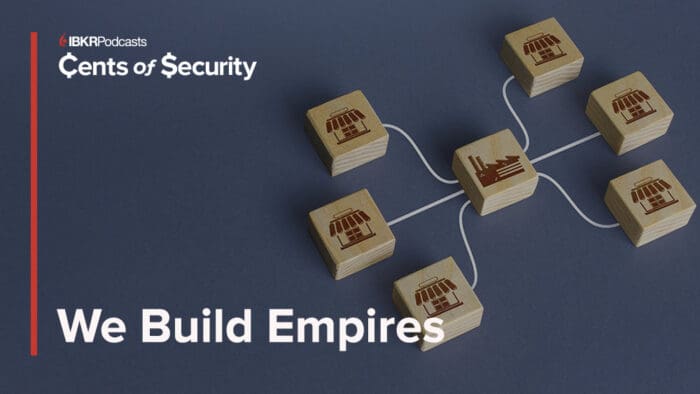
When researching a company, you can sometimes be surprised to find that the company is part of a larger group called a holding company. What is the structure of the holding company? What is reason of joining a holding company? We cover all of that and more! Russell Burns, Analyst at Finimize joins Cassidy Clement to discuss.
The following is a summary of a live audio recording and may contain errors in spelling or grammar. Although IBKR has edited for clarity no material changes have been made.
Welcome back to the Cents of Security Podcast. I’m Cassidy Clement, senior manager of SEO and Content and Interactive Brokers, and today I’m your host for the podcast. Our guest is Russell Burns, Analyst at Finimize.
When researching a company, you can sometimes be surprised to find that the company is actually part of a larger group that’s called a holding company. What is the structure of a holding company and what exactly is the reason that a company would join a larger one such as a holding company? Today we’re going to cover all of that and more.
Welcome to the program Russell.
Hi, good to be here.
So, since this is your first episode on Cents of Security, why don’t you tell the listeners a little bit about your background in the industry, how you got started, et cetera.
Sure. So, I’ve worked in financial markets for about 30 years, mainly in investment banks and joined as a global analyst. Just over a year ago, for the first 20 years or so, I focused on Japan and was based in Tokyo for a few years. But over the last 10 years expanded to global markets. I focused on long short investing, special situations, and holding companies, and that’s one reason why I’m happy to be joining you today.
Yeah. Awesome. So, holding companies are exactly what we’re looking for today’s topic. So, when you’re looking at holding companies, a lot of people would be surprised to see how many companies make up those larger holding companies or things of that nature.
But what exactly is it? How do they operate and work?
Are they like a public company or are they private? I guess the root of this question is could retail investors actually invest in holding companies such as a stock investment?
Yeah, very much look, the holding companies can be public or private, listed and unlisted. So, the unlisted type of private equity firms will often use a holding company structure to manage their investments in portfolio companies. But as you said, for the purposes of this conversation and the listeners, it’s probably better to focus on the publicly listed ones as they’re easier to invest in.
What are some of the popular ones that we see in the day-to-day when it comes to financial commentary or the news?
Yeah, I mean there’s a couple of large ones, you can find listed holding companies all around the world. A couple of the largest one in the states would be Berkshire Hathaway. That owns a diverse range of businesses, including a hundred percent ownership and insurance and railroad companies.
But it also has many minority states and companies like Apple, Bank of America and Coke. And next up you’ve got Alphabet. It set up a holding company structure in 2015. As part of this restructuring of Google, it acts as the parent company provides strategic direction, resource allocation and oversight across the portfolio of companies, including Google, YouTube, and self-driving taxi company Waymo.
And then you can looking cross to Japan. One of the biggest holding companies is SoftBank. Whose founder gained infamy with a $20 million investment when he bought 30% of Alibaba back in 2000, and the stake was valued at around $57 billion when it listed on the New York Stock Exchange in 2015. Now it’s out of Alibaba, but it with now it’s out of Alibaba, but its investments are still focused on AI tech and telco companies.
It’s currently the lead financier in the rollout of the $500 billion Stargate Project in the US. And then moving across to Europe, you have Prosus. Prosus was set up by Naspers in 2019. Nasper’s again was lucky. It held a big investment in Tencent that it bought originally back in 2001, and now it’s become the second biggest company in China.
And it wanted to find a way to realize the value as Nasper’s was trading a significant discount to its net asset value. And net asset value is like you add up all the assets of a company has minus the debts, and that’s how you get to the net asset value. So, to try to reduce that discount, it transferred ownership of those internet assets of it transferred ownership of its internet assets, including Tencent, to process a newly created company that it listed in Europe.
Tencent remains. Prosus is key asset accounting for around 80% of its net asset value. And finally, just one more to add. In the UK there’s three. It’s an investment company specializing in private equity and infrastructure but also operates as a holding company. It’s listed on the FTSE 100. Its recent success has been driven by its investment in action at leading European non-food discount retailer, which has grown to become its largest holding.
In its portfolio accounting for approximately 70% of its net asset value, and there’s a common thread here. It’s quite typical that one investment can turn out to be really successful and become a key part of the holding company’s net asset value.
It’s interesting that you mention that because as I’m listening to you speak. It almost seems as if the holding companies function as a portfolio almost, but it’s a company with a lot more complexity. And you’re talking about how these different levels or percentages of investments kind of work in the way of somebody balancing something like a portfolio.
When it comes down to that, and there may be different levels of balance or dilution from different times. What exactly are the pros and cons associated?
So, what exactly are the pros and cons associated?
Yeah, you covered quite a lot in that. In that bit there, Cassidy. So, I got to try and go about, some holding companies will have a diverse portfolio and other times it can be very concentrated with one or two holding. So, in a Berkshire Hathaway you get a really diverse mix of businesses, mainly into the US also in Japan.
But you know that success was being driven really by Warren Buffet and his team and being exceptional investors. Investing in a holding company can also be a way to buy assets on the cheap. As holding companies can often trade a discount to their net asset value.
So, investing in a holding company can also be a way to buy assets on the sheet as the holding company can trade at a discount to its net asset value. I suppose another advantage is the reduction of liability risk because each subsidiary company within a portfolio typically has a separate legal status.
So, problem in one doesn’t really undermine the overall risk of the other. But it’s not as straightforward as that because when you are buying a holding company, the performance of one subsidiary can impact the entire group’s net asset value. So, you could invest in a holding company for a specific asset, it holds, but the actual returns are undermined by unexpected losses elsewhere.
So, you touched on concentration risks. That, you may buy, take a holding in a company, which because you like the asset that holds, but sometimes, the management makes mistakes and losses appear elsewhere and undermine the returns for that year. So that’s always a risk of investing in a holding company.
But one of the other disadvantages, I suppose the advantage of buying a holding company when it’s got a discount to NAV is you are buying things at a cheap value, but that discount to NAV can widen. Because there’s no guarantee that discounts to NAV, cheap things get cheaper and get cheaper.
And that’s typically because the holding company may be owned or run by a founder or the founder’s family and they’re not really interested in what minority investors think about. So that’s why there’s advantages if you can take a larger stake and control what’s going on. So that’s definitely a drawback of buying things at a discount to nav.
Just because they’re cheap doesn’t mean that they can’t get cheaper.
So, when you were touching on the complexity element a lot of things that showed up in my research was how sometimes this is looked at as a potential. Disadvantage or something that you really have to pay close attention to because it’s akin to trying to do 10 things at once, trying to watch 10 TV shows at once, trying to run in 10 different directions.
But does it ever rear its head in the way of being a jack of all trade, master of none because these companies are trying to orchestrate in almost several different sectors simultaneously.
Sure. I think, you touch on that about the idea. Similar to a holding company, you get conglomerate discounts. So, any company that doesn’t have a focus on one specific area and has a mix of businesses that it just trades at a discount to, it’s now because that value may never get realized. So, unless the company unwinds all its assets, it will stay at that discount.
Yeah, that’s definitely a big point that I’m seeing, especially when it comes to some of the historical trends, at least, because as you mentioned about some of the focus as it changes over time, when it comes to, let’s say nowadays AI and tech is a very heavily interested. A lot of people have a lot of high interest in that area.
They see it as an area for growth. But when we are working with a holding company or you investigate a holding company for what their structure is, is it ever that, the truth or the realized findings that you see that maybe their money ends up in the long wrong places? Their allocation ends up being incorrect because they may have been jumping the gun, or maybe they’re looking for an area of growth that’s not as realized as.
The rest of the world sees it. I guess something that comes to mind for me is several years ago, way before the AI craze, VR and AR, virtual reality and augmented reality was supposed to be this crazy wave that all of these tech companies and holding companies were trying to ride. And it just didn’t turn out to be that way.
Think about how many people have Metas. AR VR goggles these days, or Apples. They’re very expensive and they’re not adopted as quickly as forecasted.
So slightly different from the holding up of it, but definitely look, when it comes to tech and development, these companies can invest in, and this, these cases were billions into a technology that didn’t work. I suppose with all these entrepreneurial ideas; there’s no guarantee of success.
So, it’s not like a startup or a VC fund where they’re investing in one company that you know may go bankrupt. The beauty of having those balance sheets where they didn’t have to take on loads of debt and leverage to make it happen, the risk was they could afford to finance it. Yes, it was a me, an expensive mistake, especially for Meta that time and Apple with the investment in the cars which backed out, and the VR headsets for lights, Sony, whichever they, or Apple, they, it happens, but unless they try, they don’t always succeed.
So, I think that’s part of it as well. And now with AI, you’ve got, who’s winning the race, what will Apple do? They’ve chosen not to develop. Are they going to go and buy Perplexity or somewhere to build that part out? But yeah, there’s, yeah. There’s risk in investing always.
Yeah, the, what’s interesting to me is this AI space race, if you will, right now, that’s happening of who’s going to take the crown, who’s going to really be winning this race in the end? And that kind of leads me to my next question, which is. The conflict-of-interest area. So as you start to incorporate all of these different companies and all of these different, we’ll say pieces that come together to make larger products, because let’s say you own a company that makes, you know widget one, that becomes part of something utilized in company two, are there regulatory complexities that come in here?
Because it seems like there could be a potential conflict of interest if you are starting to acquire all these different companies.
Big companies are always going to buy smaller ones if they can see the growth potential for it. That’s there. You do have regulators, FTC to come in to stop certain conflicts coming in with controlled monopoly. You’ve got the Google breakup now on search there’s definitely some, there’s potential conflict of monopoly interests, too much controlled in the hands of a few, ethical issues as well, but potentially with AI of who’s making the actual decisions or what’s coming out on the output, and to be careful with it. Part of capitalism though, is that people, companies, small companies are successful, and they get bought up by, by bigger ones.
Whether it’s in pharmaceuticals, companies can’t develop themselves, or big techs finds out a small tech company and they like the, I like it that I always Google bought YouTube for a billion dollars, I don’t know the exact number off the top, but for a billion dollars in sales and now it’s worth multiples of that.
At the time it looked like they were overpaying, but then it’s turned out to be a great investment. But I get your point with AI there’s a lot of moving parts there. It’s very hard for regulators to stay ahead of a trend when even the greatest minds in tech and investing are still trying to figure it out for themselves.
You brought up some great points today, Russell. Thanks so much for joining us. Yeah, of course. So as always, listeners can learn more about an array of financial topics for free at interactivebrokers.com slash campus.
Feel free to leave us a rating or review and follow us on your favorite podcast network. Thanks for listening, everyone.
Information posted on IBKR Campus that is provided by third-parties does NOT constitute a recommendation that you should contract for the services of that third party. Third-party participants who contribute to IBKR Campus are independent of Interactive Brokers and Interactive Brokers does not make any representations or warranties concerning the services offered, their past or future performance, or the accuracy of the information provided by the third party. Past performance is no guarantee of future results.
This material is from Finimize and is being posted with its permission. The views expressed in this material are solely those of the author and/or Finimize and Interactive Brokers is not endorsing or recommending any investment or trading discussed in the material. This material is not and should not be construed as an offer to buy or sell any security. It should not be construed as research or investment advice or a recommendation to buy, sell or hold any security or commodity. This material does not and is not intended to take into account the particular financial conditions, investment objectives or requirements of individual customers. Before acting on this material, you should consider whether it is suitable for your particular circumstances and, as necessary, seek professional advice.












Join The Conversation
For specific platform feedback and suggestions, please submit it directly to our team using these instructions.
If you have an account-specific question or concern, please reach out to Client Services.
We encourage you to look through our FAQs before posting. Your question may already be covered!