
- Solve real problems with our hands-on interface
- Progress from basic puts and calls to advanced strategies
Interactive Options Course
Posted December 30, 2025 at 1:57 pm
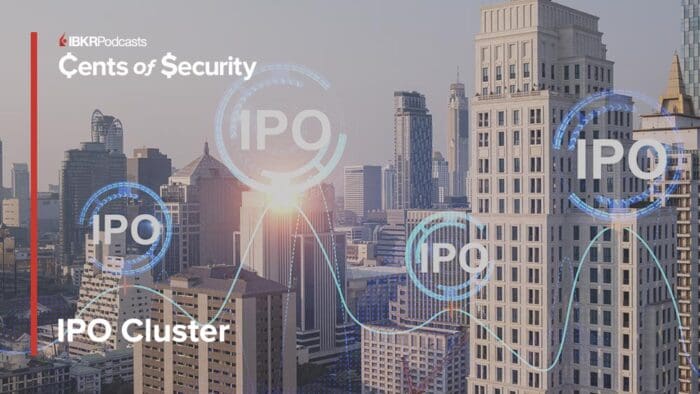
In this Cents of Security podcast, I’m joined by Jeffrey Fidelman, CEO of Fidelman & Company, to unpack what’s really driving today’s IPO pipeline—and how founders should think about fundraising in an AI‑first world.
The following is a summary of a live audio recording and may contain errors in spelling or grammar. Although IBKR has edited for clarity no material changes have been made.
Hello everybody and welcome back to Cents of Security Podcast. I’m here today with Jeffrey Fidelman, a Fidelman and Company, a CEO. So, Jeffrey, welcome. Thank you, co, for coming back to the studio. Why don’t you tell everybody about yourself a little bit if they haven’t watched the two prior IPO podcast?
Thank you so much for having me again, Mary. My background was in banking, both at Morgan Stanley and HSBC. Then at a venture fund and in 2015 we ended up launching what is now an investment bank, specifically focused on early-stage companies and emerging managers. And over the past 10 years, we’ve grown to about 40 individuals all remote all over US and Canada. And today we offer fundraise as a service, which is effectively productized fundraising for all of our clients.
So what sectors are dominating IPO activity right now, and how does this compare to historical trends?
I think a lot of the sectors that are currently dominating the IPO market, as thin as it has been, are around picks and ax’s infrastructure. Something that I think I spoke about probably on the last or maybe the first podcast that we did data centers, AI infrastructure, compute and especially power.
I can say that from our banking perspective, we’ve seen close to half a dozen different energy companies, whether they are energy installers and contractors, or actually technologies around how to create energy from nuclear to fusion and fission. I think we’re going to see a lot more in the energy space as well as compute continues to the demand for compute rather continues to overexert the supply and we just need compute, and what compute needs is energy.
So how have macroeconomic factors such as interest rates, inflation and global growth impacted IPO valuations and investors’ appetites.
I think answering maybe backwards that investors have continued to have appetite across the stages, across the chain. Where you have later stage investors that have put capital into these companies a number of years ago that are waiting for a liquidity event and retail investors or funds that are looking to participate in their offerings, knowing that a lot of these companies that are going through IPOs are really growth companies as opposed to a company going IPO already at its value stage and maintaining from a more macroeconomic perspective, interest rates, came down and probably will continue to come down certain basis points. Anywhere from 50 to a hundred, I believe, not before the end of the year, but certainly into quarter one or quarter two of next year. That will just accelerate additional demand as capital becomes cheaper. Borrowing will likely increase, especially with those that have stores of cash, and they’ll just be able to reinvest that capital.
And taking aside the bigger names that are being traded. I do think that there is a significant demand just from a technological infrastructure perspective around energy.
So what role are private equity and venture capital firms playing in this new pipeline?
I think that the majority of liquidity events that have been happening more recently were through the private markets, so a company being acquired, and m and a activity being done, a roll of strategy being enacted. I do think that a lot of those companies are getting to a certain point in size. Where large, you would have to go to a larger and larger private equity firm until you can’t possibly go any larger and you would have to tap the public markets in order to get that liquidity out. So as private equity and venture capital funds have grown so too has the delay around companies going public because they can always or often can seek an exit through another equity acquisition through another private equity venture capital or corporate acquisition that they can go through. And now that private companies are getting larger and faster, I think the public markets are just a natural outlet for them to gain liquidity.
So, in your opinion, how has regulatory scrutiny or geopolitical risk influenced cross-border IPOs and listings on major exchanges? For instance, our companies favoring US markets over Hong Kong or London. And why?
As much as I hate giving the answer, it depends. It really depends on where the company is either domiciled or where the majority of its business is being held. I think that US markets continue to outpace all others in terms of IPO activity as well as growth and growth potential. We have seen a lot of companies that were not domiciled in the US go through the route of either taking an IPO in Hong Kong or Singapore or somewhere else or just staying private for a little bit longer to see how both tariff situations resolve as well as general geopolitical risk.
All right. Last question before we get into the meat of our conversation, and that is, what is the outlook for IPO performance post listing our newly public companies outperforming or underperforming benchmarks.
I think it that, that question has maybe two answers. I was always at the school of thought that when a company goes public, it should move, but not by a margin of, I don’t know, more than let’s say 10%, 15%, 20% at most. And what we’ve been seeing is a lot of companies going public and skyrocketing incredibly.
And I’m not sure if that’s a sign of it being mispriced and going public where there’s a lot of money being left on the table, either for existing investors management or otherwise, or it’s a sign of so much pent up retail demand that when the company does go public and it was not possible to buy into it by prior to either through secondaries or exposure through funds, you have a huge amount of retail investors piling into these companies because they also believe in this general mindset of a continued market growth. A lot of the retail investors now, especially with the transition of wealth, haven’t really lived through a recession quite yet. Or maybe they were early on in, in their professional careers or certainly investing careers, and it’s been up into the right for a very long time.
Not to say that there’s necessarily a correction or anything along those lines, but I think it’s easy to buy into kind of the cycle when everything seemingly continues to go up.
So, Jeff, what is the commoditization of fundraising?
I believe that especially with the advent of AI, there were two buckets that I would always put fundraising into or the way that you could fundraise with a third party or otherwise. And with AI there’s now a third and prior to. Aside from the do-it-yourself methodology, you had different types of platforms, which effectively crowdfunding platforms that would post your offering to a group of investors and really rely on you to invest in marketing dollars to go out and raise that capital.
Then you have certain advisors, assuming that they’re licensed, which are typically one, two a small handful of individuals that really rely on their phone books and rolodexes to go out to their investors to have them invest in your opportunity but although you being the client and now there’s a number of platforms that are AI driven, which promise this outreach or matching algorithm and then promise mass outreach to a number of investors getting you more responses or maybe more meetings.
And you have this movement towards commoditization or even productization of capital raising or fundraising, and I think that all too often people are looking for the quick and easy fix where in certain industries and may arguably in many or most industries or most avenues of life, there is no quick and easy fix. People are starting to really push back and see that, and I’m speaking with a number of individuals, both clients and otherwise, that have used these AI platforms or used this, product as the over productization of raising capital that is too automated or too AI driven and it’s not working and it’s not working for a variety of reasons, both from a domain reputation perspective and too high of a volume of outreach, but also this lack of human connection which oftentimes investors are looking for, and investors in earlier stage need that human connection to the founders and the management team. But I would argue that investors, even in public equities or private fixed income or anything else, are always looking for some sort of connection. That they believe in a company, that they believe in its growth or its value, or whatever the case may be.
So, with all of this commoditization, it’s really restricting the humanization of raising capital, especially at an early stage. The commoditization is very ineffective, or when it is, it’s few and far in between that makes sense. The AI thing is so much better, right? In the old days it was about handshakes. Let’s go out to dinner or let’s go do this, and then afterwards we shake on it. Let’s try to make this thing work, and so on, so forth.
So, it’s like the pendulum, right? It’s has to go from, let’s meet and greet and talk. Versus this whole other thing. Let’s say I figure out a way that’s even better, and now maybe a more balanced approach. A little bit of AI, a little bit of let’s meet and talk it out, right?
I think AI can be very helpful in supplementing that those activities but there is something that we were all told in school that if you write down, notes or when you’re studying, you’ll learn it more.
There’s a certain benefit in going through a process that ultimately prepares you for the main event or the presentation. And a lot of times when we are working with a client and helping them put together their investor materials, we have them intimately involved in that process because it’s important for the founder to know why every period was on each page and why it was there and why each graph was there.
Same thing with financial modeling, and same thing really, when our analysts are reaching out to investors. They have had tools that we’ve built for them in the past and we’ve found that makes them more efficient but less effective. And I’d rather focus on effectivity of their spending 90 seconds on clicking on an investor’s LinkedIn and their socials and their company page, aligning their messaging with the investor philosophy or investment thesis of that fund, and then doing the outreach and that extra 90 seconds, one 20 seconds, which we were trying to eliminate. Didn’t really realize until we did, how absolutely important that is for an analyst to go through, at least on our side, before even reaching out to an investor.
Okay. So, in the old days it seemed like you would come up with a pitch deck and then possibly somebody would want to see a demo of your platform, your system or understand more of how it works, right? Does that even still occur?
From an investor perspective, absolutely. Quite frankly, from my perspective as well. I always try to understand how a client is positioning themselves. How the platform works in order to put together the right copy and the right outreach and list of investors. But oftentimes, I’ve found that being proactive when you’re speaking with investors is very helpful and leads ultimately to a higher likelihood of success, where you have your pitch and then at the end of it, yes, you always ask for money but you also propose to have a demo, especially if it’s some sort of SaaS or tech product or service that you want to show them and having them go through the demo and having them understand how it works will hopefully better align them with your product and vision and ultimately investment.
Got it. So that’s when they’re more likely to invest is after the demo, I would think.
Yes, and in today’s day and age, especially with vibe coding platforms like Replit or Lovable it’s not acceptable to be going out to raise dollars of $100,000 or $150,000 to build a platform. It’s relatively inexpensive enough besides bandwidth and some dollars that need to be paid for subscriptions to these platforms.
Okay, so as we come to a close, is there anything else you want to drive home about this topic?
I am cautiously optimistic around what’s what, how this year will end 2025, and how next year 2026 will shape up from an IPO perspective, the market seems to be. Packed. And barring any kind of geopolitical or any types of events, which we all know may or may not happen we’ll see. I expect a very strong IPO market in the beginning half of the year.
I think that leads to more dollars in investors’ pockets, coupled with where inflation is and other investment opportunities, at least that I’ve been seeing on our end. From a firm, I think there’ll be a lot of capital reinvested into private markets. And a lot of times just statistically speaking, it trickles down into early stage as well.
Awesome. I can’t wait to hear about it. Can’t wait for the new year, want to hear about all those new ideas out there percolating and I just want to thank you once again, Jeffrey Fidelman, CEO of Fidelman and Company for joining us today.
Thank you so much.
Thank you again, Mary.
Information posted on IBKR Campus that is provided by third-parties does NOT constitute a recommendation that you should contract for the services of that third party. Third-party participants who contribute to IBKR Campus are independent of Interactive Brokers and Interactive Brokers does not make any representations or warranties concerning the services offered, their past or future performance, or the accuracy of the information provided by the third party. Past performance is no guarantee of future results.
This material is from Fidelman & Co. and is being posted with its permission. The views expressed in this material are solely those of the author and/or Fidelman & Co. and Interactive Brokers is not endorsing or recommending any investment or trading discussed in the material. This material is not and should not be construed as an offer to buy or sell any security. It should not be construed as research or investment advice or a recommendation to buy, sell or hold any security or commodity. This material does not and is not intended to take into account the particular financial conditions, investment objectives or requirements of individual customers. Before acting on this material, you should consider whether it is suitable for your particular circumstances and, as necessary, seek professional advice.
IPO investments carry substantial risks including extreme price volatility, limited operating history, lack of liquidity, potential for significant losses, and uncertainty regarding future performance.
Alternative investments can be highly illiquid, are speculative and may not be suitable for all investors. Investing in Alternative investments is only intended for experienced and sophisticated investors who have a high risk tolerance. Investors should carefully review and consider potential risks before investing. Significant risks may include but are not limited to the loss of all or a portion of an investment due to leverage; lack of liquidity; volatility of returns; restrictions on transferring of interests in a fund; lower diversification; complex tax structures; reduced regulation and higher fees.











Join The Conversation
For specific platform feedback and suggestions, please submit it directly to our team using these instructions.
If you have an account-specific question or concern, please reach out to Client Services.
We encourage you to look through our FAQs before posting. Your question may already be covered!