
- Solve real problems with our hands-on interface
- Progress from basic puts and calls to advanced strategies
Interactive Options Course

Posted November 5, 2025 at 1:04 pm
The article “Matching Engines in 3 Minutes: Terminology Guide for Traders and Developers” by Databento was originally posted on Medium Databento.
This guide is intended for traders, researchers, and engineers who are involved in algorithmic trading. It’s also useful for network and systems engineers who are making their first foray into financial trading infrastructure.
These are key terms that you’ll find useful in navigating colocation and server hosting for a trading system, and also in describing how your system interacts with a trading venue’s matching engine.
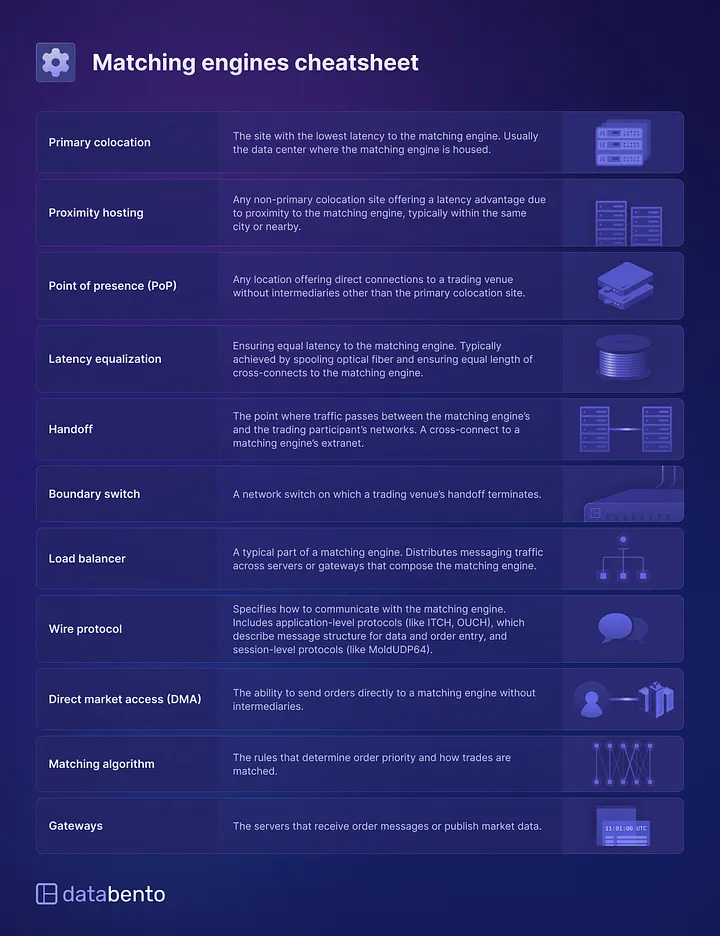
Primary colocation. The site with the lowest latency to the matching engine. Usually the data center where the matching engine is housed, but this is not always the case—some venues only allow connectivity outside of the data center where their matching engine resides. For example, NYSE’s primary colocation site is in NYSE’s Mahwah data center.
Proximity hosting. Any non-primary colocation site offering a latency advantage due to proximity to the matching engine, typically within the same city or nearby. For example, any hosting location in New York or New Jersey could be considered a proximity hosting site for Nasdaq, whose primary colocation is in Carteret.
Point of presence (PoP). Any location offering direct connections to a trading venue without intermediaries other than the primary colocation site. For example, EBS has PoPs in Secaucus and Slough.
Latency equalization. Ensuring equal latency to the matching engine. Typically achieved by spooling optical fiber and ensuring equal length of cross-connects to the matching engine. Also called fiber equalization.
Handoff. The point where traffic passes between the matching engine’s and the trading participant’s networks. A cross-connect to a matching engine’s extranet.
Boundary switch. A network switch on which a trading venue’s handoff terminates.
Load balancer. A typical part of a matching engine. Distributes messaging traffic across servers or gateways that compose the matching engine.
Wire protocol. Specifies how to communicate with the matching engine. In financial trading environments, this often refers interchangeably to any communication protocol, and not only the physical and data link layers (OSI layers 1 and 2) as the term “wire” seems to imply. Includes application-level protocols (like ITCH, OUCH), which describe message structure for data and order entry, and session-level protocols (like MoldUDP64).
Direct market access (DMA). The ability to send orders directly to a matching engine without intermediaries.
Matching algorithm. The rules that determine order priority and how trades are matched. Examples include pure FIFO, pro rata, and price-broker-time.
Gateways. The servers that receive order messages or publish market data.
Information posted on IBKR Campus that is provided by third-parties does NOT constitute a recommendation that you should contract for the services of that third party. Third-party participants who contribute to IBKR Campus are independent of Interactive Brokers and Interactive Brokers does not make any representations or warranties concerning the services offered, their past or future performance, or the accuracy of the information provided by the third party. Past performance is no guarantee of future results.
This material is from Databento and is being posted with its permission. The views expressed in this material are solely those of the author and/or Databento and Interactive Brokers is not endorsing or recommending any investment or trading discussed in the material. This material is not and should not be construed as an offer to buy or sell any security. It should not be construed as research or investment advice or a recommendation to buy, sell or hold any security or commodity. This material does not and is not intended to take into account the particular financial conditions, investment objectives or requirements of individual customers. Before acting on this material, you should consider whether it is suitable for your particular circumstances and, as necessary, seek professional advice.












Join The Conversation
For specific platform feedback and suggestions, please submit it directly to our team using these instructions.
If you have an account-specific question or concern, please reach out to Client Services.
We encourage you to look through our FAQs before posting. Your question may already be covered!