
- Solve real problems with our hands-on interface
- Progress from basic puts and calls to advanced strategies
Interactive Options Course

Posted November 7, 2024 at 12:16 pm
Learn about Algo Trading Strategies with Part I.
To learn algorithmic trading, you can follow these key steps:
1. Build the skills and knowledge needed for algorithmic trading such as:
2. Choose Learning Resources:
Books: You can begin with the free books such as:
Recommended read:
Free Resources to Learn Algorithmic Trading | A Compiled List
For a more in-depth understanding, consider taking algorithmic trading courses that offer comprehensive training and hands-on experience in the field.
3. Hands-On Experience:
4. Advanced Learning and Continuous Improvement: Stay updated with industry trends and continuously refine your skills while getting started with algorithmic trading. Join professional networks and communities to learn from experienced practitioners.
Let us now see the workflow of algorithmic trading next.
Coming to the “Understanding of the Workflow”, it is a concept that explains how each trade gets placed using algorithms behind the scenes.
Historically, manual trading used to be prevalent, in which, the trader was required to gather the data manually and place the order telephonically for the execution of the trade. That would involve a lot of time and effort and hence, not make much of returns since not much of trading could take place.
Now with Algorithmic trading coming into existence, the entire process of gathering market data till placement of the order for execution of trade has become automated.
Coming to how a quantitative analyst goes about implementing algorithmic trade, here is a simplified diagram:
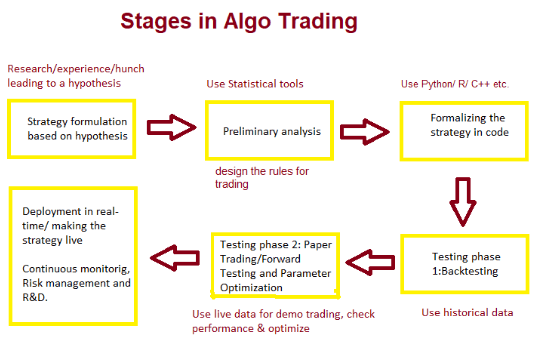
The image above shows how a quant implements algorithmic trade.
In the first step, you will need to do research or get some experience leading to a hypothesis. That is how your strategy formulation will be based on the hypothesis you set.
Then in the second step, with the help of preliminary analysis and usage of statistical tools, the rules are designed for trading.
In the third step, the strategy is formalised in coded language using one of the languages namely, Python/R/C++. This is done for the system/computerised trading platform to understand the strategy in a language that is understandable to it.
Now, in the fourth step, Testing phase 1 is done through backtesting, in which historical price information is taken into consideration. In this, the strategy is tested using historical data to understand how well the logic would have worked if you used this in the past. This way, the performance of the strategy is tested. Also, depending on the results you get the opportunity to optimise the strategy and its parameters.
Then, the fifth step is Testing phase 2 in which the testing of strategy happens in the real environment. In this, you do not need to invest actual money but it still provides you with a very accurate and precise result. Hence, with this, one can expect to get the results which may also come about in the actual environment. The only drawback is that it is a time-consuming activity but you can do this by using the feature provided by the broker. Alternatively, you can also develop your framework to test the game.
The sixth step involves deployment in the real environment, which requires multiple facets to be managed, which are generally not considered in backtesting.
Functionally, the following aspects are required to be managed:
Technically, the following aspects are required to be managed:
Visit QuantInsti to watch the video on using Python trading bots to backtest a trading strategy.
Next, let us check out how to build your algorithmic trading desk.
For setting up your algorithmic trading desk, you will need a few things in place and here is a list of the same.
Now we will see some advantages of algorithmic trading.
Here are some of the advantages of algorithmic trading.
Recommended read:
How much salary does a quant earn?
Let us move to the disadvantages of algorithmic trading now.
Below you can see the disadvantages of algorithmic trading.
Recommended read:
Now we will see the recent developments and potential future trends surrounding algorithmic trading.
In India, around 50-55% of trades are currently executed through algo trading, and this figure is expected to grow by 15% in the coming years.
Robo-advisory services utilise algorithms to deliver financial advice and handle portfolio management with little to no human input, making financial planning more affordable and efficient for a wider range of clients. The global robo-advisory market is projected to grow to $41.07 billion by 2027. ⁽⁵⁾
The influence of AI algorithmic trading on the stock market is expected to increase. Software developers are likely to create more advanced and faster algorithms capable of analysing larger datasets. These systems will improve at detecting intricate patterns, swiftly adapting to market changes, and adjusting trading strategies in real-time. This trend may lead to AI trading becoming a dominant force in financial markets, potentially consolidating power among a few firms with the most advanced technology. ⁽⁶⁾
The algorithmic trading business is sure to offer you an advanced system of trading. With the apt knowledge, regular compliances and regulations, an algorithmic trading platform is the fastest choice amongst traders.
In case you are also interested in developing lifelong skills that will always assist you in improving your trading strategies. In this algo trading course, you will be trained in statistics & econometrics, programming, machine learning, and quantitative trading strategies and methods, so you are proficient in every skill necessary to excel in quantitative & algorithmic trading. Learn more about the EPAT course now!
Originally posted on QuantInsti blog.
Information posted on IBKR Campus that is provided by third-parties does NOT constitute a recommendation that you should contract for the services of that third party. Third-party participants who contribute to IBKR Campus are independent of Interactive Brokers and Interactive Brokers does not make any representations or warranties concerning the services offered, their past or future performance, or the accuracy of the information provided by the third party. Past performance is no guarantee of future results.
This material is from QuantInsti and is being posted with its permission. The views expressed in this material are solely those of the author and/or QuantInsti and Interactive Brokers is not endorsing or recommending any investment or trading discussed in the material. This material is not and should not be construed as an offer to buy or sell any security. It should not be construed as research or investment advice or a recommendation to buy, sell or hold any security or commodity. This material does not and is not intended to take into account the particular financial conditions, investment objectives or requirements of individual customers. Before acting on this material, you should consider whether it is suitable for your particular circumstances and, as necessary, seek professional advice.












Join The Conversation
For specific platform feedback and suggestions, please submit it directly to our team using these instructions.
If you have an account-specific question or concern, please reach out to Client Services.
We encourage you to look through our FAQs before posting. Your question may already be covered!