
- Solve real problems with our hands-on interface
- Progress from basic puts and calls to advanced strategies
Interactive Options Course

Posted September 28, 2026 at 1:21 pm
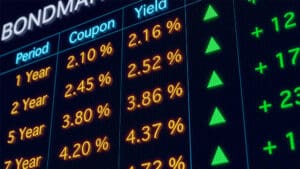
The ongoing Washington and Tehran impasse is roiling markets to start the week, as yields soar further into the nosebleeds. The geopolitical premium bolstering oil prices is worrying Wall Street that the Fed will meaningfully tighten monetary policy to constrain inflation. Fixed income is also facing the challenges of robust growth, substantial budget deficits and a corporate borrowing binge tied to AI. Shifting demographics that are increasingly favoring risk assets in portfolios rather than credit are also weighing on bonds, albeit to a lesser extent. President Trump’s disagreements with his Iranian counterpart are concerning investors that this conflict could be long lasting, creating a headwind for government debt and stocks for an extended period of time. Emblematic of this nervousness is a Treasury curve that is jumping by almost 10 basis points across maturities and exceeding recent highs, while the four major equity benchmarks and all 11 principal sectors and subcategories minus energy related groups are declining. Similarly, commodities are selling off broadly with the exception of crude, while cryptocurrencies are sinking in response to tighter financial conditions that are currently benefiting both the greenback and volatility protection instruments that appreciate when turbulence hits. Elsewhere, prediction markets are catching bids.
Any evidence later this week that elevated fuel charges and soaring interest rates are weakening labor market momentum could lift slowdown worries and lure buyers to Treasurys. We have a packed economic calendar as we close out the month, with equities now flat for September and a plethora of employment numbers set to hit the wire. Still, the geopolitical backdrop is poised to be the predominant factor driving markets in the coming days, and there’s certainly runway for a significant rally in stocks and especially fixed income if signs of progress emerge from the Middle East. Meanwhile, October is geared to have investors worry about another substantial risk for Wall Street, as rising chances of a blue wave in November could drive concerns of AI regulation tempering corporate earnings growth.
China’s industrial profit growth slowed in August with anemic domestic demand outweighing the dramatic jump of the communications and electronics manufacturing sector. Profits were up 4.2% year over year (y/y), a deceleration from July’s 11.2% jump, according to the National Bureau of Statistics. For the first eight months of 2026, profits expanded 15.7%, a decline from 17.6% year to date as of the end of July. China has been heavily dependent on exports to sustain its industrial sector at a time when domestic demand is low. Among various sectors, computers, communication equipment and other equipment manufacturing profits jumped 110% year to date as of August with foreign firms buying technology for implementing AI services. More domestic-focused sectors illustrated the impact of weak spending by Chinese consumers with profits for the wine, beverages and refined tea manufacturing category sinking 34.7% year to date. The disappointing earnings occurred despite industrial production growing 5.2% y/y last month, which exceeded both the economist consensus estimate for a 4.8% increase and July’s 4.5% growth. For the first eight months of this year, however, output was up 5.3% y/y, an unchanged rate from the year-to-date period that ended in July.
August wholesale price pressures in Japan accelerated on a y/y basis but climbed at a slightly slower monthly pace than in July, according to the Corporate Services Producer Price Index. Prices were 3.7% higher than in August 2025 following July’s 3.6% y/y ascent. Economists expected an unchanged annual rate. Conversely, month-over-month (m/m) inflation, at 0.3%, eased from 0.4% in July. Within the m/m metric, transportation and postal activities became 0.8% more costly. Domestic air travel tickets became 8.1% more expensive as airlines passed higher fuel costs onto customers. Ocean freight travel and travel arrangement services, furthermore, were up 4.7% and 3%. When excluding international transportation, the m/m gauge was up only 0.2%.
Other broad categories with increases and the extent of their price changes were as follows:
The other services category reflected the impact of hotels becoming 4.9% more expensive. Also in August, the advertising services category experienced a 2.4% decline. Invoices for television and radio advertising reflected a 5.6% drop in fees while the internet, newspaper, magazine and other advertising group sank 0.6%.
Industrial production in Singapore was up 15.4% y/y during August following July’s 6.9% annualized gain, but it contracted by 0.5% m/m. The m/m 0.5% decline, furthermore, was disappointing when compared to July’s 2.3% expansion. The m/m result was driven by a drop in the somewhat volatile biomedical manufacturing sector. Indeed, when excluding that component, the m/m headline was up 5.8%. In July, output ex-biotech was elevated only 0.8% m/m. Separately, the y/y gain was supported by 28.5% and 33.9% northward movement in output by the electronics and precision engineering clusters. The former category benefited from production of infocomms and consumer electronics products and semiconductors growing 66.3% and 26.1%. In precision engineering, production associated with machinery and systems soared 39.2%. Transport engineering and biotech output also contributed to the annual increase with production expanding 9.5% and 0.4%, respectively. The chemicals industry was the only area to post a decline with output contracting 12.7% y/y. Plant maintenance limited petroleum output and softer demand and feedstock supply disruptions curtailed activities among petrochemicals companies.
New to Interactive Brokers?
Open AccountInformation posted on IBKR Campus that is provided by third-parties does NOT constitute a recommendation that you should contract for the services of that third party. Third-party participants who contribute to IBKR Campus are independent of Interactive Brokers and Interactive Brokers does not make any representations or warranties concerning the services offered, their past or future performance, or the accuracy of the information provided by the third party. Past performance is no guarantee of future results.
This material is from IBKR Macroeconomics, an affiliate of Interactive Brokers LLC, and is being posted with its permission. The views expressed in this material are solely those of the author and/or IBKR Macroeconomics and Interactive Brokers is not endorsing or recommending any investment or trading discussed in the material. This material is not and should not be construed as an offer to buy or sell any security. It should not be construed as research or investment advice or a recommendation to buy, sell or hold any security or commodity. This material does not and is not intended to take into account the particular financial conditions, investment objectives or requirements of individual customers. Before acting on this material, you should consider whether it is suitable for your particular circumstances and, as necessary, seek professional advice.
Futures, event contracts, and forecast contracts are not suitable for all investors. Before trading these products, please read the CFTC Risk Disclosure. For a copy, visit our Warnings and Disclosures Page.
Trading in digital assets, including cryptocurrencies, is especially risky and is only for individuals with a high risk tolerance and the financial ability to sustain losses. Eligibility to trade in digital asset products may vary based on jurisdiction.
Related Articles

















Join The Conversation
For specific platform feedback and suggestions, please submit it directly to our team using these instructions.
If you have an account-specific question or concern, please reach out to Client Services.
We encourage you to look through our FAQs before posting. Your question may already be covered!