
- Solve real problems with our hands-on interface
- Progress from basic puts and calls to advanced strategies
Interactive Options Course

Posted August 10, 2026 at 11:03 am
What does it really take to build a successful career on a trading desk? Xheni Brahaxhija shares her journey from compliance to front-office trading while discussing the critical role of access, mentorship, sponsorship, and leadership in creating opportunities and helping more women thrive in financial markets.
The following is a summary of a live audio recording and may contain errors in spelling or grammar. Although IBKR has edited for clarity no material changes have been made.
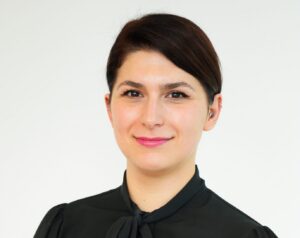
Welcome to another episode of IBKR Podcasts. I’m Maria Dieguez, working in the Institutional Sales team and based in our London office. Our guest today is Xheni Brahaxhija, she’s a rates and inflation trader at Marex.
Her journey from post-communist Albania to United World Colleges and into financial markets has shaped her views on ambition, access, and opportunity. She’s passionate about the role of education, mentorship, and sponsorship in helping more women enter, grow, and succeed in front office careers.
Xheni, it’s a pleasure to have you with us today.
Hey, Maria. Thank you so much for having me. It’s a real pleasure to be part of this conversation and share my perspective.
Mm-hmm. It’s not common to find women in trading roles within the financial sector. How did you end up in this role? Can you tell us a little bit more about your journey?
Yeah. Well, definitely my career was not a straight line. I started at Marex eight years ago in compliance, so I did not begin in front office. But, as an international student at the time, I was very clear on one thing. First, I needed to get in. And I trusted myself that once I was inside the business, I would learn, build relationships, and eventually make it on a trading desk.
And I would say that mindset came from much earlier on. So as you mentioned, I grew up in Albania and a society that was still quite patriarchal, but education was always treated as the great equalizer. So I would say whether you were a boy or a girl, you were expected to work hard and excel. And then I went into study at the United World Colleges. This was an experience that truly shaped me. And UWC is built around the idea that where you come from should not determine where you end up. Your background is a starting point. It does not have to be your ceiling. And moving on to Marex, you know, I treated every role as a way to move closer to the market.
And funny enough, each week I would spend time with a different broking trading sales desk, you know. I really wanted to learn how products were priced, what moved them, where risks sat, and how trades flew from one point to the other through the business. And moving, I would say moving in market risk was a turning point. I had a great manager who invested in me, helped me technically, taught me how to navigate the organization and open doors. And by then trading actually felt like the natural transition. But I would say the route was not as obvious. I remember being in the kitchen and I ran into the head of trading, of energy and he asked me, you know, “What, what’s going on? What are you doing with your life?” And I was joking and I said, “You know, making my seventh cup of coffee, for the day.” And he looked at me like completely deadpan and he said, “You know, there are two trading desks being built. You should look into them.” You know, I needed the direction.
But I would say direction only matters if you act on it. So I followed up, I put myself forward and eventually I joined the swaps desk. I was very fortunate that the desk, to join the desk during its building phase. So I not only learned about products, pricing and risk, but also the infrastructure needed to run a desk from front to back. And it showed me that trading is not just what happens on screen. There’s an entire ecosystem built behind every trade eventually. And that conversation truly stayed with me because I learned that somebody can actually point you towards a door, but you still have to walk through it. So I would say talent matters, but talent without access and sometimes without direction can actually remain invisible.
And you mentioned that you would sit for an hour with different teams to learn. Were they willing to share that time with you? Weren’t they too busy to dedicate time to you? I think it, it speaks quite highly about the people in your company.
Yeah. That is something I always appreciated about Merit. People are incredibly approachable and collaborative. You know, at first, coming from compliance, I would get the occasional suspicious look, you know, “Why is compliance sitting next to me?” But once they realized I genuinely was curious about the product and the market they open up, they share stories, they explain, you know, how they thought, and if they did not know the answer, they’d always point me towards somebody who did. So yes, you know, they were busy, but I found that people were willing to make time when they saw that the curiosity was genuine and I respected their time. So it speaks, you know, highly of the people, but also of the culture. Knowledge was not treated, or still not treated as something to be guarded. People, you know, who are willing to share it with somebody who shows real interest and is prepared to learn.
So that experience taught me that access is not way always offered formally. You know, sometimes it can be created by asking a thoughtful question and earning people’s trust on the way.
Mm-hmm. And what challenge have you faced or do you think women commonly face in this type of front office roles?
Well, you know, even when I first started, I would say even today, the first challenge is not, you know, proving that you can do the job. Is getting to, is getting people to picture you on that seat in the first place. You know, as women do remain underrepresented in trading. So when you get there, you’re not only reading the market, you’re also reading the room.
So I would say this is embedded, like, since early on because many women are taught to work hard and trust that, you know, their hard work will speak for itself. But your work does not walk into a promotion meeting and speak for you. You have to. So being good is essential but is not enough. People need to associate your name with judgment, ideas, and commercial value. And I recently come to learn that, you know, visibility is not vanity. It’s part of how trust is built. And many talented women out there wait until they feel completely ready before putting themselves forward. And I understand why, because when you are one of the few, the margin of error can feel way smaller. So there, rather than simply telling women to be more confident we all should ask, you know, who’s being developed? Who’s being backed? Who’s being allowed to take risks, make mistakes, recover, and grow? Because confidence often comes from after somebody has been given the opportunity and not before that.
Mm-hmm. And how do you think that the challenge you have described can be overcome?
I would say, you know, there are two levers to this. The self-leadership part and the actual leadership responsibility. By self-leadership I mean owning my own development. So making, you know, make your ambitions visible. Know what your strengths are. Be honest what you need to do in order to learn. And ask for feedback. You know, put your hand up for stretch assignments. Build relationships before you need something. You know, it also means that you’re not waiting until you feel 100% ready. But at the same time, we cannot turn this into a– we cannot turn a structural issue into a woman’s self-improvement project. You know, this is where leadership comes in, and it matters enormously. Leaders decide who gets visibility, who gets credit, who gets stretched, and who gets sponsored. And that is where I would say culture is created, and not through slogans, but through actual decisions. Also this industry sometimes sells the myth of the self-made trader. I personally do not buy into that. You know, performance matters, but nobody has built so far careers alone. At some stage, somebody has taught you, trusted you, or given you the opportunity. Careers are shaped by teams, managers, sponsors, and the culture around you. So good cultures do not lower the bar. They make sure that talented people have a fair chance to reach it.
Mm-hmm. And what are the key factors that help women overcome these barriers?
Well, for me, there are four pillars to this: education, mentorship, sponsorship, and community. You know, education gives you the competence to do your job. Mentorship gives you judgment, and sponsorship gives you access, opens doors. But community is the one that gives you that momentum. And to wrap this up, you know, self-leadership activates all four. So in markets, competence is non-negotiable. You need to know your product, you need to know your risk, your macro context, and your technicals. But on a trading desk, who you learn from matters enormously, especially in your early career. Your manager may be your most important teacher, not simply the person who gives you reviews for your performance, right? So you can study curves, pricing risk, and the macro environment, but an experienced trader has more than 20 years of pattern recognition and market intuition.
And honestly, no textbook in the world can give you that. They are the ones that know when a move matters, when it makes noise, when to add risk, and when to actually step back and what the flow or liquidity may be telling them. So I would say a great manager makes that sort of thinking visible. They explain what are they seeing and why. They give you room to ask question, take controlled risk, make mistakes, and learn from them. And they can teach you how to truly think like a trader. So who you sit next to and who invests time in you can shape the trader you actually become. But I would say, you know, do not wait for the perfect mentor to appear.
Seek people out inside and outside your organization. Most firms have a internal mentoring program, so use them. External organizations such as Women in Financial Markets are the community that can connect you to different perspective, experiences, networks. You know, mentorship does not always begin by asking, “Will you be my mentor?”
You know, start with a conversation, ask a specific question, listen and act on the advice, and follow up, you know, how it’s going. I would say the stronger mentorship relationships are built over time through curiosity, consistency, and trust, you know. But sponsorship is completely different. You know, a mentor says, you know, “Here’s how I would think about you. Like, here is my rationale behind this thinking.” Whereas the sponsor says, you know, “Put Xheni in the room.” Mentorship is seen as guidance, where sponsorship is actual advocacy. And many career-defining decisions actually happen when you’re not in the room, when leaders are deciding who is ready and who gets the exposure. And then there comes in the community part. Again, this is why I’m such a vocal supporter of Women in Financial Markets. WiFIM creates visibility, connection, and access to women at different stages in their career. So personally, like seeing someone several steps ahead has changed the question from, you know, can somebody like me do this, to how do I get there? And I would say the goal is not to create women who can survive every single barrier alone and break every single glass ceiling. It should be to create environments where talent is developed, is noticed, backed, and trusted, because giving somebody the seat is not enough. You have to give them access to the whole experience.
Mm-hmm. So many takeaways from today’s conversation, Xheni. I wanna try to summarize some of them. I would say that there is no single route into trading, so determination and strategic career moves matter. Learning beyond your immediate job description can significantly expand career opportunities. Success requires both a strong performance and visibility. The issue is often access and support, not a lack of ambition or confidence. Leadership and culture are essential for career development. Talent thrives when companies intentionally create the conditions for success. Mentors have helped people grow, a sponsor help people advance, and professional networks can accelerate development and create opportunities.
Xheni, thank you so much for sharing your experience and perspective as a trader. It’s been a thought-provoking and enlightening conversation, and I’m sure our listeners will take away a great deal from your journey and insights.
Thank you, Maria. It’s truly been a pleasure.
Thank you. And thank you to everyone listening. We hope you enjoyed this episode of IBKR Podcast, and see you next time.
The analysis in this material is provided for information only and is not and should not be construed as an offer to sell or the solicitation of an offer to buy any security. To the extent that this material discusses general market activity, industry or sector trends or other broad-based economic or political conditions, it should not be construed as research or investment advice. To the extent that it includes references to specific securities, commodities, currencies, or other instruments, those references do not constitute a recommendation by IBKR to buy, sell or hold such investments. This material does not and is not intended to take into account the particular financial conditions, investment objectives or requirements of individual customers. Before acting on this material, you should consider whether it is suitable for your particular circumstances and, as necessary, seek professional advice.
The views and opinions expressed herein are those of the author and do not necessarily reflect the views of Interactive Brokers, its affiliates, or its employees.










Join The Conversation
For specific platform feedback and suggestions, please submit it directly to our team using these instructions.
If you have an account-specific question or concern, please reach out to Client Services.
We encourage you to look through our FAQs before posting. Your question may already be covered!