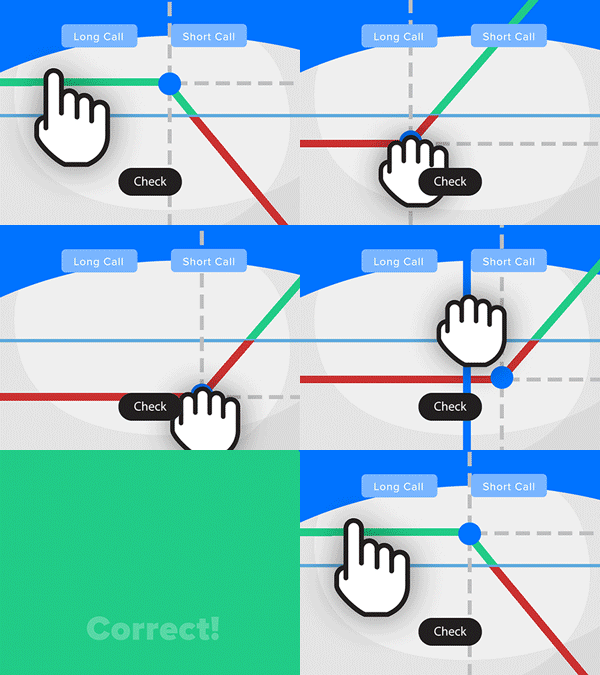
- Solve real problems with our hands-on interface
- Progress from basic puts and calls to advanced strategies
Interactive Options Course

Posted May 12, 2026 at 10:30 am
What do strong Q1 company profits tell us about the health of the consumer?
We’re approximately two-thirds of the way through earnings season, and first-quarter results have been very strong, with 84% of companies in the S&P 500 exceeding estimates and earnings per share (EPS) growth among the best we’ve seen over the past five years.1 Notably, this performance has not been limited to Technology; Energy, for instance, has also done particularly well. While many observers have been looking for signs that higher oil prices may be taking a toll on the consumer, so far, that hasn’t been the case. There has been some forward guidance mentioning that inflation could potentially impact investors’ pocketbooks and therefore cut into profits. But this was more of a footnote than a warning, and not at all comparable to the big caveats we saw with the tariff situation a year ago. Frankly, we were surprised not to see more companies hedge a bit with respect to future inflation. But so far, companies are not considering it a major risk, and some firms’ growth forecasts have actually gone up. The ‘K-shaped’ economy– in which different segments of the economy diverge sharply—is one factor, as higher-income consumers will be impacted less by energy inflation. Furthermore, they will also benefit from the higher returns coming from the stock market. But even in Consumer Staples earnings reports, we’re not seeing any major warnings signs, and planned tax cuts in the U.S. are also likely to help relieve some of lower-end consumers’ pain. In our view, it is this lack of negative forward guidance that is allowing the stock market to take off. If strong earnings beats were being offset by cautious guidance, then markets’ reaction may have been muted. But with strong earnings and few caveats, stocks have been able to realize more of their near-term upside potential.
Bottom line: Negative impacts of higher oil prices on consumers may emerge over the next couple of quarters, but so far, companies have not felt compelled to highlight them as a key risk.
Historically, the airline industry has been challenging to invest in. Coming out of COVID, it got a significant boost as people looked to travel more. But as we’re seeing now with the impact of higher oil prices, it is a business that is sensitive to many potential disruptions. Soaring jet fuel prices are causing some airlines, including Air Canada, to cancel routes,2 while European airlines are being forced to deal with the dual problems of potential fuel shortages and regulations that require them to reimburse travelers for cancelled flights even if they’re caused by fuel supply issues.3 At least a couple of airlines are reportedly looking for mergers, and we’ve already seen U.S. low-budget carrier Spirit Airlines go out of business. This is an important story to monitor for both investors and travelers. So far, the oil shock hasn’t had much impact on travel volume, in part because people who really want to travel are willing to absorb the higher cost, as they did post-pandemic. However, if people are being hit both on the cost of flights and at the gas pump, they may reach a breaking point where demand does fall off. It all depends on how long higher energy prices last. What is certain is that airlines’ pre-conflict cost expectations are no longer accurate, which impacts the business case for some of their services. Looking ahead, if we get to a stage where airline stock prices are severely depressed but oil prices have moderated, we would consider it an opportunity for a short-term, tactical trade. However, while many airlines have seen their stock prices fall, we would not yet consider them to be depressed, and overall uncertainty remains high.
Bottom line: So far, the surge in jet fuel prices is affecting airlines more from a stock perspective than from the standpoint of consumer demand—but that could change if higher prices persist.
Prediction markets like Kalshi have been attracting increasing amounts of money and are even courting institutional investors. But can these platforms serve as a useful tool in investment processes, or even as a destination for capital? At this stage, platforms like Kalshi are more like betting markets than anything else, in our view, and we have not spent a lot of time evaluating them as an investment tool. However, they are a good bellwether for the beliefs people have—when they think the U.S.-Iran situation might end, for example. If users of the platform expect the conflict to be resolved in one-to-two months and we think it will be sooner, then we can expect a potential upside surprise. As such, we can use the options markets more effectively, including more precise sizing of our positions. We will never make a decision solely off of insights gained from prediction markets, but they can serve as a good source of intel. Currently, these platforms tend to be better at predicting political decisions than financial or macroeconomic outcomes, but we will continue to monitor their development as they move into new areas like commodity markets.
Bottom line: While prediction markets are not currently a major part of our investment processes, they do provide some useful insights on how people are thinking.
For a detailed breakdown of our portfolio positioning, check out the latest BMO GAM House View Report .
—
Originally Posted May 11, 2026 – Jet fuel costs are rising. Time to buy airlines?
Commissions, management fees and expenses all may be associated with investments in exchange traded funds. Please read the ETF Facts or prospectus of the BMO ETFs before investing. Exchange traded funds are not guaranteed, their values change frequently and past performance may not be repeated.
For a summary of the risks of an investment in the BMO ETFs, please see the specific risks set out in the BMO ETF’s prospectus. BMO ETFs trade like stocks, fluctuate in market value and may trade at a discount to their net asset value, which may increase the risk of loss. Distributions are not guaranteed and are subject to change and/or elimination.
BMO ETFs are managed by BMO Asset Management Inc., which is an investment fund manager and a portfolio manager, and a separate legal entity from Bank of Montreal.
®/™Registered trade-marks/trade-mark of Bank of Montreal, used under licence.
Information posted on IBKR Campus that is provided by third-parties does NOT constitute a recommendation that you should contract for the services of that third party. Third-party participants who contribute to IBKR Campus are independent of Interactive Brokers and Interactive Brokers does not make any representations or warranties concerning the services offered, their past or future performance, or the accuracy of the information provided by the third party. Past performance is no guarantee of future results.
This material is from BMO Exchange Traded Funds and is being posted with its permission. The views expressed in this material are solely those of the author and/or BMO Exchange Traded Funds and Interactive Brokers is not endorsing or recommending any investment or trading discussed in the material. This material is not and should not be construed as an offer to buy or sell any security. It should not be construed as research or investment advice or a recommendation to buy, sell or hold any security or commodity. This material does not and is not intended to take into account the particular financial conditions, investment objectives or requirements of individual customers. Before acting on this material, you should consider whether it is suitable for your particular circumstances and, as necessary, seek professional advice.
Related Articles
















Join The Conversation
For specific platform feedback and suggestions, please submit it directly to our team using these instructions.
If you have an account-specific question or concern, please reach out to Client Services.
We encourage you to look through our FAQs before posting. Your question may already be covered!