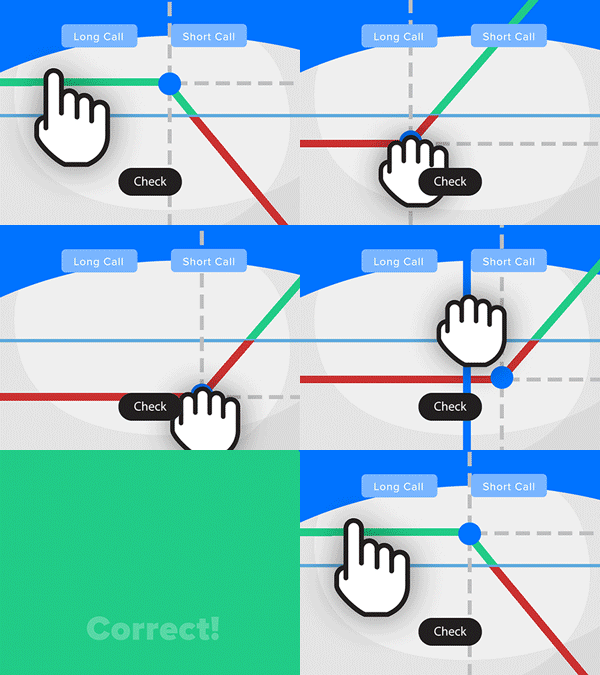
- Solve real problems with our hands-on interface
- Progress from basic puts and calls to advanced strategies
Interactive Options Course
Posted October 16, 2025 at 1:18 pm
Market Chameleon’s Dmitry Pargamanik and Will McBride join Jeff Praissman in the IBKR Podcast Studio to break down one of the most talked-about options strategies: the credit put spread. They discuss how traders use it to define risk, manage volatility, and capture steady income — plus how data, probabilities, and timing play into successful execution.
The following is a summary of a live audio recording and may contain errors in spelling or grammar. Although IBKR has edited for clarity no material changes have been made.
Hey everyone, this is Jeff Praissman with the Interactive Brokers Podcast. It’s my pleasure to welcome back to the IBKR Podcast Studio from Market Chameleon, Will McBride and Dmitry Pargamanik. Hey guys, how are you?
Hey Jeff. Thanks for having us.
Hey Jeff. Thanks for having us. It’s always a pleasure.
Love having you guys in. You know, we just finished up a great webinar talking about credit put spreads, and I’m excited to have you in the studio to do maybe a deeper or just a different dive on it. So, I’m gonna kick it off for you guys.
For our listeners who may be new to option strategies, could you break down exactly what a credit put spread is and why it’s becoming such a popular strategy among retail traders?
Yeah, so the credit put spread is a strategy that involves two legs. You’re selling a put on one strike and then buying a put on the strike below, in the same expiration. This allows you to trade with defined risk. You’re selling one option, but you want to define your risk, so you buy another option to stop you out at a certain point.
When comparing credit put spreads to other bullish strategies like buying calls or selling naked puts, what specific advantages make these credit spreads stand out in terms of risk management?
Yeah. The difference is—they happen to all be bullish, the ones you described: buying calls, selling naked puts, or using credit put spreads. But there are advantages and disadvantages to each. What makes credit put spreads stand out is: when you buy a call, you’re paying for an option—it’s a net debit, you’re buying premium. Some traders prefer to sell premium or sell implied volatility. When you go to the other side to express a bullish viewpoint, you could sell a put or an out-of-the-money put. There, you have risk—if the stock goes against you, you have undefined risk all the way down if the stock goes to zero. So you have a lot of risk. The credit put spread, by contrast, uses two options, and this allows you to predefine your risk at the outset of the trade. If you sell one put and buy another put below it, you know that the most that spread can be worth is the difference between the strikes—$5 for a $5-wide spread, $10 for a $10-wide spread, etc.
So, knowing how much you’re selling it for ahead of time and what the max value can be allows you to predefine that risk right at the start of the trade.
And during the webinar—which, for our listeners, if you missed it, you can always find recorded copies on our website under Education—you mentioned that credit put spreads can be structured either near the money or out of the money.
Could you walk us through how these different approaches impact the risk/reward profiles, and when a trader might choose one over the other?
Yeah. When we look at options, we have different strikes, and we compare those strikes to where the stock price is.
A put spread that’s further away from the stock—downside strikes—is an out-of-the-money put spread. For that spread to have value at expiration, the stock has to decrease enough to move that spread into the money. An at-the-money put spread, on the other hand, is where you’re selling the strike roughly where the stock is and buying another strike below it. Even if the stock falls a little bit, that spread will start to go into the money. The difference is: when you’re selling an out-of-the-money put spread, you’re going to get less premium, because the stock needs to fall further before that spread gains value. You have that cushion—that buffer zone—before it moves against you. With an at-the-money spread, you don’t have that same cushion, but you’ll potentially get more reward because you’re selling a higher premium.
Right, so really—with at-the-money—you have a higher chance it might expire at full value, but it’s going to cost you more. Out-of-the-money, you’ve got less chance, but also less likelihood of being exercised or assigned depending on which side you’re on.
Right.
And you know, when you’re looking—obviously traders like metrics, right? That’s a key part of this: research and data. So, what are the most critical metrics that they focus on when screening for credit put spread opportunities, and why are they more important than, say, other data points?
Yeah, I don’t know if there are metrics that are more important than others, because it depends. Each metric is telling you something different—it’s different information and how you factor it into your overall assessment of the trade.
One of the ones we discussed recently is how far away you are—how much cushion you have—in a put spread. Other metrics you could use are how much liquidity there is: are the options you’re looking at showing a lot of volume, do they have open interest? This helps with price discovery, liquidity, and execution when getting in or out of a spread.
Then you have valuation models—where’s the market price relative to a theoretical value or benchmark, and how far is it deviated from that theoretical value? Some other metrics are probabilities or theoretical probabilities of success—whether the spread finishes in the money or out of the money, profitable or unprofitable. There are many different types of metrics to look at, and again, I can’t say one is more important than the others in the sense of “don’t worry about these, just look at this,” because each metric tells you something different. And it’s important if you need that information.
Right. And I would think it also just depends on the trader themselves and their portfolio and position to begin with, right? There are going to be certain metrics that—let’s say we’re doing the same trade—but if we have different portfolios, I might be looking at metrics one, two, and three and saying, “Okay, judging by what I have, these are probably the most important points for whether I want to do it or not.” And then you might be looking at the same trade with a different position, focusing on metrics five, six, and seven, saying, “No, these are the most important for my situation.” So it’s pretty fluid, depending on where you’re at, where you want to go, and what you’re trying to accomplish.
Yes, exactly. It could be because of your unique circumstances—and like you said, both sides of the trade. That trade could fit differently depending on what they need to do and what they’re looking for overall in their portfolio.
And, you know, historical win rates seem to be a key component of the screening process as well. How are they calculated—and obviously they’re based on the past, right—so how predictive are they of future success?
Yeah, and it’s a good question. When we look at a strategy or a trade, we start evaluating it from the perspective of how likely this trade or strategy is to succeed given the conditions. We look at it from a historical point of view because, obviously, we don’t know what this option will be worth a month from now. If we did, it would be very easy.
What we try to do is get a sense of how likely something was to happen in the past—not because it’s guaranteed to happen again, but to understand the realm of possibility.
I’ll give you an example: we were talking about football before this started, and you might ask, “What are the statistics or metrics of a kicker making a field goal from 50 yards away?” We could say, well, the last three times he tried it, he was successful. Does that mean the next three times he’ll be successful? Not necessarily. We can’t conclude that because he did it three times in a row, he’ll do it again three times in a row or forever. And in addition, the factors might not be the same—wind, health, field conditions, etc. But what that allows us to do is come up with an idea of the realm of possibility. If you ask someone, “Will he be able to hit from 50 yards away?” you could look at historical data just to get an idea of how good he’s been in the past. It helps guide your decision-making—it’s one factor, a piece of information, a quick reference point when making those decisions.
And, you know, we’re coming up on earnings season next week. We have the big banks—J.P. Morgan, Bank of America, and so forth—coming out, I think, on the 14th. So it seems like a timely question to ask: how do you recommend incorporating corporate events like earnings announcements in this credit put spread screening process?
Are there specific adjustments you make to the criteria or the volatility?
Yeah, that’s a good question—and it ties into the previous example. When you’re making a comparison or an evaluation, you’re trying to find similar situations in the past so you can analyze them properly. Like we said before—if you ask how successful a kicker is from 50 yards away, that’s the condition. From 20 yards away, he’ll likely be much more successful. The same applies with options and events like earnings, which create more volatility. More volatility means the stock could move more sharply, increasing the probability of reaching further strikes compared to a period without earnings. So, when we’re looking at something like a credit put spread and trying to evaluate whether we’re getting a reasonable premium given the conditions, we’d have to look back historically at periods with similar conditions—specifically ones that included earnings or corporate events—to make the evaluation more fair and accurate.
And, you know, sometimes I think one thing traders kind of struggle with—especially ones new to options—is realizing that you don’t need to hold an option to expiration, right? Part of it too is buying, selling, or closing out a position. And I think a lot of times people struggle with determining the optimal time to exit a position—in this case, a credit put spread. Do you have any exit strategies you’ve found more effective based on historical analysis?
Well, I think entering and exiting positions involves so many factors, like we were just discussing. And, as you mentioned, it will be unique to the person and their position. Sometimes you may have, let’s say, a credit put spread that you sold for one reason—and something changed. The conditions changed, the reason changed—and you might want to exit just for that reason, whether it’s profitable or unprofitable. Or, you might reassess what you thought it was worth at the time you traded versus what you think it’s worth now, or how it fits into your portfolio overall.
Sometimes even when you have a contract or position on, it serves your overall portfolio by reducing risk—and that might be necessary. You might actually be profiting from it, but you still need that option because it balances out your risk. If it does that, then by exiting it you might actually increase your risk, which you don’t want to do. So there are lots of different scenarios and factors when it comes to managing your overall portfolio risk and deciding whether to exit or enter. Sometimes you’re exiting because you found a better opportunity—and by exiting, you’re freeing up funds for that next opportunity. So it’s very dynamic and unique. That’s just part of managing risk and trading.
Got it, got it. And then to pivot a little bit—oftentimes technical analysis and option strategies go hand in hand for at least certain traders. Are there any specific technical indicators that you’ve found work particularly well when screening for credit put spreads?
So, technical analysis has more to do with analyzing stock behavior—how the stock is moving. You’re looking at the stock’s behavior using different technical indicators just to get a sense of volatility or directionality. You’re really looking at it from a historical standpoint to understand how that stock behaves, what it’s been doing, and whether that fits your outlook for the stock. It’s just another metric or assistive tool, but it mainly has to do with analyzing the stock itself.
And, you know, obviously volatility plays such a crucial role in option pricing. How does your screening approach adapt to different market volatility regimes? Are there adjustments you make during extremely high or low volatility? And, as you mentioned before, these credit spreads involve buying one option and selling another. So it’s a little different than a single option, since they offset each other a bit—but obviously, different strikes have different volatility. So even with that offset, they can still diverge or converge depending on the period of time, I would assume.
Yeah, that’s a good question too. When we look at selling one option and buying another, besides managing directional risk, you’re also offsetting some of your Vega risk. You’re selling implied volatility and then hedging it by buying implied volatility. If implied volatility goes down, while you’re short one and long the other, they offset. If volatility goes up, you’re still long one and short one—again, offsetting. That’s one of the advantages of doing a spread, because if you just buy one option, you have full exposure to long Vega. If you sell one option, you have full exposure to short Vega.
So one of the benefits of buying and selling together is that you’re reducing that risk—hedging some of it off.
The relationship between the two options also matters. There’s usually some correlation; one isn’t just going to skyrocket while the other goes to zero. That relationship can be tested historically to see where it stands today versus historical benchmarks. As for overall volatility—yes, the options will move with it. You’ll likely get more premium near the money as implied volatility rises. But the benefit is that you can hedge or offset some of that Vega and implied volatility risk through the spread.
Got it. Well, Dmitry, this has been great. Are there any final thoughts you’d like to leave with our listeners?
Yeah, I think when you’re looking at trading—especially for people who’ve just started trading and are looking at buying or selling a call or a put—the very next stage is to move on to a two-legged spread: a call spread or a put spread.
Just understanding the benefits of the spread—how and when you could use it, and how to evaluate it—becomes very important. A lot of times, it helps you achieve what you’re trying to do with defined risk.
Ah, great. And once again, for our listeners, Dmitry and Will from Market Chameleon—you can find a lot of great webinars and past podcasts on our site. Also, check them out—they have a morning YouTube show, I believe at nine o’clock, guys? Or 9:30 Eastern Time?
Nine.
Nine o’clock. Great. So check out their YouTube channel. Well, for now, that’s all. Thanks, guys—really appreciate it.
Thanks, Jeff. Always a great job, D.
The analysis in this material is provided for information only and is not and should not be construed as an offer to sell or the solicitation of an offer to buy any security. To the extent that this material discusses general market activity, industry or sector trends or other broad-based economic or political conditions, it should not be construed as research or investment advice. To the extent that it includes references to specific securities, commodities, currencies, or other instruments, those references do not constitute a recommendation by IBKR to buy, sell or hold such investments. This material does not and is not intended to take into account the particular financial conditions, investment objectives or requirements of individual customers. Before acting on this material, you should consider whether it is suitable for your particular circumstances and, as necessary, seek professional advice.
The views and opinions expressed herein are those of the author and do not necessarily reflect the views of Interactive Brokers, its affiliates, or its employees.
The information provided on MarketChameleon is for educational and informational purposes only. It should not be considered as financial or investment advice. Trading and investing in financial markets involve risks, and individuals should carefully consider their own financial situation and consult with a professional advisor before making any investment decisions. MarketChameleon does not guarantee the accuracy, completeness, or reliability of the information provided, and users acknowledge that any reliance on such information is at their own risk. MarketChameleon is not responsible for any losses or damages resulting from the use of the platform or the information provided therein. The 7-day free trial is offered for evaluation purposes only, and users are under no obligation to continue using the service after the trial period.
Options involve risk and are not suitable for all investors. For information on the uses and risks of options, you can obtain a copy of the Options Clearing Corporation risk disclosure document titled Characteristics and Risks of Standardized Options by going to the following link ibkr.com/occ. Multiple leg strategies, including spreads, will incur multiple transaction costs.















Join The Conversation
For specific platform feedback and suggestions, please submit it directly to our team using these instructions.
If you have an account-specific question or concern, please reach out to Client Services.
We encourage you to look through our FAQs before posting. Your question may already be covered!