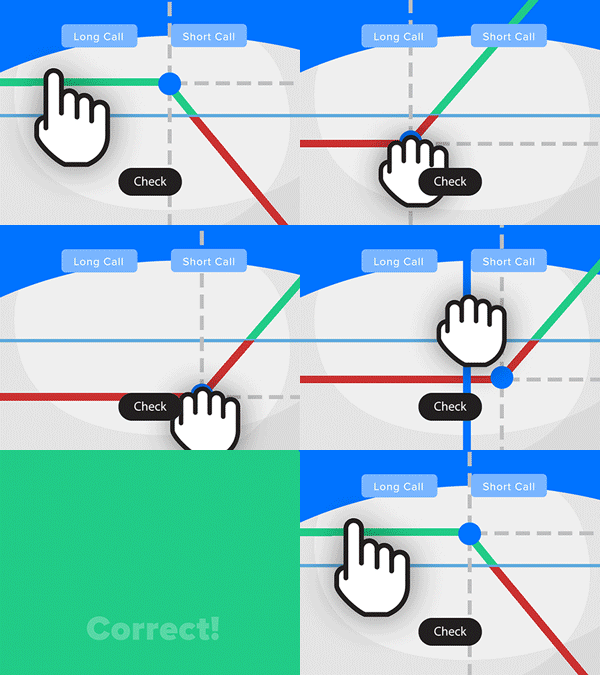
- Solve real problems with our hands-on interface
- Progress from basic puts and calls to advanced strategies
Interactive Options Course

Posted October 29, 2026 at 2:30 pm

Tech stocks are getting hammered after Google and Microsoft disappointed shareholders during their earnings calls with heavy AI capex bills weighing on free cash flows and calling into question whether the monumental investments will prove to be worth it. The uncertain capital return prospects of the massive outlays amid ongoing financing efforts via stock and debt issuance, is sending the Nasdaq lower by over 1.5% as Wall Street worries about a potential slowdown ahead. The deceleration concerns, a patient Fed Chair Warsh yesterday afternoon and falling oil prices stemming from Middle East deescalation attempts are driving bids for Treasuries, and those slipping interest rates paired with better-than-anticipated GDP and unemployment claim data is serving to bolster the cyclical trade. Indeed, the small-cap Russell 2000 is gaining by more than 1.3%, as 9 of the 11 principal sectors appreciate in the session as participants try to get a broadening going. The curve is descending in bull-steepening fashion led by the monetary policy sensitive shorter tenors, as the October presser featured an emphasis on wanting to keep growth buoyant, signaling a committee that likely won’t hike against the backdrop of deteriorating sentiment for the AI expansion. Elsewhere, commodities are declining across the board, cryptocurrencies and the greenback are flat and volatility protection instruments are seeing cheapening premiums.
GDP Runs At Fastest Pace of 2026
The US economy expanded at an annualized rate of 3.4% in the third quarter, as the AI expenditure boom drove the fastest acceleration in a year. Economists anticipated Gross Domestic Product (GDP) to come in at 3.2%, which would have also been higher than the prior period’s 2.2%. Consumer spending, business investment, private inventories and government disbursements contributed 2.5%, 1.8%, 1.6% and 0.9% to the headline number, while residential outlays and net exports subtracted 0.1% and 3.3%. Had it not been for the surge in imports, performance would have been much better, however, those foreign materials are integral to the data-center build-out.

Consumers Dip Into Savings as Energy Bites
The Fed’s preferred inflation gauge came in exactly as expected last month and didn’t offer surprises to investors. The Personal Consumption Expenditures (PCE) price indices reflected increases of 0.5% and 0.3% month over month (m/m) across the headline and core categories, accelerating from August’s 0.3% on the former while sustaining an equal pace on the latter. Year over year (y/y) figures came in at 3.6% and 3.1%, ahead of the prior period’s 3.4% and 3%. The cost pressures compelled households to draw into their savings, as incomes expanded 0.2% m/m while spending rose 0.5%, versus projections of 0.3% and 0.6% and the previous report’s 0.3% and 0.9%. Indeed, the personal savings rate fell to a 47-month low of 3.8%. Outlays and charges were dominated by energy products, as higher fuel bit a greater chunk of household budgets.
Claims Remain Near Historical Lows
Labor conditions remained stable in the past two weeks as unemployment claims decreased and arrived beneath expectations. Initial and continuing filings slipped to 194k and 1.701 million during the weeks ended Oct. 24 and 17, arriving under the 199k and 1.720 million anticipated and the prior period’s 195k and 1.722 million. Four-week moving averages were little changed at 196.75k and 1.710 million, versus the previous interval’s 198k on the former and unchanged on the latter.
Is Midterm Risk Priced In?
With the midterm elections approaching this Tuesday, the expectation of a blue wave is worrying investors of a politically driven AI slowdown, where the democratic party attempts to lift oversight and tighten regulations on the main driver of economic growth and the bull market in stocks in recent years. The potential for a deceleration in the modern technology’s build-out is the reason why the Nasdaq 100 is trading almost 7% off of its record high reached less than 4 weeks ago. The big question heading into the event, however, is whether that’s enough of a haircut in light of the possible trouble on the horizon, or if further downside is warranted if both chambers of Congress flip. In consideration of the substantial decline in interest rates amounting to more than 40 basis points at the long-end in a short time span alongside still buoyant earnings projections, Wall Street is likely too fearful here, especially when considering a patient Fed and robust GDP numbers that support an equity broadening. Moreover, if the AI trade fizzles out and the drop in yields extends, the cyclical momentum in the economy is certainly supportive of the baton being passed to the Dow Jones Industrial and Russell 2000 benchmarks, which should limit the damage at the index level stemming from the semis and the Mag7 facing steep share price decreases under that scenario.
International Roundup
ECB Holds Steady, But Pres. Announces Departure
The European Central Bank (ECB) kept interest rates unchanged this morning after raising in June and September. Officials decided to stay on hold and evaluate the impact of their previous hikes before lifting again. Additionally, energy costs aren’t spreading to the overall economy materially at this juncture, which strengthened the case for keeping the benchmark steady. Growth has been a concern on the continent too, and policymakers didn’t want to tighten too much into an energy shock and face greater risk of recession. During the event, the audience learned that President Christine Lagarde is stepping down in February, roughly 9 months before her term ends as she stated “”I don’t think that I can remain neutral; I don’t think that I can be comfortable in that neutrality, at the present time. I’m interested in the truth, and I see the truth being very often damaged, contradicted by misrepresentation, and from the position that I have had for the last 20-plus years of my life… there are things that I can say. Whether people will listen or not is another story, but I feel that I should say those things. Voilà.”
South Korea Sentiment Strengthens
Gauges of business and economic conditions in South Korea strengthened broadly this month with the Composite Business Sentiment Index (CBSI), which covers all industries, hitting 104.2, up 5.1 points from the preceding month. The Economic Sentiment Index, which combines results of the business metric and a Consumer Survey print, furthermore, was 9 points higher than in September. At 100.8, it hit its highest level since at least April, when it recorded a 91.7 result.
According to the Bank of Korea, the CBSI headwinds were 1-point and 6-point declines in the manufacturing segment’s business conditions and inventories groups. After climbing to 82 in July, the category fell 1 and 2 and two points in August and September. Production, new orders and financial situations offset those results by posting gains of 5, 4 and 2 points, respectively.
Unlike manufacturing, the non-manufacturing sectors benefited from every segment strengthening by the following amounts:
New to Interactive Brokers?
Open AccountFutures, event contracts, and forecast contracts are not suitable for all investors. Before trading these products, please read the CFTC Risk Disclosure. For a copy, visit our Warnings and Disclosures Page.
Trading in digital assets, including cryptocurrencies, is especially risky and is only for individuals with a high risk tolerance and the financial ability to sustain losses. Eligibility to trade in digital asset products may vary based on jurisdiction.
Related Articles














Join The Conversation
For specific platform feedback and suggestions, please submit it directly to our team using these instructions.
If you have an account-specific question or concern, please reach out to Client Services.
We encourage you to look through our FAQs before posting. Your question may already be covered!