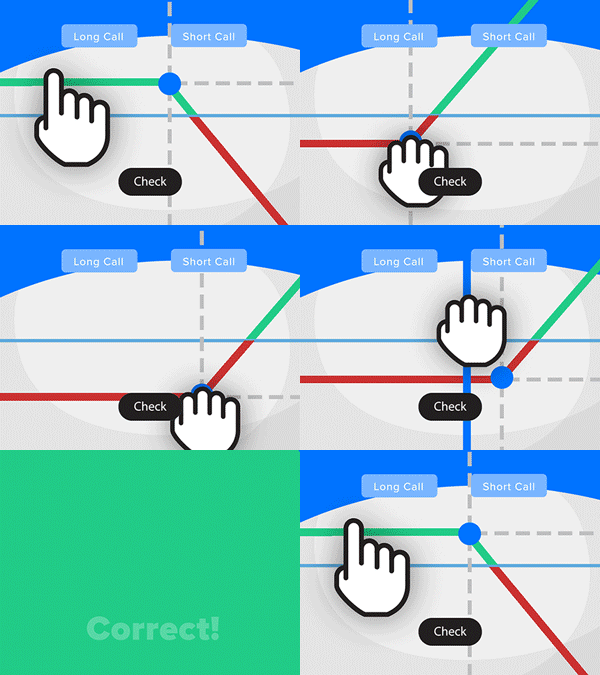
- Solve real problems with our hands-on interface
- Progress from basic puts and calls to advanced strategies
Interactive Options Course

Posted October 22, 2026 at 11:45 am
If you own municipal bonds, you probably winced when you opened your September statement.
The Bloomberg Municipal Bond Index lost 4.36% last month, its worst month since September 2008, at the height of the financial crisis. Going back to 1990, only two months were worse, and both were in 2008. The selling peaked on September 28, when more than 117,000 muni trades were reported in a single day. That was the most since at least 1995.[1]

For an asset class that most people own because it’s supposed to be boring, that was a jolt. But I’ve been investing for more than 30 years, through a lot of rate cycles, and one lesson keeps repeating itself. The moments that feel worst for bondholders have often set up the best opportunities for income.
I believe that’s where we are today.
The short answer is that interest rates are rising almost everywhere at once.
In September, the Federal Reserve raised rates for the first time in more than three years, lifting its benchmark to a range of 3.75% to 4.00%.
But the Fed isn’t alone. By one count, 54 central banks[2] have raised rates so far this year, as the war with Iran has driven up energy prices and revived fears of inflation. Markets now expect three more quarter-point hikes from the Fed over the next 12 months, according to CME Group’s FedWatch Tool.
Munis also took an extra hit from supply. Issuance is on pace for a record $600 billion this year,[3] as states and cities raise money for roads, bridges, airports and water systems. When that much supply meets nervous buyers, prices have to fall.
By late September, issuers were hitting the brakes.[4]
The other side of the coin is that yields on high-quality munis are now at levels many investors haven’t seen in well over a decade.
Why? Because when bond prices fall, yields rise.
At the end of September, the 10-year AAA muni yield stood at 4.13% and the 30-year at 5.25%. Both were the highest month-end readings in Bloomberg’s benchmark data, which goes back to 2009.

Keep in mind that this income is generally exempt from federal income tax. Take an investor in the top bracket, who pays 37% plus the 3.8% net investment income tax. For that investor, a 5.25% tax-free yield is equivalent to nearly 8.9% from a taxable bond.
I’m not the only one who’s noticed. Burton Malkiel, the Princeton economist and author of A Random Walk Down Wall Street, wrote last month that “high-quality bonds offer unusually favorable returns compared with other investments.”[5] Jason Katz of UBS called today’s market “a generational opportunity to actually create ballast in your portfolio and create income.”[6]
There’s also reason to think the supply pressure may ease. Strategists at JPMorgan expect $1 billion to $3 billion a week to come off the new-issue calendar if current conditions persist.[7]
To be clear, I’m not telling anyone to sell their stocks. But the math between stocks and bonds has changed. If you’ve ignored fixed income for the past decade, it may be time for a fresh look.
The fund flows tell an interesting story. In the week ended September 30, investors pulled a net $6.67 billion from muni mutual funds, the biggest weekly withdrawal since May 2022, according to the Investment Company Institute (ICI). A lot of that was investors selling near the lows.
Others took the opposite approach. That same week, $2.1 billion flowed into muni ETFs, according to LSEG Lipper. Much of that money came from tax-loss harvesting. Investors sold bonds at a loss to offset taxable gains elsewhere, then immediately reinvested in similar bonds at today’s higher yields. By the week ended October 7, muni funds were back to net inflows of about $1.1 billion.
Panic is rarely a good investment strategy. With year-end approaching, this could be a good time to ask your tax advisor whether harvesting losses makes sense for you.
You don’t have to lock up your money for 30 years to benefit from higher yields. In September, short-term munis actually took the biggest hit. One- and two-year AAA yields rose more than a full percentage point during the month, while the 30-year yield rose 0.61 percentage point, according to Bloomberg data.

That means investors can now earn meaningfully more income without going far out on the yield curve. At the end of September, a two-year AAA muni yields 3.55%. For a top-bracket investors, that’s equal to about 6% from a taxable bond, compared with 4.89% on a two-year Treasury.
Shorter maturities matter even more if rates keep climbing. When bonds mature sooner, the money can be reinvested at the new, higher yields instead of sitting in lower-coupon bonds for decades. Charles Schwab notes that investors “may not need to extend too far out the maturity spectrum to generate attractive tax-advantaged income.”[8]
Not all munis are created equal, though. In 2024, Brightline, Florida’s private passenger railroad, sold $1.2 billion of unrated junior bonds paying a 14% coupon. The bonds were backed by permits and rights-of-way for an expansion to Tampa that hasn’t been built. After several Brightline parent entities filed for bankruptcy on September 24, those bonds fell as low as 5 cents on the dollar.[9]
A high coupon is not the same as a good investment. And the word “municipal” doesn’t mean a government is standing behind the bond.
I can’t tell you that rates have peaked. With inflation pressures still building, they could go higher, and bond prices could fall further in the near term.
But I’ve always believed that investing is about discipline, not drama. Today’s muni market offers something it hasn’t in a long time, especially for investors who need income, value tax efficiency and want to preserve capital. It’s a chance to get paid while you wait.
—
Originally Posted October 21, 2026 – Muni Bond Yields Hit Their Highest Level in More Than 15 Years
A bond’s credit quality is determined by private independent rating agencies such as Standard & Poor’s, Moody’s and Fitch. Credit quality designations range from high (AAA to AA) to medium (A to BBB) to low (BB, B, CCC, CC to C). Credit quality designations range from high (AAA to AA) to medium (A to BBB) to low (BB, B, CCC, CC to C). In the event a bond is rated by more than one of the ratings organizations, the highest rating is shown.
Tax-equivalent yield assumes a 40.8% federal rate (37% plus the 3.8% net investment income tax). Bond funds are subject to interest-rate risk; their value declines as interest rates rise.
The Bloomberg Municipal Bond Index is a rules-based, market-value-weighted benchmark index that tracks the U.S. long-term, tax-exempt, investment-grade bond market.
[1] Aashna Shah, “Muni Trading Jumps to Highest Since at Least 1995 on Market Rout,” Bloomberg, September 29, 2026, https://www.bloomberg.com/news/articles/2026-09-29/muni-trading-jumps-to-highest-since-at-least-1995-on-market-rout.
[2] The Kobeissi Letter (@KobeissiLetter), “The global rate hike cycle is here. 15 of the 33 major central banks, or 45%, have raised interest rates over the last 6 months, the largest proportion since 2023 …,” X, October 12, 2026, 11:48 a.m., https://x.com/KobeissiLetter/status/2109687610146795661.
[3] Andrew Bary, “Muni Bonds Are Yielding 5%. They Rival Stocks Now.,” Barron’s, September 16, 2026, https://www.barrons.com/articles/muni-bonds-yielding-5-percent-rival-stocks-438f044b.
[4] Aashna Shah, Shruti Singh, and Brian W. Smith, “Billions of Muni-Bond Deals Are Stuck in Limbo as Yields Soar,” Bloomberg, September 28, 2026, https://www.bloomberg.com/news/articles/2026-09-28/la-nashville-bond-sales-get-stuck-in-limbo-as-yields-soar.
[5] Burton G. Malkiel, “It’s a Good Time to Buy Bonds,” Wall Street Journal, September 23, 2026, https://www.wsj.com/opinion/its-a-good-time-to-buy-bonds-94e1c93e.
[6] Hayley Cuccinello, “Advisors to the Ultra-Wealthy Steer Clients Back to Bonds as Yields Climb,” CNBC, October 10, 2026, https://www.cnbc.com/2026/10/10/advisors-to-the-ultra-wealthy-steer-clients-back-to-bonds.html.
[7] Aashna Shah, Shruti Singh, and Brian W. Smith, “Billions of Muni-Bond Deals Are Stuck in Limbo as Yields Soar,” Bloomberg, September 28, 2026, https://www.bloomberg.com/news/articles/2026-09-28/la-nashville-bond-sales-get-stuck-in-limbo-as-yields-soar.
[8] Cooper Howard, “Do Munis Still Deserve a Place in Your Portfolio?,” Charles Schwab, September 16, 2026, https://www.schwab.com/learn/story/do-munis-still-deserve-place-your-portfolio.
[9] Martin Z. Braun, “Brightline Junior Muni Bond Rises to 11 Cents on the Dollar,” Bloomberg Tax, October 8, 2026, https://news.bloombergtax.com/daily-tax-report-international/brightline-junior-muni-bond-rises-to-11-cents-on-the-dollar.
All opinions expressed and data provided are subject to change without notice. Holdings may change daily.
Some of these opinions may not be appropriate to every investor. By clicking the link(s) above, you will be directed to a third-party website(s). U.S. Global Investors does not endorse all information supplied by this/these website(s) and is not responsible for its/their content.
About U.S. Global Investors, Inc. – U.S. Global Investors, Inc. is an investment adviser registered with the Securities and Exchange Commission (“SEC”). This does not mean that we are sponsored, recommended, or approved by the SEC, or that our abilities or qualifications in any respect have been passed upon by the SEC or any officer of the SEC.
This commentary should not be considered a solicitation or offering of any investment product.
Certain materials in this commentary may contain dated information. The information provided was current at the time of publication.
Some links above may be directed to third-party websites. U.S. Global Investors does not endorse all information supplied by these websites and is not responsible for their content.
Please consider carefully a fund’s investment objectives, risks, charges and expenses. For this and other important information, obtain a fund prospectus by clicking here or by calling 1-800-US-FUNDS (1-800-873-8637). Read it carefully before investing. Foreside Fund Services, LLC, Distributor. U.S. Global Investors is the investment adviser.
Information posted on IBKR Campus that is provided by third-parties does NOT constitute a recommendation that you should contract for the services of that third party. Third-party participants who contribute to IBKR Campus are independent of Interactive Brokers and Interactive Brokers does not make any representations or warranties concerning the services offered, their past or future performance, or the accuracy of the information provided by the third party. Past performance is no guarantee of future results.
This material is from US Global Investors and is being posted with its permission. The views expressed in this material are solely those of the author and/or US Global Investors and Interactive Brokers is not endorsing or recommending any investment or trading discussed in the material. This material is not and should not be construed as an offer to buy or sell any security. It should not be construed as research or investment advice or a recommendation to buy, sell or hold any security or commodity. This material does not and is not intended to take into account the particular financial conditions, investment objectives or requirements of individual customers. Before acting on this material, you should consider whether it is suitable for your particular circumstances and, as necessary, seek professional advice.
Mutual Funds are investments that pool the funds of investors to purchase a range of securities to meet specified objectives, such as growth, income or both. Investors are reminded to consider the various objectives, fees, and other risks associated with investing in Mutual Funds. Please read the prospectus accordingly. This communication is not to be construed as a recommendation, solicitation or promotion of any specific fund, or family of funds. Interactive Brokers may receive compensation from fund companies in connection with purchases and holdings of mutual fund shares. Such compensation is paid out of the funds' assets. However, IBKR does not solicit you to invest in specific funds and does not recommend specific funds or any other products to you. For additional information please visit https://www.interactivebrokers.com/en/index.php?f=1563&p=mf
Any discussion or mention of an ETF is not to be construed as recommendation, promotion or solicitation. All investors should review and consider associated investment risks, charges and expenses of the investment company or fund prior to investing. Before acting on this material, you should consider whether it is suitable for your particular circumstances and, as necessary, seek professional advice.
Tax-loss harvesting involves selling investments at a loss to offset capital gains, which carries inherent risks, including potential loss of principal and market volatility. There is no guarantee that tax-loss harvesting will achieve desired tax benefits or investment outcomes.
The information in this material is provided for informational purposes only and does not constitute tax advice and cannot be used by the recipient or any other taxpayer to avoid penalties under any federal, state, local or other tax statutes or regulations, or to resolve any tax issue.
Interactive Brokers does not provide tax advice, does not make representations regarding the particular tax consequences of any investments, and cannot assist clients with tax filings. Investors should consult with their tax professional about the tax implications of any investment.
Municipal Bonds are only available from Interactive Brokers for IBKR LLC, IBKR Canada, IBKR Hong Kong, IBKR Australia and IBKR Singapore entities.
Mutual Fund products are only available from Interactive Brokers for IBKR LLC, IBKR Hong Kong and IBKR Singapore entities.
Related Articles















Join The Conversation
For specific platform feedback and suggestions, please submit it directly to our team using these instructions.
If you have an account-specific question or concern, please reach out to Client Services.
We encourage you to look through our FAQs before posting. Your question may already be covered!