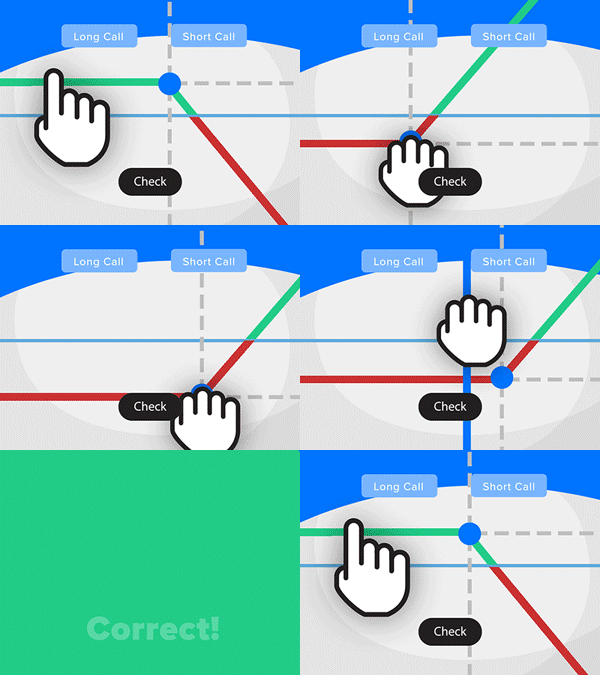
- Solve real problems with our hands-on interface
- Progress from basic puts and calls to advanced strategies
Interactive Options Course

Posted October 14, 2026 at 11:30 am
Editor’s Note: This article has been updated with additional content.
Consumer prices rose from 3.4% to 3.7% year-ove-year in September, above the 3.6% economists expected, according to the Bureau of Labor Statistics report released Wednesday.
On a monthly basis, the Consumer Price Index increased 0.6%, matching expectations and accelerating from August’s 0.4% pace.
Core inflation, which strips out volatile food and energy prices and is the gauge the Fed watches most closely, rose 0.3% month over month against a 0.2% forecast.
The annual core rate came in at 2.6%, versus 2.5% expected and above August’s 2.4%. Both measures of annual inflation still remain above the Federal Reserve’s 2% target.
Before the report, traders priced a 22% chance of a second consecutive hike in October, according to the CME FedWatch tool.
Gasoline did most of the work.
The gasoline index jumped 9.1% in September, accounting for more than half of the monthly increase, the BLS said. The broader energy index rose 5.2%.
Over the past 12 months, energy prices are up 20.4% and gasoline is up 34.2%.
Food prices were unchanged on the month. Food eaten at home fell 0.1%.
Outside of energy, price pressures kept building. Shelter, the largest component of the index, rose 0.4% after a 0.3% gain in August.
Owners’ equivalent rent, which estimates what homeowners would pay to rent their own home, rose 0.3%. Rent rose 0.2%.
Used cars and trucks rose 0.7%. Airline fares rose 1.2% on the month and are up 22.4% from a year ago.
The report arrives two weeks before the Federal Reserve’s next meeting on Oct. 27-28.
The Fed raised its benchmark rate by a quarter point to a range of 3.75% to 4.00% on Sept. 16, its first hike in three years, in a unanimous vote. The median projection from the meeting pointed to one more increase before year-end.
On Polymarket, traders now see a 43% chance of a quarter-point hike in October, against 57% for no change.
Stocks fell and Treasury yields jumped after the report.
Contracts tied to the S&P 500 dropped 0.6% to about 7,786 in premarket trading. The Nasdaq 100 lost 0.7% to 30,367, and the Dow Jones Industrial Average slid 0.6% to 51,603.
Small caps fell the most. The Russell 2000 dropped 1.4% to 2,756.
Yields rose across the curve.
The 2-year Treasury yield, the maturity most sensitive to Fed policy, climbed 13 basis points to 4.93%. The 10-year yield rose 9 basis points to 5.31%, and the 30-year yield gained 5 basis points to 5.61%.
The U.S. dollar index rose 0.5% to 102.38.
Gold fell 1.2% to $4,095 an ounce, and silver dropped 2.6% to $57.62. WTI crude rose 1.3% to $95.37 a barrel.
Bitcoin (CRYPTO: BTC) slipped 1.2% to $82,621.
Producer prices follow on Thursday, with economists expecting a 0.5% monthly increase.

—
Originally Posted October 14, 2026 – Inflation Comes in Hotter Than Expected at 3.7%, Keeping Fed Hike Bets Alive (UPDATED)
© 2022 Benzinga.com. Benzinga does not provide investment advice. All rights reserved.
Information posted on IBKR Campus that is provided by third-parties does NOT constitute a recommendation that you should contract for the services of that third party. Third-party participants who contribute to IBKR Campus are independent of Interactive Brokers and Interactive Brokers does not make any representations or warranties concerning the services offered, their past or future performance, or the accuracy of the information provided by the third party. Past performance is no guarantee of future results.
This material is from Benzinga and is being posted with its permission. The views expressed in this material are solely those of the author and/or Benzinga and Interactive Brokers is not endorsing or recommending any investment or trading discussed in the material. This material is not and should not be construed as an offer to buy or sell any security. It should not be construed as research or investment advice or a recommendation to buy, sell or hold any security or commodity. This material does not and is not intended to take into account the particular financial conditions, investment objectives or requirements of individual customers. Before acting on this material, you should consider whether it is suitable for your particular circumstances and, as necessary, seek professional advice.
U.S. Spot Gold trading through IB LLC accounts is only available to legal residents of the United States that do not reside in Arizona, Montana, New Hampshire, and Rhode Island.
Trading Bitcoin involves significant risk. Bitcoin prices can be highly volatile and may fluctuate rapidly, potentially resulting in substantial losses. Because Bitcoin operates on a decentralized blockchain, network congestion or technical issues may occasionally delay transaction settlement. Regulatory frameworks for digital assets are still evolving and could impact availability, liquidity, or pricing. When trading through Interactive Brokers, execution and custody are facilitated by regulated partners such as Paxos or Zero Hash; however, these arrangements do not eliminate the possibility of operational or counterparty risk.
There is a substantial risk of loss in foreign exchange trading. The settlement date of foreign exchange trades can vary due to time zone differences and bank holidays. When trading across foreign exchange markets, this may necessitate borrowing funds to settle foreign exchange trades. The interest rate on borrowed funds must be considered when computing the cost of trades across multiple markets.
Investments in certain commodities (precious metals) may be subject to significant price volatility and often involve risks related to market fluctuations, liquidity constraints, geopolitical events, and changes in global economic conditions that could adversely affect their value.
Trading in digital assets, including cryptocurrencies, is especially risky and is only for individuals with a high risk tolerance and the financial ability to sustain losses. Eligibility to trade in digital asset products may vary based on jurisdiction.
Futures are not suitable for all investors. The amount you may lose may be greater than your initial investment. Before trading futures, please read the CFTC Risk Disclosure. A copy and additional information are available at ibkr.com.
CFDs are complex instruments and come with a high risk of losing money rapidly due to leverage. 58.4% of retail investor accounts lose money when trading CFDs with IBKR. You should consider whether you understand how CFDs work and whether you can afford to take the high risk of losing your money.
Spot currencies are not available at IBKR Singapore.
Related Articles















Join The Conversation
For specific platform feedback and suggestions, please submit it directly to our team using these instructions.
If you have an account-specific question or concern, please reach out to Client Services.
We encourage you to look through our FAQs before posting. Your question may already be covered!