- Solve real problems with our hands-on interface
- Progress from basic puts and calls to advanced strategies
Interactive Options Course

Posted October 20, 2026 at 1:43 pm
The Nasdaq is green for the second consecutive session and rebounding from sharp pre-market losses that were sparked by a 32% first-day IPO decline in Elice, a South Korean AI data-center firm. The steep plunge initially triggered fears that funding issues for tech will persist as a near-term challenge; however, intraday buying supported by well-received earnings reports, falling oil prices, slipping yields and the strong seasonals of late October have the four major domestic equity benchmarks, 10 of the 11 principal sectors and all the subcategories minus those related to energy rallying. WTI crude is declining by more than a significant 5% from its daily high of $101.37 on unconfirmed news that Washington and Tehran apparently reacted positively to a preliminary deal organized by Qatar and Pakistan, which is raising optimism that violence in the Middle East will subside in the short run. The cheaper fuel charges and easing angst about the tech space potentially slowing along with a record low in pending home sales amidst declines in starts and permits, have the Treasury curve descending aggressively in bull flattening motion led by duration. The lighter borrowing costs are also weighing on the greenback while bolstering non-energy commodities and cryptocurrencies. Elsewhere, risk-on attitudes have investors unwinding hedges again, as premiums on volatility protection instruments decrease in light of the offensive mindsets.
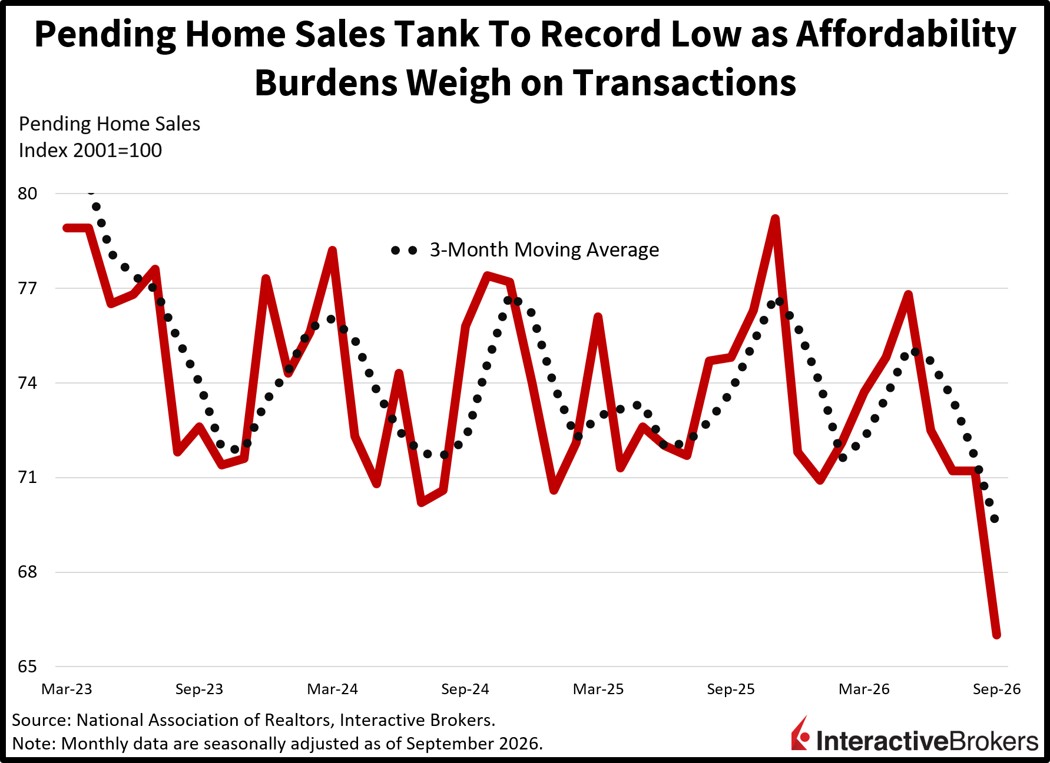
Pending home sales in September hit the lowest level since at least 2001, which is when the data series originated. The 7.3% month-over-month (m/m) contraction missed expectations of -0.5% by a mile and then some and reversed the entire modest gain of 0.3% from August. On a year-over-year (y/y) basis, the gauge plunged 11.3%, as elevated mortgage rates and lofty valuations offset the positive impacts of buoyant stock market performance, healthy hiring and subdued unemployment. Every region declined, with the West, South, Midwest and Northeast seeing m/m decreases of 9.2%, 8.2%, 6.5% and 4.2% amidst broad y/y plunges. The implications for closings are ugly at this juncture, as contract signings are a leading indicator for finished transactions with paperwork typically agreed upon prior to financing, inspections and keys exchanging hands.
The affordability challenges hurting transaction momentum have builders significantly slowing down their pace of construction, as this morning’s September housing starts data posted the second worst number since the pandemic recession in 2020. The 1.221 million seasonally adjusted annualized units (SAAU) represented a 5.2% m/m decline and missed the median estimate of 1.3 million by a wide margin. It also came in under the 1.288 million from August and when looking back 76 months, only last May was lower. Both the apartment building and single-family segments performed poorly, falling 7.2% and 4.6% m/m, driven mainly by the West and Midwest regions experiencing decreases of 23.2% and 19% m/m. The South and Northeast served to counter some of the negativity, rising 6.1% m/m on the former while arriving unchanged on the latter.

Building permits, which represent the volume of applications submitted to local authorities prior to breaking ground were less dim, as construction companies appeared to focus on apartment rentals rather than single-family projects, as the former category rose to a six-month high while the latter segment dropped to a 42-month low. Overall, the September headline of 1.4 million SAAU came in near the 1.39 million expected as well as the 1.402 million from August. Regional participation was pretty strong, but a 10.2% m/m drop in the West weighed on the print, offsetting the 13.3%, 1.5% and 0.5% gains in the Northeast, South and Midwest.
Geopolitical relief could be on the way considering the sudden plunge in energy costs against the backdrop of prediction markets and election polls showing the Republicans trailing the Democrats by wide margins in both the Senate and the House of Representatives, as well as in gubernatorial elections. The GOP could be looking to achieve some progress on the Middle East front that could reduce pain at the pump and improve the party’s chances next month, and that alone would offer a substantial lift to equities, an asset class that has recently produced choppy performance in response to elevated interest rates. Irrespective of what happens with foreign affairs, however, incoming corporate earnings announcements from SpaceX, Netflix, Tesla, Meta, IBM, Lam Research, Texas Instruments, Western Digital and Ring Central are poised to quell fears of an AI bubble, strengthen confidence about the economic cycle and bolster investor enthusiasm as we head into the final weeks of 2026. But to maximize this market’s potential heading towards the best seasonal period, we would need buoyant profitability numbers, optimistic outlooks and a relaxation in US-Iran tensions, as that could drive stocks another 6-8% higher.
The People’s Bank of China this morning decided to hold its key prime rates for the seventeenth consecutive month but trimmed its bank reserve requirement by 0.5 percentage points and dropped its seven-day reverse repurchase rate to 1.5%, a 0.1 percentage point reduction. The changes are intended to help improve financial liquidity. Also, PBOC Governor Pan Gongsheng announced that the central bank is considering shifting toward using the overnight reverse repo rate as its main policy tool. It would allow banks to choose between the nightly rate and the country’s prime benchmarks when setting interest charges on their loans. Other debt, such as derivatives and bonds, could also be priced based on the overnight repo. While China’s gross domestic product during the third quarter grew 4.5% from the year-ago period, the strength was focused on exports with domestic consumption languishing. Economic data released yesterday by the Chinese government illustrated this trend with export demand causing industrial production to grow much faster than retail spending. Nevertheless, the GDP expansion met the lower end of the country’s 4.5% to 5% growth target.
Production in the euro area’s construction industry ascended by 1.85% m/m in August, a notable acceleration from the 0.2% advance in the preceding month, according to Eurostat. When compared to the year-ago period, output was up 1.4%. The m/m pace overcame 2.1% and 0.4% drops in civil engineer and building construction. Specialized construction activities, which advanced 2.5%, pushed the overall industry into expansion. Hungary, Germany and Romania were among countries with the largest climbs in output, with ascents of 14%, 9.3% and 7.2%, respectively. Conversely, Slovenia, Slovakia and Italy were the weakest countries with declines of 5.1%, 4.9% and 2.9%.
The UK’s unemployment rate fell from 4.9% in August to 4.7%, a stronger reading than the economist consensus estimate for an unchanged level. Payrolls expanded by 102k on a three-month-over-three month-basis for the period that ended in August. Economists anticipated only a 20k gain following the 67k additions in the period that ended in July. Also today, the UK reported that the number of individuals receiving unemployment benefits in September climbed by 30.k, a worse result than the 19.4k economist consensus estimate and August’s 7k expansion. In other labor matters, average earnings ex-bonuses and with bonuses both climbed by 3.7% in August. Economists forecast 3.6% and 3.8% pay raises, respectively, after 3.6% and 3.9% gains in the preceding month.
New to Interactive Brokers?
Open AccountInformation posted on IBKR Campus that is provided by third-parties does NOT constitute a recommendation that you should contract for the services of that third party. Third-party participants who contribute to IBKR Campus are independent of Interactive Brokers and Interactive Brokers does not make any representations or warranties concerning the services offered, their past or future performance, or the accuracy of the information provided by the third party. Past performance is no guarantee of future results.
This material is from IBKR Macroeconomics, an affiliate of Interactive Brokers LLC, and is being posted with its permission. The views expressed in this material are solely those of the author and/or IBKR Macroeconomics and Interactive Brokers is not endorsing or recommending any investment or trading discussed in the material. This material is not and should not be construed as an offer to buy or sell any security. It should not be construed as research or investment advice or a recommendation to buy, sell or hold any security or commodity. This material does not and is not intended to take into account the particular financial conditions, investment objectives or requirements of individual customers. Before acting on this material, you should consider whether it is suitable for your particular circumstances and, as necessary, seek professional advice.
IPO investments carry substantial risks including extreme price volatility, limited operating history, lack of liquidity, potential for significant losses, and uncertainty regarding future performance.
Futures, event contracts, and forecast contracts are not suitable for all investors. Before trading these products, please read the CFTC Risk Disclosure. For a copy, visit our Warnings and Disclosures Page.
Trading in digital assets, including cryptocurrencies, is especially risky and is only for individuals with a high risk tolerance and the financial ability to sustain losses. Eligibility to trade in digital asset products may vary based on jurisdiction.
IPO Subscriptions are only available for IBKR LLC, IBKR Hong Kong andIBKR Singapore entities.
Related Articles


















Join The Conversation
For specific platform feedback and suggestions, please submit it directly to our team using these instructions.
If you have an account-specific question or concern, please reach out to Client Services.
We encourage you to look through our FAQs before posting. Your question may already be covered!