- Solve real problems with our hands-on interface
- Progress from basic puts and calls to advanced strategies
Interactive Options Course

Posted October 30, 2026 at 12:15 pm
Something interesting is happening in the gold market. While prices have been declining over the past two months, one particular group of market participants has been moving in the opposite direction: gold producers.
According to the latest Commitments of Traders data, producers have been progressively reducing their net short exposure to gold, creating an increasingly visible divergence between price action and positioning. What makes this development particularly interesting is that we observed a similar situation just a few months ago, before gold experienced a significant rebound.
Could history be about to repeat itself?
The Cot Report, short for Commitments of Traders Report, is a weekly publication from the U.S. Commodity Futures Trading Commission (CFTC) that provides a breakdown of how different categories of market participants are positioned in futures and options markets.
For commodities such as gold, the report distinguishes between several groups, including money managers, swap dealers, and producers, merchants, processors, and users. Understanding how these participants behave can provide valuable insights into market sentiment, particularly when their positioning starts diverging from price movements.
Gold producers are especially interesting because their primary objective is generally not to speculate on price movements, but to manage the risks associated with their business activities. For example, a mining company may sell gold futures contracts to protect itself against the possibility of lower gold prices in the future.
Consequently, producers typically maintain net short positions in the futures market. When these positions become less negative, it means that their net bearish exposure is decreasing, potentially because they are buying back previously sold futures contracts or adjusting their hedging strategies.
This is precisely what we are witnessing today.
Looking at the latest data from the Forecaster Terminal, a clear divergence has emerged since August 25, 2026.
While gold prices have declined substantially during this period, producers have been moving steadily in the opposite direction. Their net positioning, expressed as a percentage of total open interest, has improved from approximately -8% to around -3%.
In other words, while gold has been losing value, producers have been significantly reducing their net short exposure.
This does not necessarily mean that mining companies are accumulating physical gold. Rather, the futures positioning data indicates that their aggregate net short exposure has become considerably smaller. The change may reflect short covering, additional long positions, changes in open interest, or a combination of these factors.
Nevertheless, the divergence is worth monitoring. Producers are becoming less negatively positioned even as market prices continue to weaken, potentially suggesting that extensive downside protection is becoming less attractive to these commercial participants.
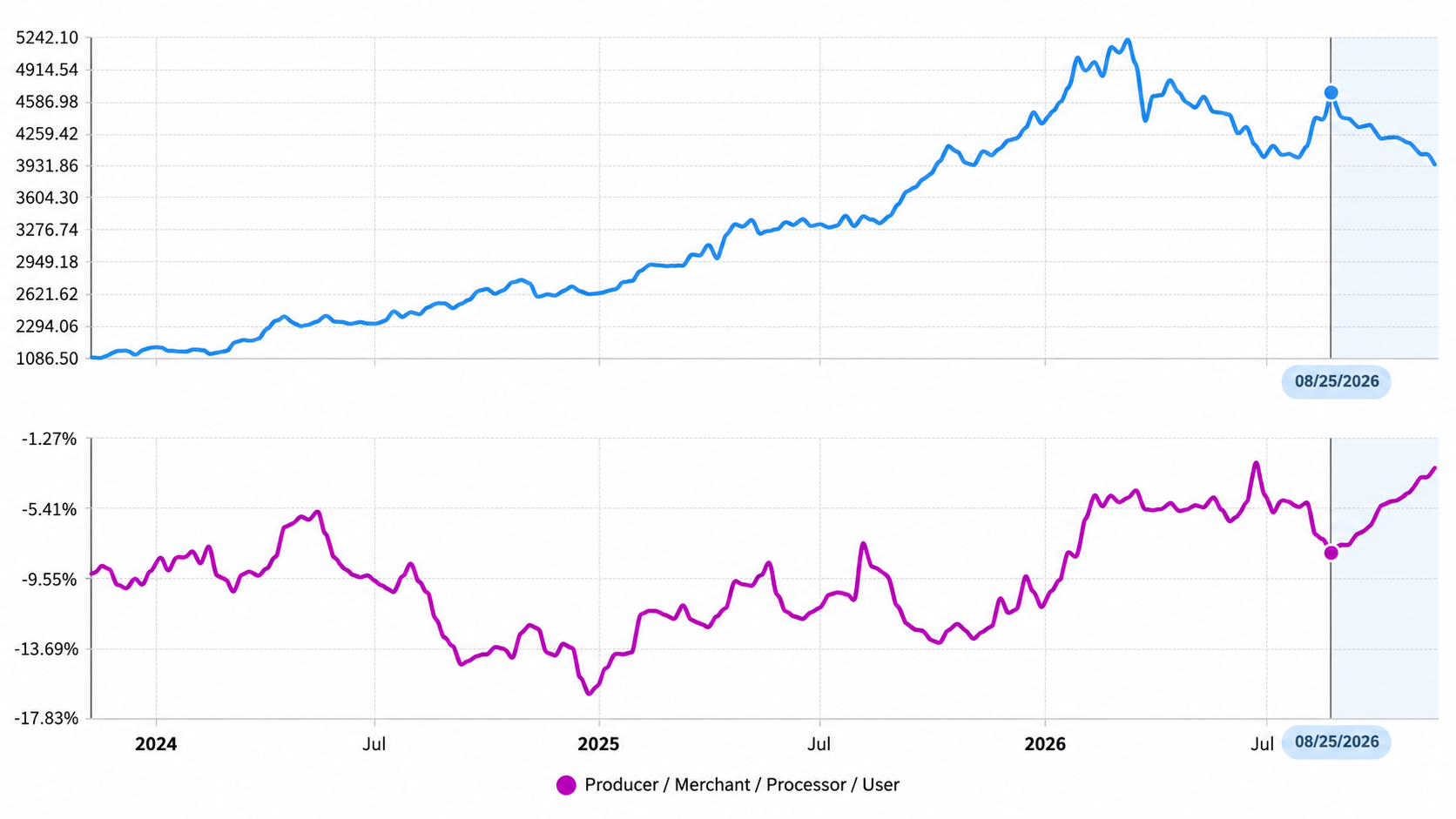
Source: Forecaster Terminal, based on CFTC Commitments of Traders data. The chart highlights the divergence between gold prices and producer positioning since August 25, 2026.
What makes the current situation particularly compelling is that this is not the first time we have identified this behavior.
On July 6, 2026, I published an article on Interactive Brokers titled Are Gold Producers Sending a Bullish Signal?, highlighting how producers were progressively closing their net short positions following a significant correction in gold prices.
At that time, I explained why declining producer hedging activity could represent an encouraging signal for the precious metal. I also highlighted a historical precedent from 2022, when similar positioning conditions appeared around an important market bottom.
Interestingly, following that July article, gold prices recovered and moved higher over the subsequent weeks, reinforcing the relevance of the positioning signal we had identified.
Today, just a few months later, we are observing another significant improvement in producer positioning during a period of falling prices.
The comparison is particularly interesting because it illustrates how valuable it can be to monitor the behavior of different market participants rather than relying exclusively on price charts. While prices tell us what the market has already done, positioning data can provide additional clues about how major participants are adjusting their exposure.
Of course, one successful historical example does not establish a statistically reliable trading signal. Nevertheless, the recurrence of this divergence deserves attention.
The latest COT data does not guarantee that gold has reached a bottom, nor does it tell us exactly when a potential recovery might begin. Commercial traders can reduce their short exposure for several reasons, and their positioning may continue to improve even while gold prices fall further.
However, I believe the current divergence provides an interesting reason to become more attentive to the gold market.
Ideally, I would like to see this improvement in producer positioning accompanied by evidence of stabilization in gold prices, followed by a recovery in price momentum. Additional confirmation from the positioning of speculative traders, together with developments in real interest rates and the U.S. dollar, would help strengthen the bullish case.
For now, the message remains straightforward: gold prices are declining, but producers are becoming progressively less bearish.
We identified a similar development earlier this year, before gold experienced a meaningful recovery. The same phenomenon is now unfolding again, and I believe investors should pay close attention.
Markets do not always turn when the headlines become positive. Sometimes, the first signs of a potential reversal emerge in the positioning of participants who are already quietly changing their exposure.
And right now, gold producers are giving us something interesting to watch.
The analysis is provided for informational and educational purposes only and does not constitute investment advice. Futures positioning is not a reliable standalone indicator of future price movements, and past performance does not guarantee future results.
Information posted on IBKR Campus that is provided by third-parties does NOT constitute a recommendation that you should contract for the services of that third party. Third-party participants who contribute to IBKR Campus are independent of Interactive Brokers and Interactive Brokers does not make any representations or warranties concerning the services offered, their past or future performance, or the accuracy of the information provided by the third party. Past performance is no guarantee of future results.
This material is from Forecaster.biz and is being posted with its permission. The views expressed in this material are solely those of the author and/or Forecaster.biz and Interactive Brokers is not endorsing or recommending any investment or trading discussed in the material. This material is not and should not be construed as an offer to buy or sell any security. It should not be construed as research or investment advice or a recommendation to buy, sell or hold any security or commodity. This material does not and is not intended to take into account the particular financial conditions, investment objectives or requirements of individual customers. Before acting on this material, you should consider whether it is suitable for your particular circumstances and, as necessary, seek professional advice.
Futures are not suitable for all investors. The amount you may lose may be greater than your initial investment. Before trading futures, please read the CFTC Risk Disclosure. A copy and additional information are available at ibkr.com.
U.S. Spot Gold trading through IB LLC accounts is only available to legal residents of the United States that do not reside in Arizona, Montana, New Hampshire, and Rhode Island.
Investments in certain commodities (precious metals) may be subject to significant price volatility and often involve risks related to market fluctuations, liquidity constraints, geopolitical events, and changes in global economic conditions that could adversely affect their value.
Short selling is an advanced trading strategy involving potentially unlimited risks and must be done in a margin account.
Trading on margin is only for experienced investors with high risk tolerance. You may lose more than your initial investment. For additional information regarding margin loan rates, see ibkr.com/interest
For specific platform feedback and suggestions, please submit it directly to our team using these instructions.
If you have an account-specific question or concern, please reach out to Client Services.
We encourage you to look through our FAQs before posting. Your question may already be covered!
Related Articles














A longer term review of the COT Producers index suggests that the July reversal is not a reliable pattern. In fact, many position lows occurred well after the price lows.