
- Solve real problems with our hands-on interface
- Progress from basic puts and calls to advanced strategies
Interactive Options Course

Posted October 5, 2026 at 1:38 pm
Stocks are positioned for their third consecutive session of gains as declining oil prices paired with solid data bolster risk appetite on Wall Street to start the week. Fuel costs are falling in response to the Middle East situation improving because crude exporters have embraced alternative avenues for shipping that have brought flows back to near pre-war levels. Meanwhile, a strong US ISM-services print has lifted GDP prospects, but the momentous activity has also raised interest rates, with the Treasury curve climbing in bear-steepening fashion led north by duration. It’s been all about growth, deficits and international developments weighing on fixed income lately, with cool domestic inflation taking a backseat to worries pertaining to heavy borrowing needs for both the AI buildout and government expenditures. Europe has entered the forefront of the challenges for global bond markets and its sluggishness has strengthened the greenback meaningfully, as difficult politics that impede fiscal discipline in conjunction with a regulatory culture that limits economic expansion make budget balancing almost impossible because revenue and spending differentials continue to widen. Turning to the trading floor, the four major US equity benchmarks are advancing amidst 9 of the 11 principal sectors gaining today, even as volatility protection instruments catch bids. Elsewhere, cryptocurrencies are sinking, but non-energy commodities and prediction markets are seeing higher prices and greater engagement.
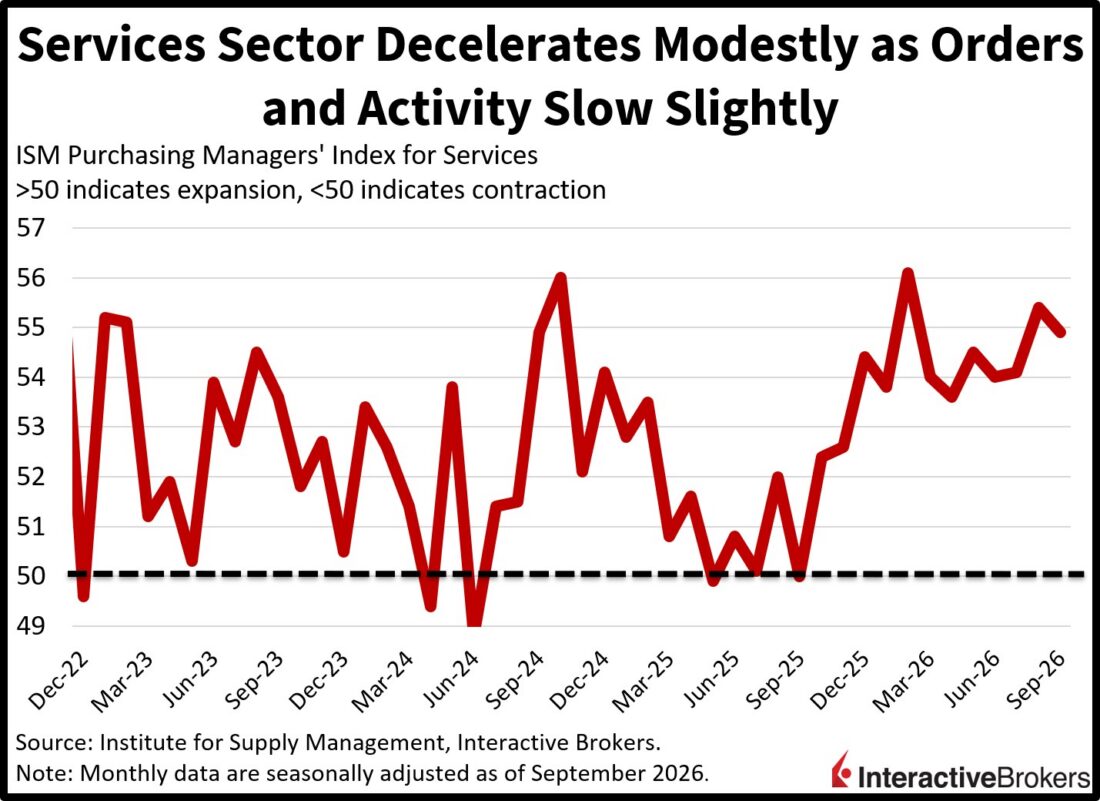
Economic conditions in the services sector remained buoyant last month, although overall momentum slowed slightly. The Institute for Supply Management’s (ISM) Purchasing Managers’ Index, at 54.9, narrowly missed the median estimate of 55 and fell from 55.4 in August. The most significant contributors to the weaker figure were business activity, new orders and exports, which slipped from August’s of 61.7, 60.9 and 56.3 to 56.5, 59.8 and 46.9. Meanwhile, employment and backlogs accelerated, countering some of the sluggishness, with the categories jumping to 50.1 and 56.6 from 47.8 and 55.6 amidst most broad segments staying above the 50 level, or the contraction-expansion border. Prices were a challenge though, as the inflation aspect of the report advanced to 74 from 72.6, mainly driven by heavier fuel charges.
Stocks are withstanding yet another session of yields soaring into nosebleeds with economic growth and earnings expansions contributing to the higher interest expenses. Strong profits have firms racing to borrow cash to fuel the AI buildout amidst worries of being left behind, and the competition is so fierce that credit costs are rising in light of heavy demand for loans against the backdrop of not enough funding supply. September was emblematic of how buoyant activity is countering tighter conditions, as Treasurys suffered brutal losses while equities were relatively flat because investors perceive current valuations and bottom-line amplification prospects as adequate irrespective of how poorly fixed income is performing. Meanwhile, if risk assets are hanging in there while a bond market meltdown worsens, the outlook is increasingly rosy when considering annualized core prices are likely to fall to 2.3% in next week’s inflation print alongside slow hiring that sustains a slowdown bid for the long-end of the curve. This combination is poised to provide breathing room for the Fed as well as alleviate Wall Street fears of a worsening rate picture, just as the unfavorable seasonal dynamics of today flip positive. Still, midterm elections and geopolitical tensions are concerns, especially if a blue wave leads to excessive AI regulation or if heightening violence inflicts damage on pivotal energy infrastructure in the Middle East.
Household confidence in Japan fell marginally in September with individuals’ willingness to buy durable goods and their perceptions of their overall livelihoods weakening. The headline sank 0.1 percentage point from the preceding month, reaching 35.4 but still surpassed the economist consensus forecast of 35.3. Among components that softened, the overall livelihood and durable goods categories sank from 34.1 and 27. 5 to 33.8 and 27.3. Also in September, the percentage of respondents who anticipated that prices would increase went from 90.6 to 92.2. Furthermore, the categories of individuals who expected prices to stay flat and those anticipating declines sank. After each category came in at 4.6% of respondents in August, the results sank to 3.8% and 3.3%, respectively, last month. In other areas, 40.5% and 40% of individuals said they expect their income to grow and had favorable views of employment. Both categories improved by 0.1 percentage point.
After climbing 0.6% month over month and 1.3% year over year in July, retail sales in Singapore contracted by 1% on a monthly basis and were only 0.7% higher than in the year-ago period, according to Statistics Singapore.
The m/m print was pulled down by motor vehicle, parts and accessories sales plunging 9.5%. When excluding this category, cash register activity expanded by 0.6%. Other categories with m/m growth and the extent of their changes were as follows:
In addition to the weak showing of motor vehicles, parts and accessories, the watches and jewelry category and the supermarkets and hypermarkets group posted 7.8% and 2.6% declines. Sales at department stores and recreational goods retailers, furthermore, dipped by 1.5% and 0.4%, respectively.
Canada’s services industry sank deeper into contraction last month with the S&P Global Canada Services PMI dropping from 49.1 to 48.3. Any reading below 50 implies a decline in business activity. Survey respondents reported declines in output and new orders that were closely associated with tariffs and the Iran war. Both challenges boosted uncertainty among business, declines in export trade and higher operating expenses. Service providers were limited in their ability to pass higher costs onto customers due to strong competition, which caused output inflation to slow, but margins were pressured. The increased margin pressures and decline in new orders caused service providers to reduce staffing for the first time since May. Companies trimmed head counts primarily by not replacing workers who resigned. A shortage of skilled job applicants also contributed to the workforce contraction. The staffing retraction caused a marginal increase in outstanding work orders. Looking ahead, businesses were more optimistic with sentiment climbing to the highest level since April. Plans for new projects, increased commercial activity and staff recruitment supported optimism. In some instances, confidence benefits from hopes of a decline in uncertainty that could improve the business climate.
New to Interactive Brokers?
Open AccountInformation posted on IBKR Campus that is provided by third-parties does NOT constitute a recommendation that you should contract for the services of that third party. Third-party participants who contribute to IBKR Campus are independent of Interactive Brokers and Interactive Brokers does not make any representations or warranties concerning the services offered, their past or future performance, or the accuracy of the information provided by the third party. Past performance is no guarantee of future results.
This material is from IBKR Macroeconomics, an affiliate of Interactive Brokers LLC, and is being posted with its permission. The views expressed in this material are solely those of the author and/or IBKR Macroeconomics and Interactive Brokers is not endorsing or recommending any investment or trading discussed in the material. This material is not and should not be construed as an offer to buy or sell any security. It should not be construed as research or investment advice or a recommendation to buy, sell or hold any security or commodity. This material does not and is not intended to take into account the particular financial conditions, investment objectives or requirements of individual customers. Before acting on this material, you should consider whether it is suitable for your particular circumstances and, as necessary, seek professional advice.
Futures, event contracts, and forecast contracts are not suitable for all investors. Before trading these products, please read the CFTC Risk Disclosure. For a copy, visit our Warnings and Disclosures Page.
Trading in digital assets, including cryptocurrencies, is especially risky and is only for individuals with a high risk tolerance and the financial ability to sustain losses. Eligibility to trade in digital asset products may vary based on jurisdiction.
Related Articles


















Join The Conversation
For specific platform feedback and suggestions, please submit it directly to our team using these instructions.
If you have an account-specific question or concern, please reach out to Client Services.
We encourage you to look through our FAQs before posting. Your question may already be covered!