Products ETF Trading

PRODUCTS
Trade ETFs Globally from a
Single Screen
The IBKR Advantage
- $0 commissions with no added spreads, ticket charges, platform fees, or account minimums
- Trade ETFs globally on 90+ market centers
- Lowest financing rates in the industry
- Professional trading platforms, order types, and tools
- Transparent shortable inventory and pricing
- Fractional Shares let you invest regardless of share price
- "Fee waived" no transaction fee (NTF) program for ETFs
- Earn extra income on your fully paid shares
Exchange-Traded Funds (ETFs) and Exchange-Traded Products (ETPs)
Interactive Brokers' "fee waived" no transaction fee (NTF) program offers over 150 exchange-traded funds (ETFs) that reimburse IBKR clients for commissions paid on ETF shares held for at least 30 days. IBKR Lite clients always pay $0 commissions on ETFs.


Spot Bitcoin ETPs offer investors improved accessibility to bitcoin and allows exposure to the cryptocurrency without having to purchase the asset. Spot Bitcoin ETPs hold actual bitcoin rather than derivatives tied to the price of bitcoin, meaning the price of the Spot Bitcoin ETPs fluctuates with the price of bitcoin in cryptocurrency markets.1
Choose Your Service Plan
Compare plans and choose the best plan for your trading needs. If your trading style changes, switch plans at any time.
IBKR Pro
Available Globally
Best for sophisticated traders and investors
IBKR Lite
Available to US and Singapore Residents
Best for retail investors
US Exchange-Listed ETFs Commissions
Low Commissions
USD 0.0005 to USD 0.0035 per share
Tiered or Fixed • No PFOF
Commissions-Free
USD 0.00 per share
Includes PFOF
Lowest Financing Rates in the Industry2
4.12% - 5.12%
Interest Charged for Margin Loans
6.12%
Interest Charged for Margin Loans
Earn interest at competitive rates on instantly available cash3
Up to 3.12%
Now insured up to $10M at our program banks4
Up to 2.12%
Now insured up to $10M at our program banks4
Trading Technology
- Free Access to all IBKR's trading platforms
- Free real-time streaming data on all US-listed stocks
- IB SmartRoutingSM
- IBKR APIs
- Free Access to all IBKR's trading platforms
- Free real-time streaming data on all US-listed stocks
Additional Plan Benefits
- No minimums for general investment accounts
- No inactivity fees
- No added spreads, ticket charges or platform fees
- No recurring fees
- No minimums for general investment accounts
- No inactivity fees
- No added spreads, ticket charges or platform fees
- No recurring fees
IB SmartRoutingSM helps support best execution by searching for the best available prices for stocks, options and combinations across exchanges and dark pools.
Clients can switch between the IBKR Pro and IBKR Lite plan at any time.
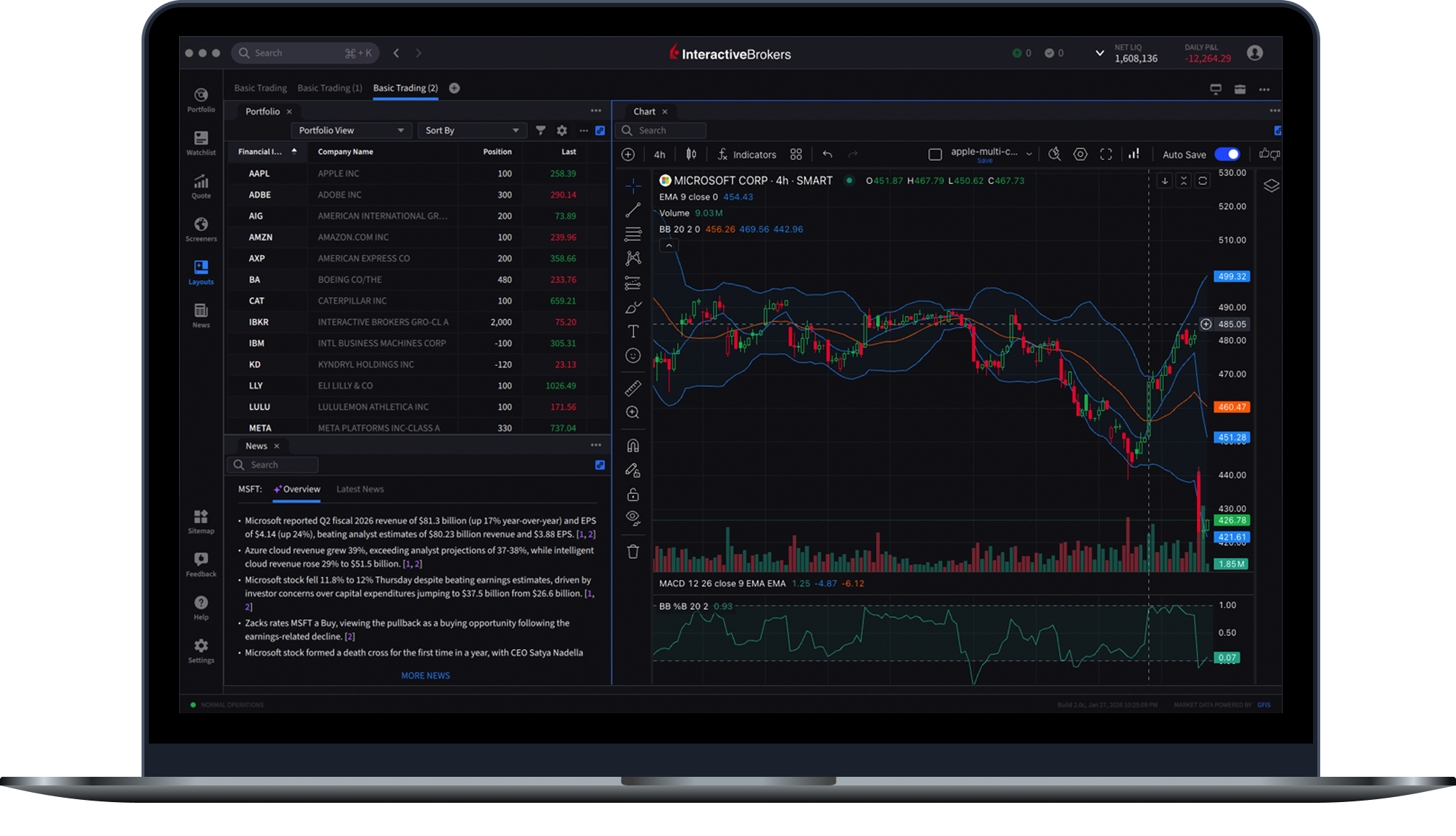
Professional Trading Platforms, Order Types, and Tools
Powerful, award-winning trading platforms and tools for managing your portfolio. Available on desktop, mobile apps, and web.
See Our Trading Platforms100+ order types, algos and tools – from limit orders to complex algorithmic trading – help you execute any trading strategy.
See Our Order Types, Algos and ToolsUse a full suite of professional trading tools to help make better decisions and manage your portfolio. Spot market opportunities with Advanced Market Scanners and analyze your portfolio with Risk Navigator.
See Our Trading ToolsFundamentals Explorer provides comprehensive, worldwide fundamentals data on over 30k companies, shows more than 300 data points per company, has more than 80 sources for newswires and reports and features 5.5k+ analyst ratings from TipRanks.
See Our Fundamentals ExplorerAlign your investments with what you care about most. Use the Impact Dashboard to identify and invest in companies that share your values, and use ESG scores from LSEG to make investment decisions based on more than just financial factors.
Learn About Sustainable Investing
What Are ETFs?
Exchange-traded funds (ETFs) are investment funds that trade on stock exchanges like an individual stock. Each ETF typically holds a diversified portfolio of assets such as stocks, bonds, or commodities, and is designed to track the performance of a specific index, sector, or theme.
Why Invest in ETFs?
ETFs offer a cost-effective way to build a diversified portfolio.
Key benefits include:
Low Cost
ETFs will generally have lower fees than mutual funds.
Diversification
A single ETF can provide exposure to dozens or
hundreds of securities.
Liquidity
ETFs can be bought and sold throughout the trading
day at market prices.
Transparency
Most ETFs disclose holdings daily, so investors
know what they own.
However, ETFs (like all financial products) have risks such as:
- Market Risk: Like stocks, ETFs can lose value due to changes in market conditions, interest rates, or economic factors.
- Tracking Error: Some ETFs may not perfectly mirror the performance of their target index due to fees, trading costs, or replication methods.
- Liquidity Risk: Not all ETFs are highly traded. Lower trading volume can lead to wider bid-ask spreads or price inefficiencies.
- Product Complexity: Leveraged, inverse, or synthetic ETFs carry unique risks that may not suit all investors.
- Currency & Regional Risks: International ETFs may be affected by currency fluctuations or geopolitical events.
Interactive Brokers’ Education and Resources About ETFs
Traders’ Academy
Traders’ Academy by Interactive Brokers provides complimentary resources to educate you on ETFs, including the following courses
ETF Liquidity Considerations
ETF shares can trade in the secondary market at a premium or discount to their Net Asset Values, which can create a catalyst for creations or redemptions. However, the secondary market accounts for a limited portion of an ETF’s overall liquidity.
ETPs at a Glance
An exchange-traded product (ETP) is a financial instrument traded on a regulated stock exchange. It is designed to replicate the return of an underlying benchmark or asset before fees, with the easy access and tradability of a share. Exchange-traded products offer investors access to a whole universe of exposures, from traditional asset classes like equities and bonds to alternatives like commodities and currencies, once only accessible for institutional investors.

Start trading like a professional today!
Open AccountDisclosures
- RISK DISCLOSURE REGARDING COMPLEX OR LEVERAGED EXCHANGE TRADED PRODUCTS
- According to StockBrokers.com Interactive Brokers Review: Read the full article Online Broker Reviews, January 28, 2026. "The industry’s cost leader: Interactive Brokers continues to set the benchmark for cost efficiency, offering margin rates and high yields on idle cash that consistently outperform the competition." View our margin rates for more information.