| Account Application and Information | |
| Individuals | Institutions |
| Advisors | Brokers |
Trader Workstation
To ensure that you are always running the latest version of the Trader Workstation (TWS) and for quickest access, we encourage you to use the Browser-Based version of the TWS available from the top right corner of our website or from this page. Customers with slow internet connections may want to consider the downloadable Standalone versions below.
|
The Browser-based TWS automatically runs the latest version through your browser. | |
-
Nov 20 2008 |
||
|
|
||
|
The beta version is pre-production test run including the newest features. Use your IB username and login, and trade as you would from the production version. | |
-
Nov 20 2008 |
||
|
|
||
|
The previous version allows you to run the previous production version of TWS through your browser. | |
-
Nov 13 2008 |
||
|
|
||
![]() |
Standalone TWS requires you to download the latest version from the IB website. TWS runs from your PC. | |
-
Nov 20 2008 |
||
![]() |
Standalone for the Mac requires you to download the latest version from the IB website. TWS runs from your computer. | |
-
Nov 20 2008 |
||
![]() |
Standalone TWS for UNIX requires you to download the latest version from the IB website. TWS runs from your PC. | |
-
Nov 20 2008 |
||
|
You can run the previous version of standalone TWS for windows. TWS runs from your PC. | |
-
Oct 1 2008 |
||
![]() |
You can run the previous version for the Mac. TWS runs from your computer. | |
-
Oct 1 2008 |
||
|
In order to run any version of TWS you must have the free Java Plugin on your computer which can be downloaded by clicking the button to the left. |
You can run TWS directly from your internet browser, or download the application
to your desktop and run it from your PC. If you have a broadband connection,
we recommend running the browser-based version of TWS, since this requires minimal
maintenance and ensures that you are always running the latest release.
If you use a dial-up connection, we suggest downloading the TWS standalone
version and running it from your desktop, as this may result in better performance. To download the standalone version, from the Software menu select Trader
Workstation. From the Software tab, select your platform from the Standalone Downloads section.
Note that you must have Internet access in order to receive market data and submit orders, regardless of whether you are running TWS from the browser or from your desktop.
Once your account has been approved and funded, you'll be able to successfully log in to the Trader Workstation.

To log in to the browser-based version, in the upper right corner of the IB website use the Login dropdown menu to select TWS. In the Login box, enter your username and password, and click Login.
To log in to the standalone version, double-click the TWS icon on your desktop, enter your username and password, and click Login.
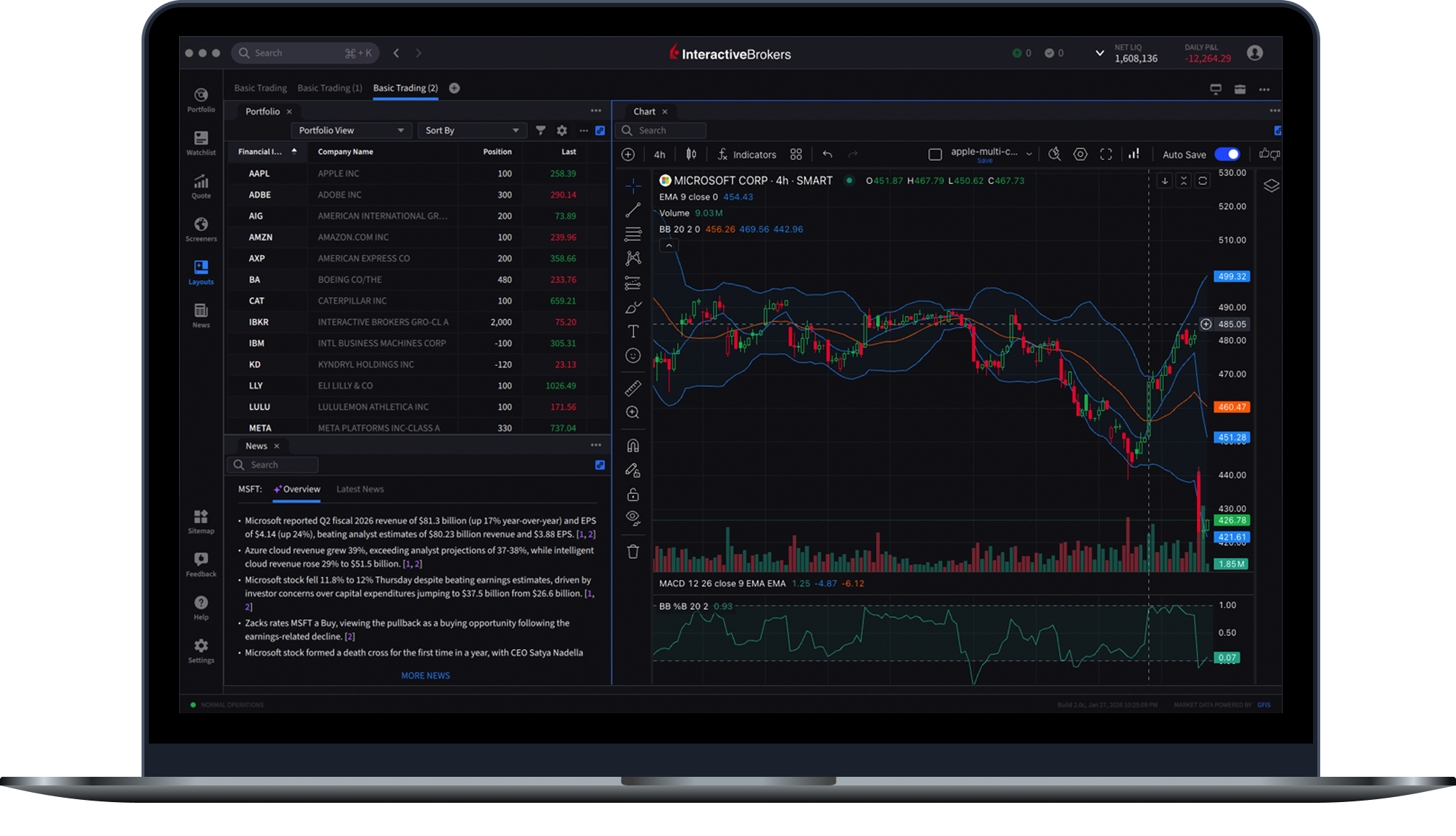
TWS supports direct-access trading for options, futures, forex, stocks, bonds and funds. It's easy to add market data to your trading window.
- Click in a blank line, enter an underlying symbol and hit Enter.
- Choose a product. For assets that require you to define or select an asset class, select the expiration month and year.
- In the Contract Selection box, highlight the contract(s) you want to add and click OK.
Hint: Use the filters in the left pane to limit selections that are shown in the right pane. - Continue to add ticker lines to your trading window. Choose SMART as the routing destination to get best-price execution through IB SmartRoutingSM.
Click in the bid or ask price for a specific contract to instantly create an order directly below the ticker line.
- Click the Ask price of an asset to create a BUY order.
- Click the Bid price of an asset to create a SELL order.

Use the Order Wizard to help modify order parameters before you transmit, or to help you create an order based on your trading objective. The categories in the left pane (Basic, Size, Price, Timing, Algorithm, Protection, Speed, Routing, Conditional, and Display) control the output selections in the right pane. Any changes you make to the order using the Order Wizard are reflected immediately in the order line. To open the Order Wizard, click the Order Wizard icon in the trading toolbar.

To transmit the order, click the "T" in the Status field. To cancel an order, click the "C" in the Status field.

Click the Account icon on the Trading toolbar to open the Account window. This window shows real-time balances, margin requirements, buying power, P&L, market values, portfolio details and more for your account.
View real-time trade reports listed line by line, and netted by contract.

Click the Trades icon on the Trading toolbar to open the real-time Trades window. This displays daily execution reports, including those completed during after-hours trading. For orders with multiple legs, or orders that execute portions at different prices or on different exchanges, click the "+" sign to the left of the execution to see details. You can elect to have the Trades icon on the toolbar blink to notify you of an execution using the Settings menu.
Use the Feature Selector to define the modules in your environment, and Global Configuration to configure all aspects of your workstation.

Once you're comfortable using TWS, you may want to change some of your configuration settings, add some advanced features, or hide features that you don't use. To configure features, on the Configure menu select Global Configuration. Use the left pane to navigate to different TWS features, use the right pane to configure them.
To display or hide features, on the Configure menu select Feature Selector. Use the Expand key to the left of each category to see individual features. Those that are currently available are checked. To hide a feature, simply uncheck it. You can hide and display features at any time, and do not need to restart TWS.
Options involve risk and are not suitable for all investors. For more information, read the Characteristics and Risks of Standardized Options before investing in options. For a copy call 203 618-5800 or click here. There is no guarantee of execution. Orders will be routed to US options exchanges.
|
The Trader Workstation (TWS) is our full-featured java-based trading and order entry application. The TWS demo mirrors the actual TWS in both form and function except market data is simulated based on the previous week's ticks and orders are not actually executed and cleared. However, TWS functionality will be identical to the actual application. The IB TWS demo is available from 00:20 - 23:50, seven days a week. If you experience technical difficulties with the demo system please email tac@interactivebrokers.com. If you are using a dial-up connection to the Internet,
we suggest you install TWS directly onto your computer by clicking here.
This will allow you to connect to both the demo
and production
TWS systems more quickly on future visits to the site. Please choose one of our TWS demos below. Our single users Individual Demo and our Multi-user Advisor Demo (1 master and 2 client accounts) utilize Reg T Margin calculations. Our Portfolio Margin demo utilizes value at risk based margin calculations for US stocks, stock options, index options and single stock futures. Portfolio Margin accounts are available for customers with over USD 100,000 (or USD equivalent) in their account.
Note: The TWS demo requires you to have free Java software installed on your computer.
To download Java, click
here.
|
|
Use the online version to take advantage of the index, search and other navigational features. Use the printable PDF version to print multiple topics or the entire guide.
IB offers a Paper Trading Account which allows traders to use the full range of IB trading facilities in a simulated environment using real market conditions. Use this test environment to:
- Learn TWS features such as order types without risk.
- Learn market dynamics in new exchanges and products.
- Simulate and test trading strategies.
- Test Application Program Interface (API) applications.
- You create a Paper Trading Account login from the Account
Management menu for your production account. This service
is accessed under the menu Trading Access.
- Accounts are created within 24 hours under normal
business circumstances. You will be notified by email when the account
is ready
for trading.
- Paper Trading Accounts are only available when the regular trading account has been approved and funded.
- Paper Trading Accounts have a separate password and
username. To use the account, log into TWS using the
user ID and
password for your Paper Trading Account in the same way you
would log into your regular account.
- Please save and protect the PaperTrader user ID and password in the same way you would protect other confidential password information.
- Use TWS with your Paper Trading Account exactly
as you would use a regular Trader Workstation (TWS) or Application
Program Interface (API). You can use most IB order types, trade
all contracts available through the TWS, and experiment with
almost every
aspect of the TWS platform.
- Your trading window will clearly indicate that you are working
in a simulated account. If you do not see this, you are trading
in your production account
and will be liable for all trade entered.
- Trades entered into
this Paper Trading Account will not actually execute on any
exchange or settle at a clearing
house.
However, the price of your executions will be determined
by real market prices and sizes.
- Trading permissions, market data subscriptions, base
currency, and other account configurations are the same as
specified for your regular account.
- A Paper Trading Account statement will be provided
each day and is available under Account
Management/Report Management for your Paper
Trading Account.
- All customers will start with USD 1,000,000 of paper
trading Equity with Loan Value, and this equity will fluctuate
as if the
trades had executed in the real market.
- You may reset your cash equity at any time by accessing Account Management for your Paper Trading Account and selecting Trading Access/Paper Trading Account Reset. Your account will be reset to USD 1,000,000. Please note that reset requests should be entered before 16:00 ET in order to take effect for the next business day.
Although the paper trading account simulates most aspects of a production TWS account, you may encounter some differences due to its construction as a simulator with no execution or clearing abilities. These differences include but are not limited to:
- No support for some order types including: VWAP, Auction, RFQ, and Pegged to Market.
- Fills are simulated from the top of the book; no deep book access.
- Limited combo and EFP trading.
- Interest does not accrue.
- Stops and other complex order types are always simulated in paper trading; this may result in slightly different behavior from a TWS production account.
- Penny trading for US Options is not supported. You will be able to submit the order but it will not receive a penny fill.
- The trade simulator will reject the remainder of any exchange-directed market order that partially executes. This may or may not match behavior of a real-world exchange. Market orders received while there is no quote on the opposite side will be held until the market data arrives (i.e. until the first partial fill).
Click on a build number or a topic in the table below to access the associated Release Notes. Notes for the most recent build are listed first.
The table below outlines our suggestions for both minimum and recommended system requirements to run IB TraderWorkstationSM.
| |
Minimum
|
Recommended
|
| Windows Version | NT 4.0 SP6, ME, 2000, XP Home, Vista | 2000, XP Professional, Vista |
| Browser | Internet Explorer 6.0 | Internet Explorer 6.0 |
| Java | Java 5.0 | Java 5.0 |
| Screen Area | 1024x768 | 1280x1024 |
| Pentium Processor | 733mhz | 1.4 ghz |
| AMD Processor | 800mhz | Athlon XP 1500+ |
| Centrino Processor | Any | 1500 |
| Celeron Processor | 1ghz | 1.7ghz |
| Bus Speed | 133mhz | 266mhz |
| Memory | 256 MB | 384 MB |
| Internet Connection | Dial-up connected at 42K or higher | Broadband with dial-up backup |
| |
Minimum
|
Recommended
|
| MAC OS Version | 10.2 | 10.4 |
| Browser | Safari 1.2.5 | Safari 1.2.5 |
| Java | Java 5.0 | Java 5.0 or higher |
| Screen Area | 1024x768 | 1280x1024 |
| G4 or G5 Processor | 800mhz | 1.25ghz |
| Memory | 256 MB | 384 MB |
| Internet Connection | Dial-up connected at 42k or higher | Broadband with Dial Backup |
The enhancements
and modifications below are in build 890 of TWS. To identify
the build number, on the TWS Help menu
select About Trader Workstation.
A new order default feature, Presets, allows you to create and save multiple order default strategies and select and change strategies quickly on an order line using the new Presets order field.
To create a preset strategy, on the Configure menu select Global Configuration. In the left pane select Presets. From the right-click menu on an instrument type, select Strategy and enter a name. Define order defaults for the new strategy and click OK. To create a strategy for a specific underlying, select Ticker and specify the symbol, then define order defaults.
In the trading window, tickers with defined strategies will display the Preset icon with mouse-over help. To allow selection of new strategies from the trading window, first display the Presets field from the Market Data list in the Layout manager. Next, click in the presets field to choose a different strategy (if you have created multiple strategies).
The Order Ticket has been redesigned to display the Quote Panel along the top. In addition, the Basic and Time in Force tabs have been combined, and the Scale functionality has been separated from the other Order Ticket functions. When you click the Scale tab the ticket changes to Scale mode.
Functionality has been added to allow all algo orders to be defined from an order line on the trading window. Previously algos could only be set up from the Order Ticket. To create an algo order, create an order by clicking the Bid or Ask field of a ticker. The Destination drop-down includes a new section labeled Algorithms. Select IBALGO, CSFBALGO, or JEFFALGO. Once you select an exchange, a new algo management line appears below the order line. These additional fields work in conjunction with the basic order line parameters Quantity, Type and Price. Define the algo order parameters in both order lines and click "T" to transmit the order.
Real-time charts have been enhanced with the following features:
- Bright yellow triangles indicate news stories on the underlying. This feature is controlled using the Show News checkbox in the charts configuration Settings page. Hold your mouse over a triangle to see the news headline. Click the headline if interested to read the news story.
- A new command, Display All Trades, has been added to the ChartTrader menu. When checked, all trades on the underlying, including any made prior to opening ChartTrader or from another TWS window, will be indicated with a trade marker shown at the time of the trade; blue markers indicate buys, red markers indicate sells. Hold your mouse over a trade marker to see details.
- When an indicator line is selected, the Edit Indicator and Delete Indicator commands will be displayed in the right-click menu.
- The Compare to Index box includes a checkbox to Add to Quote Panel. When checked the selected index is displayed in the Quote Panel.
P&L Pie charts have been added to the Report Selector in IB Risk NavigatorSM. In addition, single account users can see the Clearing Brokerage on all reports. To add this field, on the Dimensions menu select Dimension Settings and check Clearing Brokerage.
New advisor features include the display of multi-account data in the IB Risk NavigatorSM, and a new Account field on Page settings. When you define an Account or account group in the Page's settings, all orders are allocated to that page-level account or account group.
The following items have been fixed or modified in build 890 of TWS:
- The list of destinations aggregated as Smart are no longer listed in parenthesis in the Exchange field, but are displayed via mouse-over help when you hold your mouse over the "i" icon on a ticker line.
- A Pause button has been added to the Market Scanner page. Click to pause the auto-refresh flow of scanner data. Click again to resume.
- A new toolbar on the top right of each page includes an icon to Show orders separately. When selected, orders will be created in a separate Orders panel instead of directly below the ticker line.
- The Trades window now displays a row of day-of-the-week checkboxes to let you show trades as far back as a week.
- The Close positions function has been modified to correctly close positions in Separate Trading Limit and Advisor accounts.
- The ability to show the Total Row has been added to the Layout manager, and the Total Row can now be displayed on the Trades Summary page.
- Two new fields have been added to the Trades Summary page: Total (BOT) shows the total price for buys; Total (SLD) shows the total price for sells.
- The TWS Login box now includes a link to Show all fields. Click to display languages and color palette selections.
- The real-time charts Time Axis feature has been fixed to accurately display the time axis correctly.}
- Several new system-level hotkeys have been added including: Ctrl + C to copy, Ctrl + V to paste. New hotkey actions have been added, including Transmit Page and Close Positions. To record and modify hot keys in Global Configuration by selecting Hotkeys from the left pane.
- The ability to Show Legs has been added to the right-click menu from a combination order line. If legs are already displayed, this command will do nothing.
- The ISW (Integrated Stock Window) now supports clearing choices and HFA accounts.
- A new column, Data Source, can be added from the Market Data list in the Layout manager. This field shows the source for your market data, currently either Interactive Brokers or eSignal (if subscribed).
© 2001 - 2008 Interactive Brokers LLC. All rights reserved. Sun, Sun Microsystems, the Sun Logo and Java are trademarks or registered trademarks of Sun Microsystems, Inc. in the United States and other countries. Excel is a trademark or registered trademark of Microsoft Corporation in the United States and/or other countries. eSignal is a registered trademark of Interactive Data Corporation.


-
Nov 20 2008